More Than 1.5 Kindergartens Closed Each Month in Seoul Over Two Years
Number of Daycare Centers Down by 500; 135,000 Fewer Children Aged 6-7 During the Same Period
31 New English Academies for Young Children Opened in Seoul
No Official Enrollment Statistics; Estimated 20,000 Children Attending
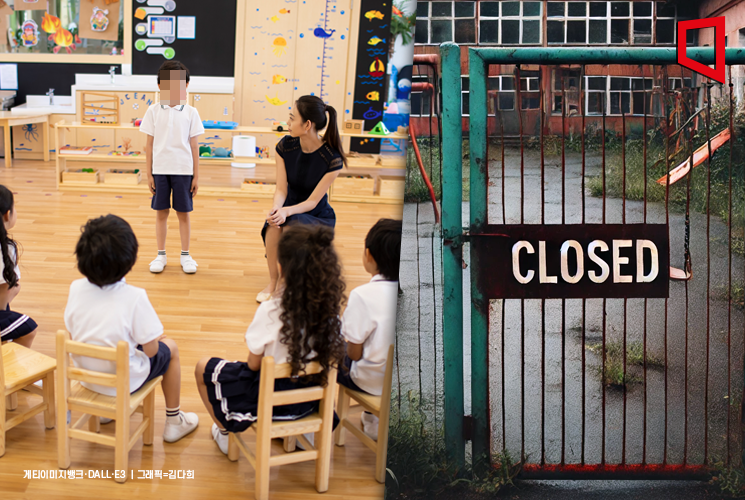
Due to the impact of low birth rates leading to a decrease in the school-age population, even in Seoul, where population density is high, more than one kindergarten on average closed each month.
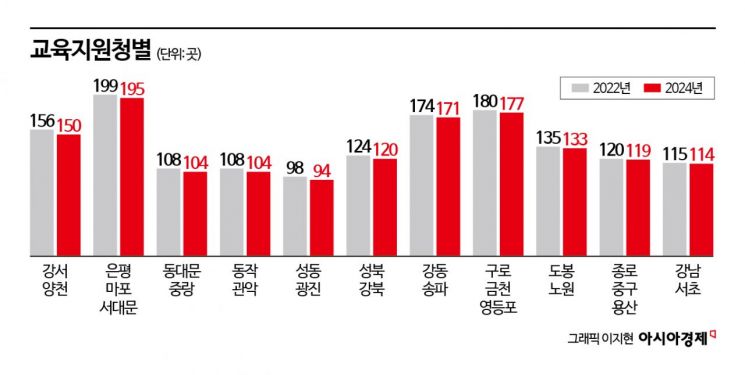
On the 27th, an analysis of the 'Key Statistics by School' by each education support office from the Seoul Metropolitan Office of Education showed that the number of kindergartens, which was 1,517 in the second half of 2022, decreased to 1,481 in the second half of last year. This means that 36 kindergartens closed over 24 months, averaging 1.5 closures per month.
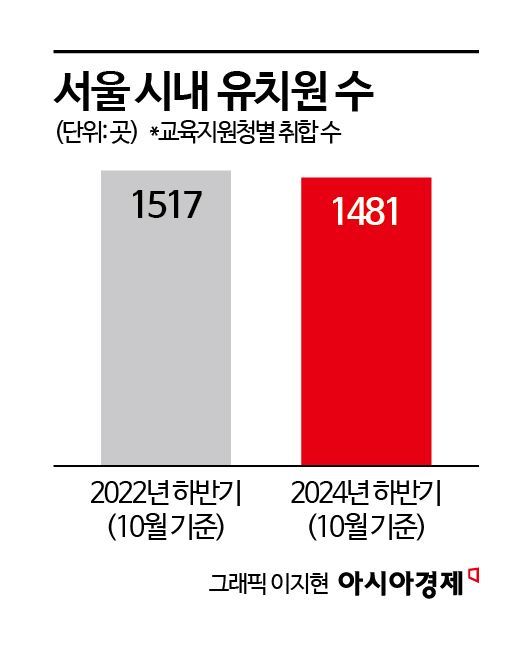
When classified by the 11 support offices, Gangseo and Yangcheon decreased by 6 from 156 to 150, followed by Eunpyeong, Mapo, and Seodaemun (199→195), Dongdaemun and Jungnang (108→104), Dongjak and Gwanak (108→104), Seongdong and Gwangjin (98→94), and Seongbuk and Gangbuk (124→120), each decreasing by 4 kindergartens.
During the same period, Gangdong and Songpa (174→171), Guro, Geumcheon, and Yeongdeungpo (180→177) each saw 3 closures, Dobong and Nowon decreased by 2 (135→133), and Jongno, Jung-gu, Yongsan (120→119) and Gangnam and Seocho (115→114) each decreased by 1.
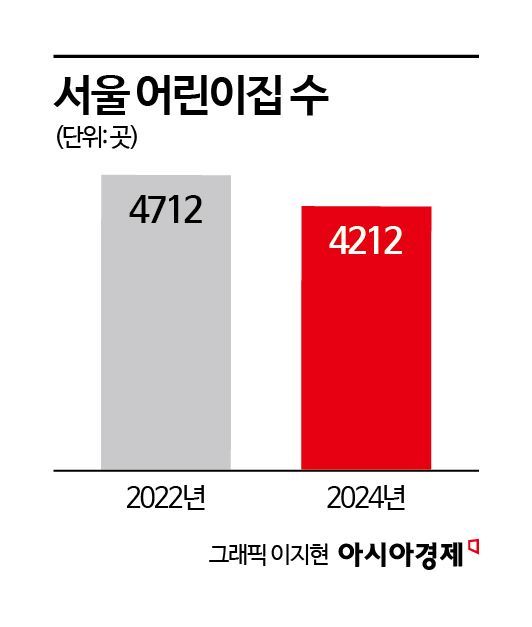
Including daycare centers, the decrease is even more significant. According to Seoul's childcare statistics, the number of daycare centers dropped from 4,712 in 2022 to 4,212 last year, a reduction of 500 centers.
According to a survey by the Korea Social Security Information Service, the total number of daycare centers nationwide was 27,387 last year, down by 1,567 from the previous year. Starting from 35,352 in 2020, the number has decreased by 1,000 to 2,000 annually, averaging 1,740 closures per year over four years.
The main reason for the decrease in kindergartens and daycare centers is the low birth rate. Assuming children attend kindergarten at ages 6 to 7, the number of kindergarten enrollees dropped from 763,000 in 2022 to 628,000 in 2024, a decrease of 135,000. This is about half the number of births last year (242,000).
Besides low birth rates, the number of cases where kindergartens and daycare centers are replaced by academies such as English kindergartens seems to be increasing. According to the office of Assemblyman Jo Jeong-hoon of the People Power Party last year, the number of English academies for young children increased by about 37%, from 615 in 2019 to 843 in 2023. During the same period, Seoul saw an increase from 227 to 258, adding 31 academies.
The exact number of students attending English kindergartens is not accurately counted. First, there is no official designation of "English kindergarten," and the criteria for defining them vary. Kindergartens refer only to national/public kindergartens established directly by the government or private kindergartens authorized by the government under the Early Childhood Education Act. Therefore, what is commonly called "English kindergarten" is merely a private academy. The government emphasizes that even this term can cause misunderstanding by implying it is a kindergarten, so it should be called "English academies for young children."
However, these English academies for young children also have different standards, making it difficult to compile statistics. Looking at the status of private tutoring centers in Seoul, each education support office classifies academies by "type of tutoring," "subject," and "tutoring hours," but the classification of English kindergartens varies depending on the criteria used. Registered English kindergartens are categorized under tutoring types such as "foreign language," "English," and "general subjects," and under tutoring subjects such as "elementary English," "middle and high school English," "essay English," and "TOEFL," all registered differently.
However, by estimating inversely the number of children of kindergarten and daycare age who are not enrolled, it is estimated that about 20,000 children attend English academies or language schools. Last year, the number of kindergarten enrollees in Seoul (ages 6 and 7) was 111,000, but only 61,000 actually attended kindergarten. The remaining 50,000 are presumed to be cared for at home, daycare centers, or academies. Among the 282,000 children eligible for daycare in Seoul (ages 0 to 7), about half, 143,000, attend daycare centers. Assuming a similar ratio, about half of the 50,000 children not attending kindergarten are daycare users, and the rest are academy users.
The Seoul Metropolitan Office of Education plans to establish unified criteria for "English academies for young children," which currently vary by the 11 support offices, and to track trends in the future.
© The Asia Business Daily(www.asiae.co.kr). All rights reserved.



















