Groundbreaking of Korea's First TPC Production Facility
Domestic Production Expected to Substitute Imports
Aekyung Chemical has commenced construction of a TPC (Terephthaloyl Chloride) plant, a key raw material for aramid fibers, and plans to start mass production early next year to improve its performance. Given the prolonged economic downturn in Gyeonggi Province, the company aims to focus its efforts on high-growth new businesses.
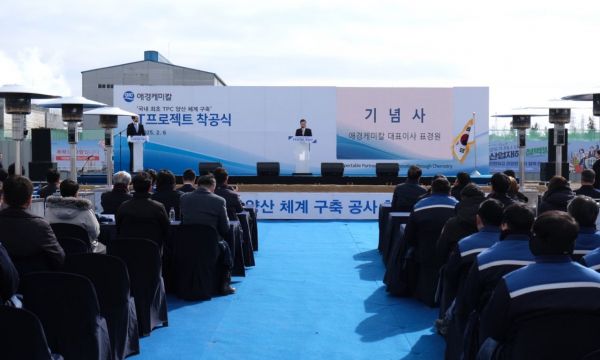 Aekyung Chemical held a groundbreaking ceremony for the TPC (Terephthaloyl Chloride) plant, a key raw material for aramid fibers, on the 7th of this month. Photo by Aekyung Chemical.
The TPC plant was established using idle land at Aekyung Chemical's Ulsan factory. It is scheduled to be completed by the end of this year, with mass production targeted for early next year. The production capacity is approximately 15,000 tons, and the company plans to consider expanding production capacity in response to the growth of the aramid market and increasing demand for TPC.
Aramid is called a "super fiber" because it is lightweight, more than five times stronger than steel, and has heat resistance that prevents it from burning even at 500 degrees Celsius. It is used as a material to complement the wear of automobile tires, and recently, the market has been rapidly growing due to benefits from the construction of 5G optical cable communication infrastructure. As a result, the demand for TPC, the key raw material for aramid, is also increasing. Global aramid demand has grown at an average annual rate of 5% over the past decade, and stable growth of 6% per year is expected until 2030. The market is anticipated to experience significant growth as the application of aramid fibers expands in the automotive, aerospace, and defense industries.
Currently, domestic aramid fiber manufacturers rely entirely on imports for their main raw materials. Aekyung Chemical's TPC production is expected to have an import substitution effect. Imported TPC solidifies during transportation and must be melted for use. Domestic production allows supply in liquid form, offering advantages in saving time, energy, and costs.
An Aekyung Chemical official stated, "Global environmental regulations, especially in the European Union, are gradually tightening. A production structure that does not generate harmful gases and reduces time, energy, and costs will help strengthen the competitiveness of not only Aekyung Chemical but also domestic aramid producers."
© The Asia Business Daily(www.asiae.co.kr). All rights reserved.
![Clutching a Stolen Dior Bag, Saying "I Hate Being Poor but Real"... The Grotesque Con of a "Human Knockoff" [Slate]](https://cwcontent.asiae.co.kr/asiaresize/183/2026021902243444107_1771435474.jpg)
















