'5,000-nit Brightness' Smartphone OLED Unveiled
World's First 'Polarizer-Free Display' Based on OCF
Clear Visibility Even Outdoors... Power Consumption Reduced
Samsung Display announced on the 27th that it will showcase its next-generation smartphone OLED with a maximum brightness of 5,000 nits at the 'Mobile World Congress (MWC) 2025,' opening on the 3rd of next month in Barcelona, Spain.
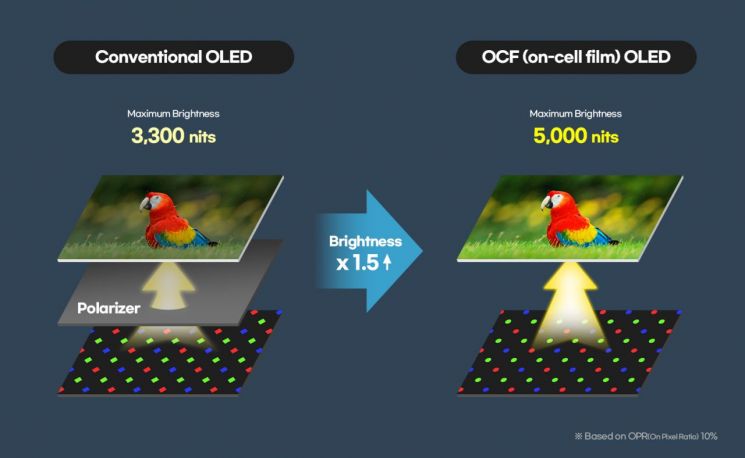
This product was developed based on Samsung Display's world-first commercialized 'polarizer-free display,' known as 'OCF (On-Cell Film)' technology. Instead of using a polarizer, this technology integrates reflection reduction functions into the panel by utilizing films and special materials. It improves outdoor visibility, delivering clear screens even outside. It also serves as a foundation for reducing power consumption and enabling design innovation. This OCF technology is gaining attention as a high value-added display technology, expanding from foldable smartphones to general bar-type smartphones and rollable notebooks.
The ultra-high brightness OLED that Samsung Display will exhibit this time achieves a maximum screen brightness of 5,000 nits. This brightness is attainable when the 'OPR (On Pixel Ratio),' which indicates the ratio of operating pixels among all pixels composing the screen, is at 10%. It boasts brightness exceeding 3,000 nits even in everyday usage environments such as watching movies. Compared to recently released premium smartphone OLEDs, it is about 1.5 times brighter at the same power consumption.
After extensive research, Samsung Display became the first in the industry to develop a panel stacking structure in 2021 that blocks external light reflection without a polarizer. By removing the polarizer, the degree of light reduction was cut to about half compared to existing panels. This allows the panel to emit light that is 1.5 times brighter with the same power or achieve the same brightness with only 63% of the power consumed by conventional panels. It provides a viewing experience indoors even under strong sunlight, and in typical usage environments, it reduces power consumption without deliberately lowering screen brightness, thereby extending device usage time.
The removal of the polarizer also makes the panel thinner, which is another advantage of OCF technology. A polarizer is an opaque plastic sheet that prevents external light reflected like a mirror by metal and glass components of the display from reducing visibility. However, the light emitted by pixels passing through the polarizer decreases in brightness by more than 50%, which lowers the display’s luminous efficiency.
OCF was developed to overcome this drawback. Panels with this technology are approximately 20% thinner compared to conventional OLED panels with polarizers. The thinner the panel, the easier it is to optimize design for durability and visibility, and the lower the panel’s resilience, making it advantageous for implementing various form factors and designs such as slidable or rollable displays. At the 'MWC 2025' exhibition, a demo zone will be prepared where visitors can visually experience the thinness of panels with OCF applied.
Lee Ju-hyung, Vice President and Head of the Small and Medium Display Business Division, said, "At this MWC 2025 exhibition, we will introduce OCF technology, which can meet market demands for low power consumption, eco-friendliness, outdoor visibility, and thin and light design, under the slogan 'L.E.A.D, the Next Wave of Display,' and present the direction of next-generation display innovation to customers and consumers." He added, "We will continue to maintain our leadership with differentiated technologies that can respond to the AI era."
© The Asia Business Daily(www.asiae.co.kr). All rights reserved.
![Clutching a Stolen Dior Bag, Saying "I Hate Being Poor but Real"... The Grotesque Con of a "Human Knockoff" [Slate]](https://cwcontent.asiae.co.kr/asiaresize/183/2026021902243444107_1771435474.jpg)















