Ministry of Culture, Sports and Tourism
Announces Results of the 2024 Cultural Diversity Survey
Only one in five people in our country has experience receiving education related to cultural diversity. It was confirmed that the public believes promoting cultural diversity would help resolve social conflicts and that education and awareness-raising for the promotion of cultural diversity are necessary.
These results were confirmed in the "2024 Cultural Diversity Survey" announced on the 27th, conducted by the Ministry of Culture, Sports and Tourism in collaboration with the Korea Culture and Tourism Institute and Statistics Korea.
The survey results showed that the overall average experience of receiving education related to cultural diversity was 21.7%. By age group, those aged 15-19 had the highest rate at 68%, and the experience decreased with increasing age.
Cultural diversity means respecting differences based on sociocultural backgrounds (race, religion, values, lifestyle, preferences, gender, age), allowing everyone to freely express cultural expressions regardless of their sociocultural background, and guaranteeing fair access for all citizens to various domestic and international cultural products.
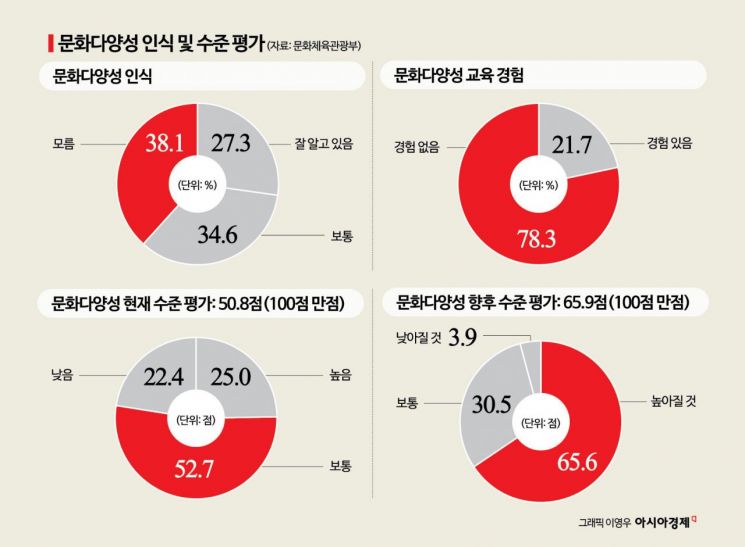
27.3% of the public reported being well aware of cultural diversity. The level of cultural diversity in our society was evaluated at 50.8 points (out of 100), and it is expected to rise somewhat to 65.9 points in five years. It was anticipated that increased cultural diversity in our society would contribute to alleviating social conflicts (26.9%), strengthening cultural and artistic competitiveness (21.8%), and improving the quality of life of social members (20.3%).
Regarding the content of education related to cultural diversity, human rights (56.8%) was the most common, followed by disability awareness improvement (55.5%), cultural diversity (43.8%), and multicultural acceptance (24.2%). For policies most important to promoting cultural diversity, education and awareness-raising (30.1%) were considered the most necessary, followed by legal and institutional improvements (22.8%) and expansion of cultural diversity programs and events (20.8%).
16.8% of the public answered that they have experience interacting with people of different nationalities, with the subjects being foreign workers (44.8%), marriage immigrants (25.5%), international students (24.9%), and ethnic Koreans from China (Joseonjok) (15.1%) in that order. Regarding differences between others and themselves, acceptance was high for different generations' values and lifestyles (76.2%), marriage with foreigners of different races (62.9%), origin from specific regions (59.3%), not following traditional gender roles (48.0%), and working with people with disabilities (46.7%).
Regarding the diversity of cultural arts and content, when examining direct experience with domestic and international cultural arts, it was found that both pure arts and popular culture had less experience with overseas content than domestic content. By field, domestic content experience was higher in pure arts such as music and popular music, while in literature, fine arts and film, and comics, animation, and webtoons, the experience of domestic and overseas content was similar.
About half of the people in our country (54.0%) have experienced prejudice or stereotypes about certain cultures or groups through media, mainly in areas such as values and lifestyles of different generations (56.6%), different religions (45.5%), different races (44.2%), and caricaturing of specific regions (43.6%). Factors restricting diversity in media content consumption included media content production focused on mainstream culture (22.2%), market dominance by large media companies (18.0%), production of content reflecting stereotypes or prejudice about specific cultures (13.0%), and biased content consumption based on algorithms (11.2%).
The Cultural Diversity Survey is conducted biennially to understand the public's awareness level of cultural diversity and the status of cultural enjoyment and creative activities. It was approved as national statistics in July last year. This survey was conducted from August 27 to September 6 last year, targeting 4,974 household members aged 15 and older (excluding foreigners) from 2,994 households nationwide through household visit interviews. Detailed information about this survey can be found later on the Ministry of Culture, Sports and Tourism website, the Culture Center, and the National Statistics Portal.
Lee Jung-woo, Director of Cultural Arts Policy at the Ministry of Culture, Sports and Tourism, said, "This survey produces statistics that grasp the awareness and attitudes of our people toward cultural diversity and will serve as important basic data for setting the direction of cultural diversity policies through time-series analysis." He added, "The Ministry of Culture, Sports and Tourism will carefully promote cultural diversity policies to raise awareness and levels of cultural diversity in the future."
© The Asia Business Daily(www.asiae.co.kr). All rights reserved.
![Clutching a Stolen Dior Bag, Saying "I Hate Being Poor but Real"... The Grotesque Con of a "Human Knockoff" [Slate]](https://cwcontent.asiae.co.kr/asiaresize/183/2026021902243444107_1771435474.jpg)















