"Significant in Terms of Buddhist Iconography Studies"
The 'Dalseong Yugasa Yeongsanhoe Gwaebuldo (達城 瑜伽寺 靈山會 掛佛圖)', stolen in 1993 and recovered in 2020, is now managed as a treasure. The Cultural Heritage Administration announced on the 27th that after reviewing opinions from various sectors and deliberation by the Cultural Heritage Committee, it was designated as a treasure.
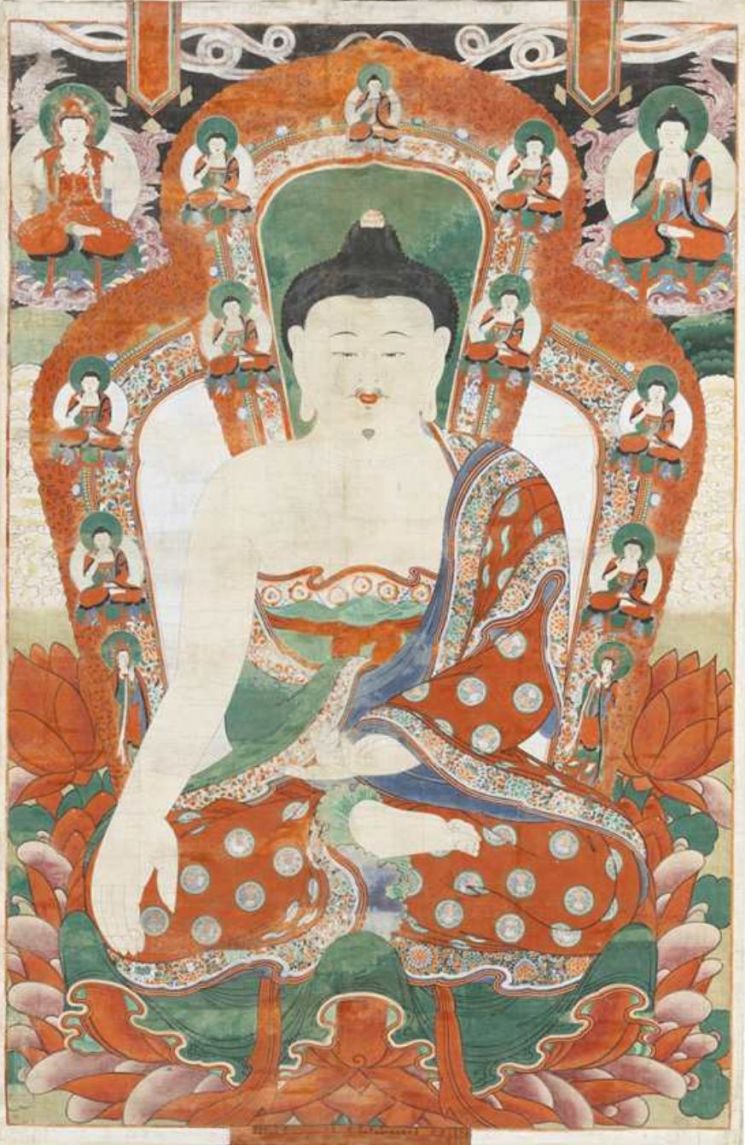
This Buddhist painting was created in 1784 during the late Joseon period with the theme of 'Yeongsanhoe.' Considering the body proportions, expressions, iconographic arrangement, and facial shapes, it is believed to be closely related to the Yuseong (有城) school of painting active in the late 18th century. Some of the inscription (?gi, production-related notes at the bottom of the painting) were damaged during the theft, so the monks who painted it are unknown.
The hanging scroll-type gwaebuldo measures 281.3 cm in width and 438.3 cm in height. Considering that gwaebuldo created around the same time are about 10 meters tall, this piece is relatively small, and it is presumed to have been made considering the spatial arrangement of the temple at that time. A Cultural Heritage Administration official stated, "It can serve as an important basis for estimating the spatial composition and scale of Yugasa Temple at that time."
The gwaebuldo depicts Sakyamuni Buddha overwhelmingly large, with Birojana Buddha and Nyorai Buddha arranged smaller at the top of the screen, following the Samshinbul (Three Buddhas) format. This composition is also confirmed in the 'Seosan Gaesimsa Yeongsanhoe Gwaebuldo (1772),' but this work is the only gwaebuldo where the principal Buddha is depicted in a seated posture.
A Cultural Heritage Administration official said, "Although parts of the painting were cut off and recolored during the theft, it holds significance in terms of the history of Yugasa Temple and the study of Buddhist iconography."
© The Asia Business Daily(www.asiae.co.kr). All rights reserved.

















