Im Minwook's "Hyper Yellow" Exhibition at Ilmin Museum of Art
Shedding Light on Unknown Continents, Oceans, and Planets from a Tourist's Perspective
On View Until April 20
Im Min-wook's solo exhibition "Hyper Yellow," which uses the Yellow Sea (Hwanghae) connecting Korea, Japan, and China as a catalyst for discussion and highlights unfamiliar places from the perspective of tourists, opens on the 28th at Ilmin Museum of Art in Jongno-gu, Seoul.
The project name Hyper Yellow means "a state exceeding yellow." Here, yellow refers not only to racial connotations but also to the Yellow Sea connecting the three Northeast Asian countries (Korea, China, and Japan), closely examining the complex aspects of the culture formed around the Yellow Sea. It embodies the artist's unique aesthetics that attempt to transcend the threshold of reality through images cycling between past and future.
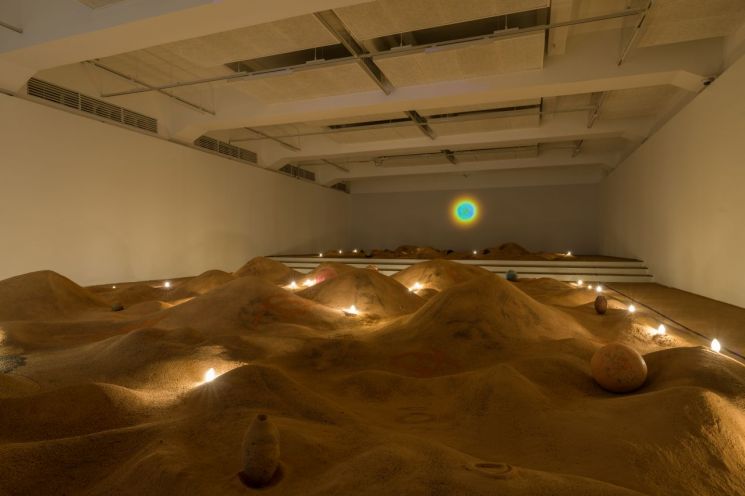
On the first floor, Exhibition Room 1 features a massive topographical sculpture titled "Solaris." Borrowing from Stanisław Lem's novel "Solaris," the exhibition overlays Japan's Todaiji Temple and a future planet. Inspired by the novel Solaris, it depicts encounters with others in a mysterious space that might exist somewhere. Using cork, loess powder, terracotta powder, and buoys, the artist formed mounds, deserts, rivers, and basins. Im explained, "It is natural but does not feel like nature, and although it will eventually disappear, it is a world whose history is difficult to imagine."
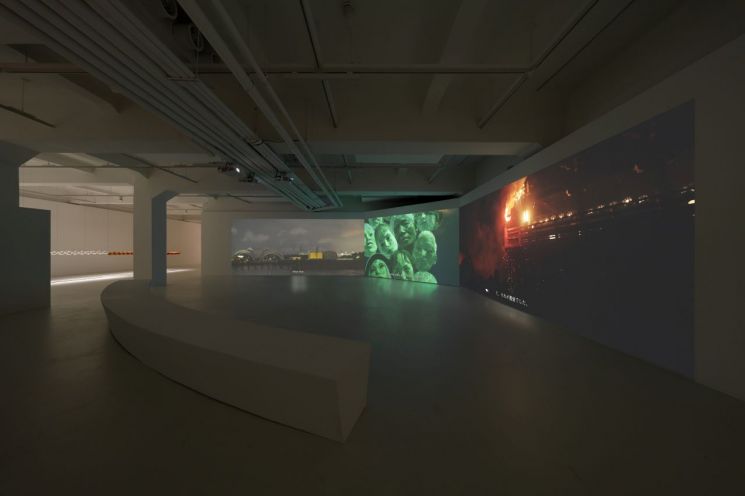
On the second floor, Exhibition Room 2 screens the three-channel video work "Donghaesa," which condenses the content of "Hyper Yellow." The artist captured ritual scenes from the "Festival of Fire" (Todaiji's "Otaimatsu") and the "Festival of Water" (Fukagawa's "Hachiman Matsuri") visited in Japan, expressing how traditional rituals offer new communal experiences even to foreign tourists.
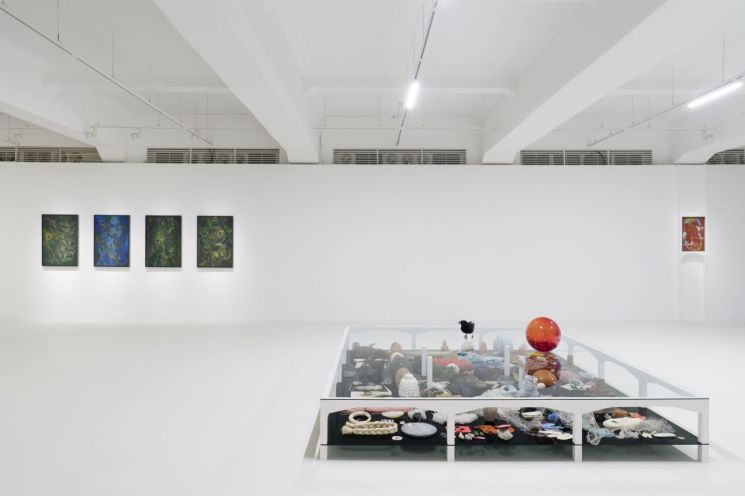 Exhibition Hall 3 exterior view. The floor exhibit on the right is 'Garden and Workshop'. Courtesy of Ilmin Museum of Art
On the third floor, Exhibition Room 3 features sculptures that weave together natural and artificial objects, break them apart, and reorder them. The central piece, "Garden and Workshop," relocates and rearranges various objects stored in the artist's studio into the exhibition space. Focusing on the "inheritances" of time prepared in a corner of the newly moved 2024 studio, it expresses multiple objects and the accumulated time they embody by intertwining natural and artificial materials.
The exhibition runs until April 20 at Ilmin Museum of Art.
© The Asia Business Daily(www.asiae.co.kr). All rights reserved.



















