KIRA Demands Cancellation of Medical School Expansion and Essential Medical Packages
Government Broke the 2020 "September 4 Medical Agreement"... "Trust Already Lost"
As the government proposed freezing the number of medical school admissions next year to resolve the medical service gap caused by conflicts between the government and the medical community, the medical sector has shown a lukewarm response. While some in the medical community believe that since the government has shown an attitude of creating some room for compromise, preparations should be made to engage in dialogue, the general view is that the possibility of gaining broad consensus is low.
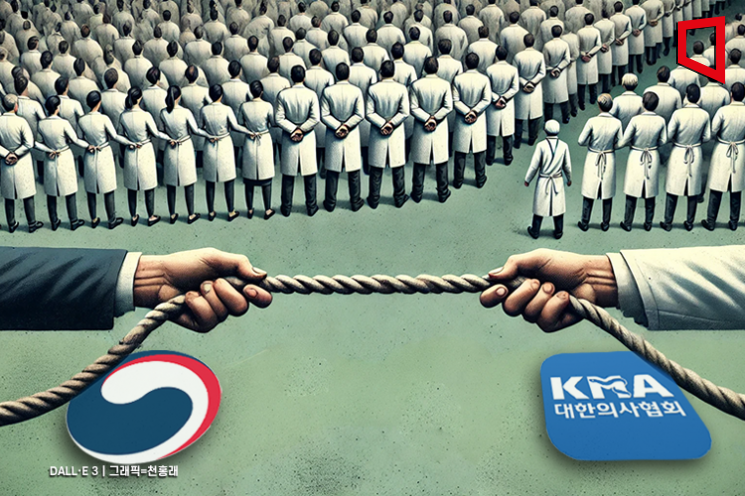
According to the medical community on the 27th, the Korean Medical Association (KMA) stated that the government's position is difficult to see as an official proposal to the medical community, nor does it appear to be a plan that properly reflects the demands of the medical sector. Regarding this, Kim Seong-geun, the KMA spokesperson, dismissed the government's stance by saying the day before, "The Ministry of Education has not changed its position that discussions on next year's quota and other matters can only proceed after first presenting alternatives on how to educate the medical students of the 2024 and 2025 classes." Earlier, on the 24th, Lee Ju-ho, Deputy Prime Minister and Minister of Education, conveyed to the deans of medical schools that if medical students return in March, there is room to revert next year's medical school admissions to the pre-increase level of 3,058 students.
The medical community's position is that the number of medical school admissions next year itself is not very important at this point. Park Dan, vice president of the Korean Intern Resident Association (KIRA) and emergency response committee member, said on the 17th at the National Assembly when meeting with Speaker Woo Won-shik, "The seven demands of young doctors are naturally necessary to establish a healthy and sustainable medical environment." The seven demands mainly call for the complete cancellation of medical school expansion and essential medical policy packages. Without a reasonable government plan addressing these, any discussion about 'after next year' is difficult.
The lack of clear measures or dialogue triggers regarding this year's increased admissions is also an obstacle. The quota for the 2025 medical school class is already set at 4,567 students, which is 1,509 more than last year. Therefore, considering educational conditions, the medical community argues that next year's quota should not only be frozen but reduced from the current level. Since the government broke the 'September 4 Medical Agreement' in 2020 and unilaterally announced an increase of 2,000 medical school admissions, trust has been lost, and unless there is a groundbreaking change in stance, the medical community still perceives it as difficult to engage in dialogue. The 'September 4 Medical Agreement' was an agreement between the government and the medical community in 2020 to discuss four major medical policies, including medical school admissions, through a 'government-medical council' formed between the two parties.
There is also a sense of concern about using medical school deans as communication channels. Spokesperson Kim said, "There was no contact officially or unofficially, and we heard the news through the media. Even now, there has been no contact from the government side," showing discomfort. The residents and medical students who have not returned maintain their stance of 'no return,' citing distrust in the government. Resident A, who resigned from a training hospital in Busan, said, "Although the government has taken a step back after about a year, I still cannot trust them," adding, "The proposal to freeze at 3,058 is very insufficient."
B, who is on leave from a medical school in the Chungcheong region, also said, "Considering the government's actions, this proposal cannot be trusted either. We never know when they might change their stance," and added, "Even if the proposal proceeds as suggested, measures to address essential medical packages and medical student education issues should be prepared first for dialogue."
Although minimal, there are also voices within the medical community urging a more progressive outlook on the situation. Resident C, who resigned from a training hospital in the Gyeongsang region, said, "Although the proposal is clearly insufficient, I view it positively as the government’s minimum gesture for dialogue," and added, "The medical community should also consider ways to open the door to dialogue, whether by drafting a medical agreement or forming a consultative body."
© The Asia Business Daily(www.asiae.co.kr). All rights reserved.
![Clutching a Stolen Dior Bag, Saying "I Hate Being Poor but Real"... The Grotesque Con of a "Human Knockoff" [Slate]](https://cwcontent.asiae.co.kr/asiaresize/183/2026021902243444107_1771435474.jpg)















