"An Income Replacement Rate of 43-44% Is a Stopgap... It Must Be Lowered Further"
"Pension System Needs Redesign... Missing the Timing Will Lead to Economic Hardship"
Joo Ho-young, Deputy Speaker of the National Assembly, pointed out on the 26th regarding pension reform that "whether the income replacement rate is 43% or 44%, pension reform without an automatic adjustment mechanism is like peeing on frozen ground."
Joo, a member of the People Power Party, made these remarks during a press briefing on pension reform held at the National Assembly in the afternoon.
Currently, both ruling and opposition parties have reached a consensus on raising the National Pension insurance contribution rate (the amount paid) from 9% to 13%. However, there are differences of opinion regarding the increase rate of the current 40% income replacement rate (the amount received) and the introduction of an automatic adjustment mechanism.
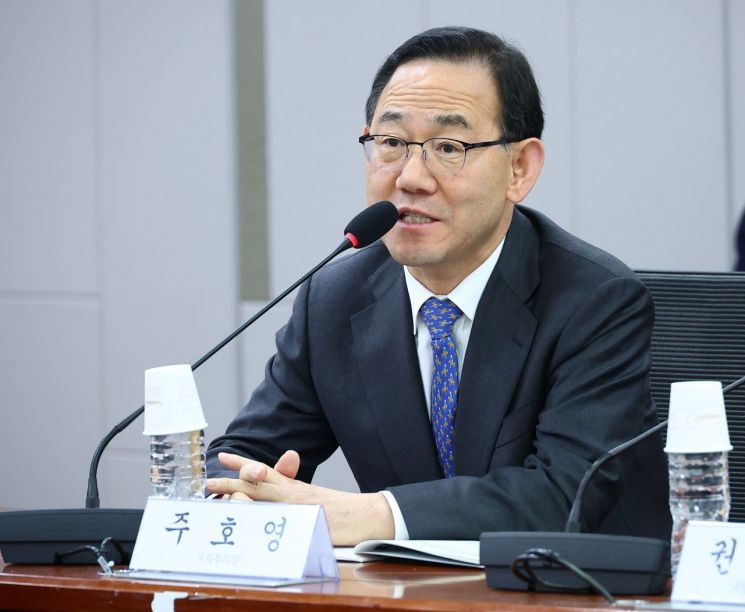
Joo emphasized, "'Let's set the income replacement rate at 43%', 'Let's raise it to 44%'?this discussion does not mean pension reform is complete," adding, "If the macro slide (automatic adjustment mechanism) is not included, it is just pretending to solve the problem."
The automatic adjustment mechanism automatically adjusts the contribution rate and income replacement rate according to macroeconomic indicators affecting pension finances. Among OECD countries, 24 have adopted this system.
Joo stressed, "Raising the income replacement rate to 43-44% while including military service and childbirth credits in pension reform is like plugging a leaking hole with poison while making another small hole next to it," adding, "For those receiving pensions, it is 'eating and running,' and from the perspective of future generations, it is plundering."
He cited analysis data from Professor Jeon Young-jun of Hanyang University's Department of Economics and Finance, a member of the Pension Research Association. According to Professor Jeon's projections, a contribution rate of 13% and an income replacement rate of 42-43% do not improve pension finances. Assuming a 9% contribution rate and a 43% income replacement rate, the cumulative deficit is expected to reach 5300 trillion won by 2050. The analysis shows that ▲13%·42% results in 5900 trillion won ▲13%·43% in 6100 trillion won ▲13%·44% in 6400 trillion won, indicating that the cumulative deficit increases further.
Joo said, "It is true that not implementing such reforms would be disastrous, but it should not be done in this way," and argued, "The income replacement rate must be lowered significantly." Otherwise, the burden will be passed on to future generations.
He also warned that if pension reform is not carried out in time, the entire Korean economy could face difficulties. Joo diagnosed, "If the amount paid increases and the amount received decreases, after that, existing assets will have to be sold," adding, "If the National Pension, the largest shareholder of Samsung, Hyundai, and others, suddenly sells its assets, it will cause a major shock to the financial market."
Regarding the Democratic Party, he criticized, "Instead of saying that labor unions cannot be persuaded, the direction should be to completely redesign the pension," and added, "It is unacceptable to patch things up ambiguously and pass the burden onto future generations."
Meanwhile, the ruling and opposition parties have, in principle, agreed to form a special committee on pension reform at the National Assembly on the same day and decided to continue detailed discussions at the government-party consultative body on the 28th.
© The Asia Business Daily(www.asiae.co.kr). All rights reserved.
![Clutching a Stolen Dior Bag, Saying "I Hate Being Poor but Real"... The Grotesque Con of a "Human Knockoff" [Slate]](https://cwcontent.asiae.co.kr/asiaresize/183/2026021902243444107_1771435474.jpg)















