As Political Petitions Soar from 2% to 46% Amid Impeachment Crisis and Fierce Party Conflict,
Livelihood Petitions Shrink from 30% to 10%
A Sad Portrait of a Divided Korea
Choi, a 25-year-old private kindergarten teacher living in Jangan-gu, Suwon-si, Gyeonggi Province, visits the National Assembly Electronic Petition website daily but feels disheartened. As petitions related to political issues such as the Constitutional Court and election systems flood in, the approval rate for the petition opposing salary cuts, which she and her colleagues support, is barely increasing. Choi said, "We joined the petition because teachers' salaries have effectively been cut, but it has been sidelined due to political issues," adding, "Among my colleagues, there is anxiety about whether the petition will even be accepted."
Recently, as political petitions have surged, the function of petitions related to livelihood issues has effectively been paralyzed. There are also forecasts that this trend will continue as political polarization intensifies following the emergency martial law declared on December 3.
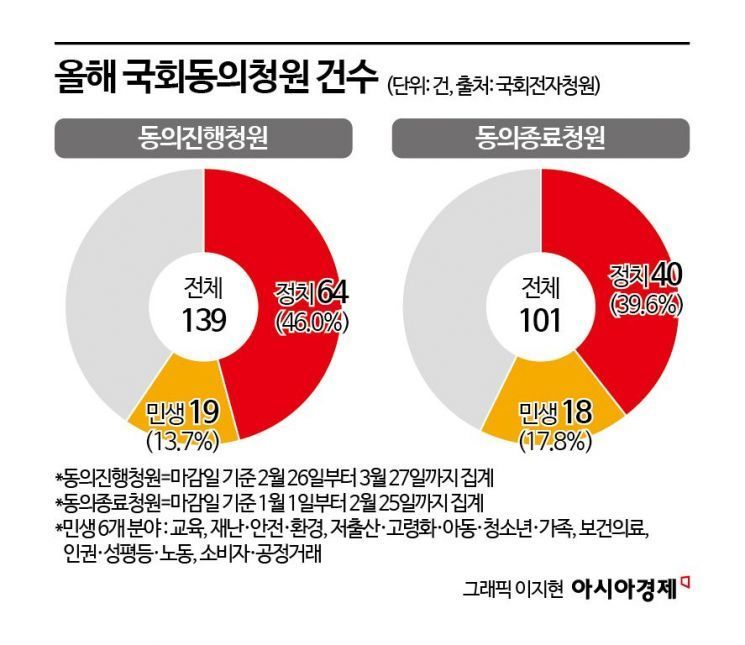
According to the National Assembly Electronic Petition on the 26th, among 139 petitions currently in the consent process (until the 27th of next month), 46.0% (64 petitions) are related to politics. This proportion is higher than the 39.6% (40 petitions) of political petitions whose consent period ended between the 1st and 25th of last month. For example, current political petitions include those related to the impeachment of Constitutional Court judges, public verification of the election system, and expulsion of National Assembly members. All are contentious political issues sharply dividing the ruling and opposition parties.
Such political petitions have surged this year, which can be attributed to the aftermath of the impeachment political crisis. The proportion of political petitions at the end of the consent period was only 2.1% (7 petitions) in 2022, 2.7% (12 petitions) in 2023, and 2.2% (15 petitions) in 2024.
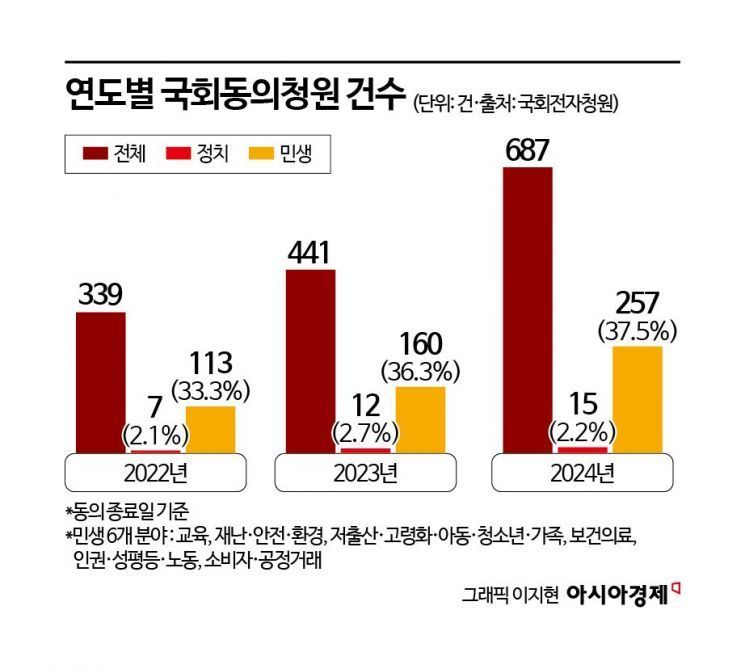
As political petitions increase, petitions in six livelihood-related areas?education, disaster/safety/environment, low birthrate/aging/children/youth/family, health care, human rights/gender equality/labor, and consumer/fair trade?are decreasing. The proportion of livelihood petitions at the end of the consent period was 33.3% (113 petitions) in 2022, 36.3% (160 petitions) in 2023, and 37.5% (257 petitions) in 2024, but it dropped to 17.8% (18 petitions) this year. The proportion in petitions currently in the consent process this year fell further to 13.7% (19 petitions).
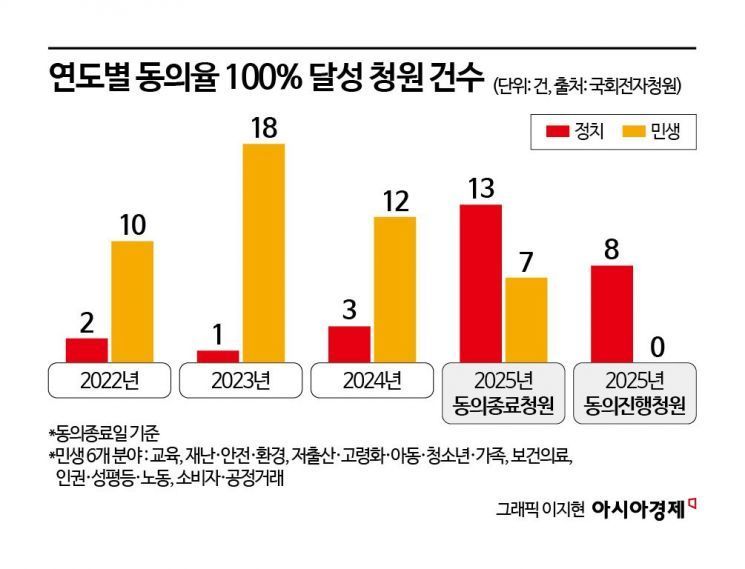
Political petitions have also surpassed livelihood petitions among those forwarded to the National Assembly standing committees. This year, 8 political petitions were referred to standing committees before the consent process ended, while none from the livelihood category were. Among petitions whose consent period ended this year, there were 13 political petitions and only 7 livelihood petitions. This reverses the results from previous years: in 2022, 2 political and 10 livelihood petitions; in 2023, 1 political and 18 livelihood petitions; and in 2024, 3 political and 12 livelihood petitions.
National consent petitions must obtain the agreement of more than 50,000 people within 30 days of being made public to be forwarded to the relevant standing committee. If the number of supporters is insufficient, the petition is discarded. Petitions with over 50,000 supporters undergo review by the standing committee's petition review subcommittee to decide whether they will be placed on the plenary session agenda.
In this situation, the petition opposing the cut of the treatment improvement allowance for private kindergarten teachers, which Choi participated in, has 21,745 supporters (43.4%), falling short of the number required for referral to the standing committee. The treatment improvement allowance is a salary item supported by the education office to compensate private teachers' wages. Recently, as the total salary of private teachers risks being cut by the amount exceeding that of public teachers, Choi and others launched the petition. Notably, when comparing total salaries, public teachers' basic salary excludes bonuses and performance pay, while private teachers' salaries include these, raising concerns about unfair calculation methods.
Other petitions such as the "Request for prompt processing of the three laws on childcare integration" (3,322 supporters, 6.6%) and "Strict punishment for fraud perpetrators" (4,224 supporters, 8.4%) are also being overshadowed by political issues. Choi said, "Livelihood issues are as important as political ones," adding, "If other issues are buried because of political matters, what is the point of petitions?"
There are also forecasts that livelihood petitions will continue to be buried as political petitions flood in. Professor Na Jin-cheol of the Department of Sociology at Kyungpook National University said, "Political polarization has worsened since the president declared martial law, and this trend will continue even if an early presidential election is held quickly," adding, "Regardless of the outcome of the impeachment trial, one side will inevitably reject it, escalating conflicts, and petitions on livelihood issues will inevitably be pushed to the back burner."
© The Asia Business Daily(www.asiae.co.kr). All rights reserved.



















