Yoo Hyemi: "Firm Trend Reversal in Fertility Rate"
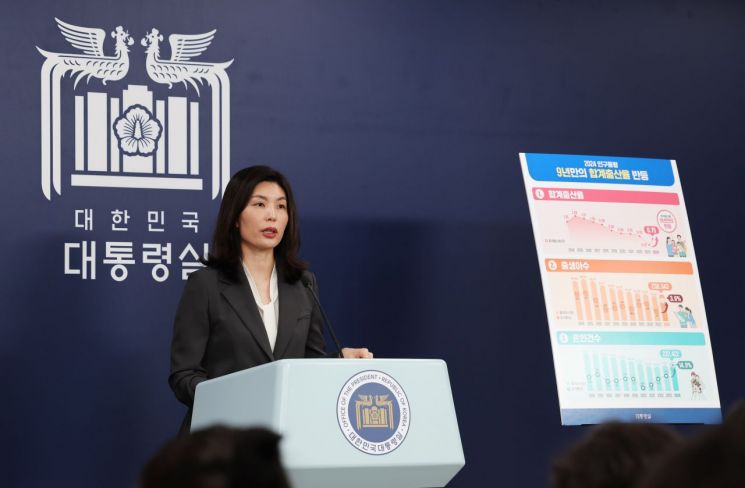
The Presidential Office evaluated last year's rebound in the total fertility rate as the result of the government boldly implementing measures to address low birth rates alongside four major reforms, and stated that it will continue to pursue policies to firmly establish this rebound as a clear trend reversal.
On the 26th, Yoo Hyemi, Senior Secretary for Low Birth Rate Response, said at a briefing at the Yongsan Presidential Office, "The rapid implementation of demand-based policies has raised young people's expectations for low birth rate policies and positively influenced their decision to have children." She particularly analyzed that the steady, long-term provision of housing supply and special loans for childbearing households helped young people decide to have children.
According to Statistics Korea's '2024 Population Trends Survey Birth and Death Statistics' released that day, the number of births last year was 238,300, an increase of 8,300 (3.6%) from the previous year, and the total fertility rate also rose by 0.03 to 0.75 last year compared to the previous year.
Regarding the fertility rate rebound, Senior Secretary Yoo emphasized, "Unlike the increase in first-born children that can result from more marriages, the birth of second children is an indicator that society is becoming a more favorable environment for childbirth." She added, "The birth of second children significantly increased from the third quarter of last year for the first time in nine years (since the fourth quarter of 2015), and the birth of third children also increased in the fourth quarter."
She continued, "The clear increase in fertility rates among women in their 30s is also meaningful," explaining, "Although the female population in their late 30s decreased by 2.7%, the number of births among women in their late 30s showed an unusual increase of 4.1%, from 68,000 in 2023 to 70,000 last year."
Senior Secretary Yoo said, "The gap between marriage and childbirth has shortened, and last year was the first year since 2015, when quarterly data on the interval between marriage and childbirth began to be released, that the quarterly figures within the year continuously decreased." She added, "The faster decision to have children after marriage is due to the expansion of government support for childbirth and parenting and the increased positive perception of children."
She also highlighted the noticeable increase in beneficiaries of policies supporting marriage, childbirth, and parenting. Yoo said, "For newlywed couple loans, the number expanded from 57,000 cases in 2023 to 63,000 cases last year, and from January last year, special loans for newborns supported 38,000 cases annually." She added, "Parental leave users increased by 5.2% to 133,000 last year compared to 126,000 in 2023, and male parental leave users exceeded 30% for the first time, reaching 42,000."
Furthermore, she noted that due to work-family balance policies, the employment rate of married women increased, and the number of women experiencing career interruptions dropped to 970,000 last year from 1.08 million in 2023, marking the lowest figure since statistics began in 2016. Yoo added, "The implementation of the protected childbirth system and childbirth notification system in July last year also contributed by improving statistical accuracy and ensuring that precious lives are not overlooked."
The Presidential Office announced plans to continue pursuing policies this year to firmly establish the fertility rate rebound as a clear trend reversal. Yoo said, "Several ministries will jointly create the 5th Basic Plan for Low Birth Rate and Aging Society, a master plan for low birth rate measures to be applied over the next five years starting next year." She added, "We will carefully grasp changes in the policy environment and design policy directions and implementation systems through thorough evaluations of overseas cases and existing policies."
Additionally, "the total fertility rate will be announced monthly starting January this year instead of quarterly," she said, "allowing for monthly monitoring of fertility rate fluctuations and detailed analysis of seasonal patterns in birth statistics."
Regarding the utilization of foreign manpower, she stated, "We will steadily implement the top-tier visa system and the introduction of regional visas to attract outstanding overseas talent," and added, "We will also focus on developing plans to utilize foreign manpower residing in Korea, such as foreign students, who have relatively good settlement conditions and Korean language proficiency."
© The Asia Business Daily(www.asiae.co.kr). All rights reserved.

















