Professor Bongsoo Kim's Team Develops High-Performance Crosslinker for Solar Cells Without Efficiency Loss
High Efficiency Mechanism Identified Through Multiple Analytical Techniques
Published in ACS Energy Letters
An international joint research team has developed an additive (crosslinker) that can solve the chronic lifespan issue of organic solar cells.
By adding only 0.05% of this crosslinker, organic solar cells with lifespan performance improved by more than 59% can be produced. This is regarded as a significant step closer to the commercialization of organic solar cells, which are attracting attention as next-generation solar cells.
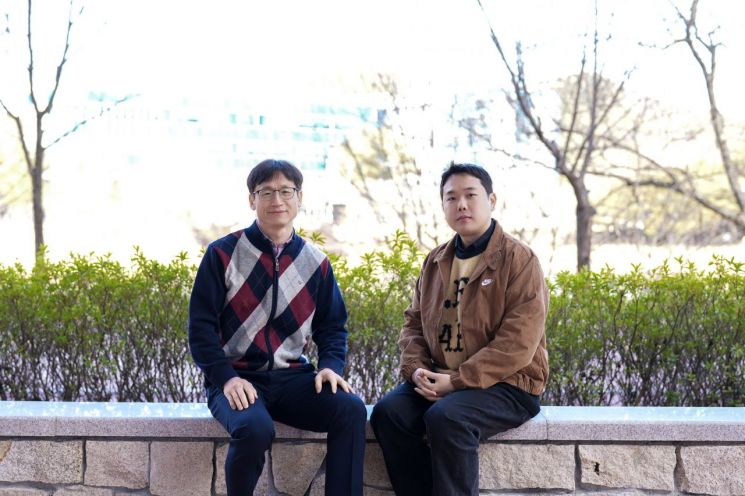
The research team led by Professor Bongsoo Kim from the Department of Chemistry at UNIST (President Jongrae Park), in collaboration with researchers from UC Santa Barbara in the United States, University of Lille in France, and the National Center for Scientific Research (CNRS), developed a crosslinker capable of producing long-lasting organic solar cells and elucidated its operating mechanism through multiple analytical techniques.
Organic solar cells are next-generation solar cells that are easy to manufacture and can be flexibly applied in film form. However, due to the nature of organic materials, they are vulnerable to heat and have difficulty maintaining long-term use.
To address this, strategies involving the addition of crosslinkers that firmly connect and protect the organic components have been studied, but excessive addition of crosslinkers to extend the cell lifespan caused a decrease in cell efficiency.
The joint research team developed a highly efficient photo-crosslinker, 6Bx, which can provide stabilization effects even when added in small amounts. This photo-crosslinker can form six crosslinking bonds per crosslinking molecule, achieving a theoretical photo-crosslinking efficiency of 96%. This is a very high level compared to the typical theoretical crosslinking efficiency of 36% for general photo-crosslinkers.
Organic solar cells made with the developed crosslinker recorded an efficiency of 11.70% even after 1680 hours at 85°C. This corresponds to 93.4% of the initial efficiency.
In contrast, cells without the crosslinker dropped to 8.17%, which is 58.7% of the initial efficiency of 13.92%. This represents an improvement in lifespan performance of about 59% or more.
Additionally, the research team identified that the high performance is due to the photo-crosslinker effectively suppressing the molecular movement of Y6 through the crosslinking reaction. Y6 is the electron acceptor in the photoactive layer of organic solar cells.
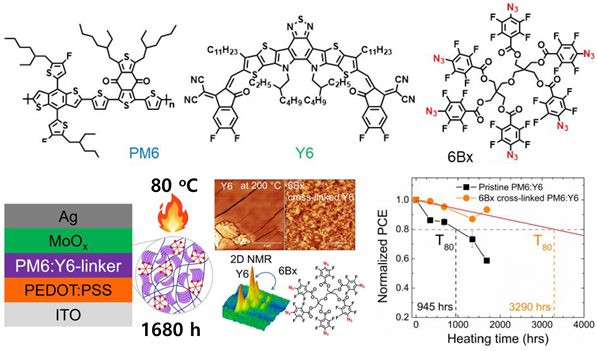 Chemical structure of the developed additive (6Bx) and the performance of organic solar cells with the additive.
Professor Bongsoo Kim said, “Through the development of a high-efficiency photo-crosslinker, we have solved the chronic stability problem of organic solar cells and further succeeded in elucidating its mechanism. This research will make a very important contribution to the development of stability enhancement technologies for the commercialization of organic solar cells.”
This study was conducted in collaboration with Professor Thuc-Quyen Nguyen from UC Santa Barbara, and the research team of Professor G. N. Manjunatha Reddy, a researcher at the Institute of Catalysis and Solid State Chemistry affiliated with the University of Lille and CNRS in France.
At UNIST, researchers Myungjae Lee and Sungjoo Yoo from the Department of Chemistry participated.
The research was supported by the Samsung Future Technology Development Foundation, and the results were published on the 10th of last month in ACS Energy Letters, a world-renowned journal in the field of energy.
© The Asia Business Daily(www.asiae.co.kr). All rights reserved.
![Clutching a Stolen Dior Bag, Saying "I Hate Being Poor but Real"... The Grotesque Con of a "Human Knockoff" [Slate]](https://cwcontent.asiae.co.kr/asiaresize/183/2026021902243444107_1771435474.jpg)
















