Vice Chairmen of KEF, KCCI, KITA, and Others Step Forward
Deliver Petition to People Power Party at National Assembly Main Building
"Directors' Swift Decision-Making Hindered... Companies Will Face Greater Hardship"
On the morning of the 26th, one day before the National Assembly plenary session on the amendment to the Commercial Act, vice chairmen of eight economic organizations, including the Korea Economic Association, visited the National Assembly to once again highlight the side effects companies would face due to the amendment expanding the duty of loyalty of directors from the company to "the company and shareholders," and submitted a petition requesting reconsideration.
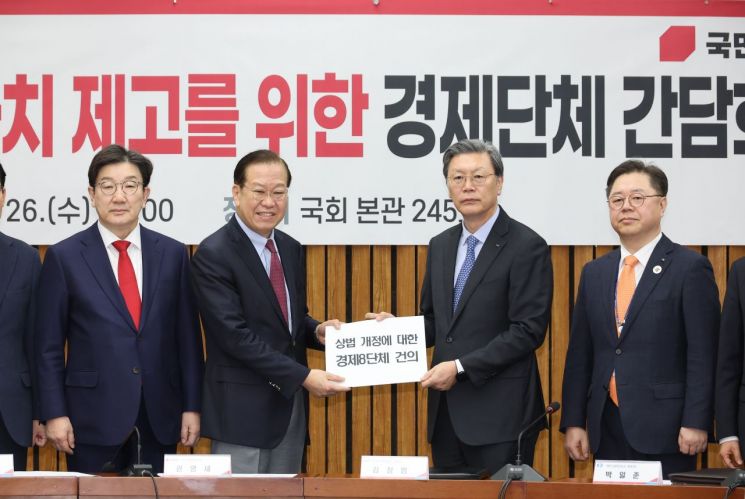 On the 26th, at the National Assembly in Yeouido, Seoul, Kwon Young-se, Emergency Response Committee Chairman of the People Power Party, received a proposal on the revision of the Commercial Act from Kim Chang-beom, Vice Chairman of the Korea Economic Association, during an economic organization meeting aimed at enhancing shareholder rights and corporate value. Photo by Yonhap News
The eight economic organizations refer to the Korea Economic Association, Korea Chamber of Commerce and Industry, Korea International Trade Association, Korea Federation of Small and Medium Business, Korea Employers Federation, Federation of Korean Mid-sized Enterprises, Korea Listed Companies Association, and KOSDAQ Association. The vice chairmen met with Kwon Young-se, Emergency Response Committee Chairman of the People Power Party, and Kwon Seong-dong, Floor Leader of the People Power Party, in Room 245 of the National Assembly main building to deliver the petition.
At the meeting, Kim Chang-beom, Vice Chairman of the Korea Economic Association, stated, "The eight economic organizations have repeatedly pointed out the economic side effects that the expansion of directors' duty of loyalty would bring and have requested the National Assembly to reconsider the discussions," reiterating the main points of the side effects. In particular, he said, "If the scope of directors' duty of loyalty is expanded to shareholders, directors will be threatened by lawsuits such as breach of trust, making it impossible to make normal management decisions." He added, "Entering new industries, like semiconductors and secondary batteries in the past, involves operating losses and stock price declines in the early stages of business. Companies will hesitate to make bold investment decisions, mergers and acquisitions, and research and development (R&D) due to fear of lawsuits from shareholders over stock price declines, making it difficult to secure future growth engines." He further predicted, "There will also be a significant increase in management rights attacks by foreign investors," emphasizing, "Korean companies are already targets of global activist funds. As of two years ago, the number of activist fund attacks in Korea ranked third among 23 major countries, following the United States and Japan. The amendment to the Commercial Act will result in handing domestic companies over as prey to these funds." Regarding this, Kim mentioned cases such as Elliott demanding Samsung Electronics return 30 trillion won to shareholders, equivalent to 75% of its capital expenditure budget in 2016, and demanding Hyundai Motor return 8 trillion won, about four times its net profit, in 2018, pointing out, "We will witness more frequent excessive management interventions."
Kim appealed, "Our companies are now standing on the edge of a cliff," asking for renewed consideration of the dire situations faced by companies in crisis. He added, "Traditional core industries such as petrochemicals and steel are suffering from severe recessions due to global oversupply, and advanced industries like semiconductors and electrical and electronics are rapidly losing competitiveness against China." He emphasized, "If directors cannot make swift management decisions at this time, restructuring and entry into new industries will become difficult, making it increasingly hard for companies to guarantee their survival." He warned, "If corporate vitality declines, investment and jobs will decrease, leading to a Korea value-down that will also harm the national economy," and proposed an alternative, "We request discussions on targeted amendments to the Capital Market Act that will provide practical help to minority shareholders."
© The Asia Business Daily(www.asiae.co.kr). All rights reserved.

















