Gokseong Juksan Village and Jangheung Jibuk Village Selected
5 Hundred Million Won Provided per Village, Facility and Equipment Construction Supported
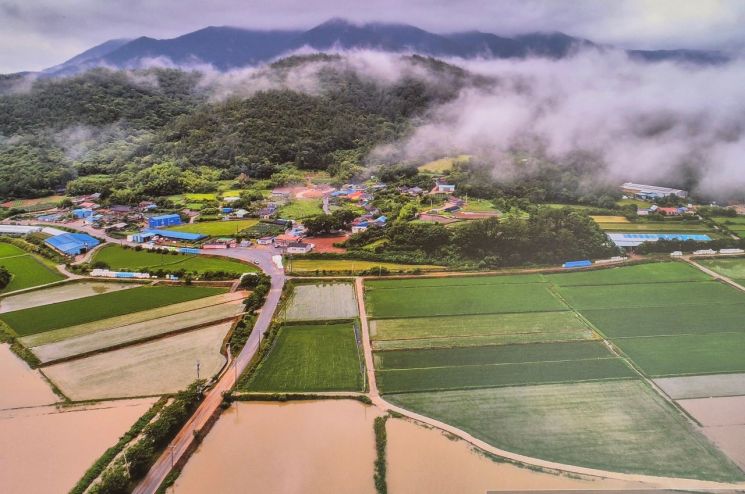 A view of Jangheung Jibuk Village, the selected site for Jeonnam Province's 2025 Organic Ecological Village Development Project. Provided by Jeonnam Province
Jeollanam-do has selected Gokseong-gun and Jangheung-gun for its project to foster successful models by linking organic ecological village resources. These villages will receive not only project funding for facility construction but also various benefits aimed at increasing residents' income.
According to Jeollanam-do on the 26th, 'Juksan Village in Seokgok-myeon, Gokseong' and 'Jibuk Village in Gwansan-eup, Jangheung', which were selected as the target sites for the 2025 organic ecological village development project, will each receive 500 million won, totaling 1 billion won, to support the production, processing, and experience facilities and equipment needed for village income projects.
The villages supported by the organic ecological village development project were selected through a first-stage document review and a second-stage expert field evaluation, targeting villages designated as organic ecological villages. The selection was based on a comprehensive evaluation of their current practices in eco-friendly agriculture, the suitability of their business plans, feasibility, and commitment.
The main specialty of Juksan Village in Gokseong is 'Baeksemi' rice, with most village farms participating in the operation of traditional grain syrup and taffy workshops since 2016. Due to its small scale, it mainly operates during holiday seasons.
Through this project, the village plans to promote the expansion of systematic production and sales of traditional foods (taffy and grain syrup) with HACCP certification, and to operate experience programs using 'Dolsilnai', a national intangible cultural heritage No. 140 hemp weaving technique. This is expected to vitalize urban-rural exchange, increase farm income, and boost village vitality.
Jibuk Village in Jangheung produces rice, tea, millet, and tea leaves on 53.3 hectares of organically certified land. It was designated as a traditional fermented tea Cheongtaejeon ecological experience village in 2005. By securing facilities for organic tea experiences, the village is expanding tea cultivation and establishing its own eco-friendly brand, aiming to revitalize the village and create jobs to increase income. There are also plans for experiential tourism courses linked to the camellia tree path established in the village and the surrounding natural scenery (designated reservoir and Sosanbong).
Kim Youngseok, Director of Eco-Friendly Agriculture at Jeollanam-do, said, "This project will serve as an opportunity to link and revitalize eco-friendly agricultural products and traditional industries produced in the village, thereby increasing residents' income."
Meanwhile, since 2009, Jeollanam-do has been the first in the nation to designate villages that practice eco-friendly agriculture and meet certain requirements as organic ecological villages. As a pledge of the 8th popularly elected governor, 68 villages have currently been designated, and the plan is to designate and foster 100 villages by 2026.
© The Asia Business Daily(www.asiae.co.kr). All rights reserved.
![Clutching a Stolen Dior Bag, Saying "I Hate Being Poor but Real"... The Grotesque Con of a "Human Knockoff" [Slate]](https://cwcontent.asiae.co.kr/asiaresize/183/2026021902243444107_1771435474.jpg)















