At the National Gugak Center's Yeyakdang on March 13-14
The National Gugak Center will present a performance that attempts to restore tradition using artificial intelligence (AI) technology.
The Jeongakdan of the National Gugak Center will hold a regular performance titled "Haengak and Boheoja - Steps of Heaven and Earth" at the National Gugak Center's Yeyakdang on March 13-14. The court ceremonial music "Boheoja" to be performed that day is a piece whose lyrics, called changsa (唱詞), have not been fully preserved. It is an annual music piece composed of three movements, but the changsa has been passed down only up to the second movement, while the third movement is transmitted with melody only, without lyrics. The National Gugak Center trained AI on about 450 classical Chinese poems to newly create the missing changsa for the third movement.
To create the changsa, the AI learned classical Chinese poems by Crown Prince Hyomyeong, calligrapher Kim Jeonghui (Chusa), and scholar Jeong Yak-yong (Dasan). Crown Prince Hyomyeong, the only son of King Sunjo, the 23rd monarch of the Joseon Dynasty, was deeply interested in arts and scholarship and was highly talented. Although he died young at the age of 21, he left behind more than 350 classical Chinese poems. About 100 more poems by Chusa and Dasan were added to this corpus.
At a press conference held at the National Gugak Center on the 25th, Lee Geonhoe, artistic director of the Jeongakdan, described the AI-composed changsa for the third movement as an "external expansion of Jeongak in line with the changes of the times." Lee said, "The Jeongakdan of the National Gugak Center is not only focused on preserving and inheriting traditional music but is also striving for the development of new Jeongak in the present era based on tradition," adding, "I believe that music based on our tradition can be greatly enhanced by using technologies like AI in accordance with the flow of the times."
Park Jin-hyung, CEO of Art Platform Yooyeon, who led the AI changsa creation process, explained that two large AI language models, ChatGPT and LLaMA 3, were used to produce the changsa. Park said, "We input the changsa of Boheoja movements 1 and 2 and possible themes for the third movement into LLaMA 3, which had learned about 450 classical Chinese poems by Crown Prince Hyomyeong, Chusa Kim Jeonghui, and Dasan Jeong Yak-yong, to first generate Korean lyrics, and then used ChatGPT to create the changsa in classical Chinese."
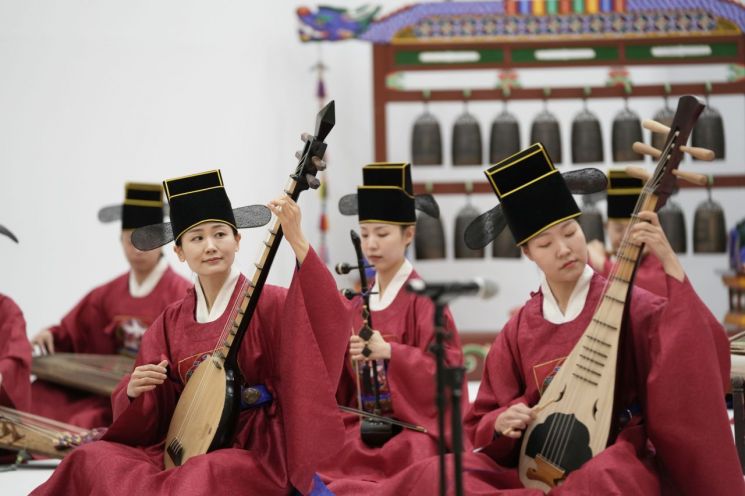 Members of the National Gugak Center Jeongakdan performed the royal court music piece "Boheoja" at the National Gugak Center Yeaakdang on the 25th.
 [Photo by National Gugak Center]
The "Haengak" that the Jeongakdan will present at the regular performance refers to the procession music played during royal processions, inspections by officials, and envoys. The royal procession music of the Joseon Dynasty consists of "Chulgungak," played when leaving the palace; "Haengak," played during the procession; "Hwanggungak," played when returning to the palace; and "Yeonnyeak," played at the banquet after returning to the palace. The Boheoja, for which AI newly created the changsa, is scheduled to be performed as the final Yeonnyeak after returning to the palace.
Boheoja, meaning "a person walking in the void," is a piece that came from the Song Dynasty of China during the Goryeo period. It is music related to Taoist thought and was a song sung by immortals circling in the void when paying respects to a superior immortal. The lyrics prayed for the immortality of the superior immortal, and when it was adopted during the Goryeo period, it became a song sung by subjects wishing for the king's health and longevity and the country's peace and prosperity, continuing into the Joseon Dynasty.
The opening Chulgungak will feature "Yeominrakman," and the Hwanggungak played when returning to the palace will feature "Yeominrakryeong," both performed in the traditional manner. During the Haengak played in the royal procession, "Chwita" and "Daechwita" will be presented. Chwita is usually performed mainly with wind instruments, but in this performance, the Jeongakdan's principal geomungo player Go Boseok and principal gayageum player Lee Myeongha will form a string instrument ensemble, adding instruments such as hyangbipa and wolgeum to present a more diverse Haengak. Also, the "Unra," an instrument consisting of several small gongs of different pitches hung on a wooden frame and played with a mallet, is occasionally included only in Chwita performances, but in this performance, it will be newly included in both Daechwita and Chwita.
© The Asia Business Daily(www.asiae.co.kr). All rights reserved.

















