Expansion of Tariff War to the Metal Sector After Steel and Aluminum
Rutnik: "Tariffs Can Help Rebuild the Copper Industry"
U.S. Heavily Dependent on Copper Imports
U.S. President Donald Trump on the 25th (local time) ordered an investigation into the impact of imported copper on national security, suggesting the possibility of imposing tariffs. This is interpreted as an intention to expand the 'tariff war' in the metal sector to copper, following steel and aluminum. If the U.S. imposes tariffs on copper, major copper-producing countries such as Chile, Peru, and China may retaliate, raising concerns about instability in the global supply chain.
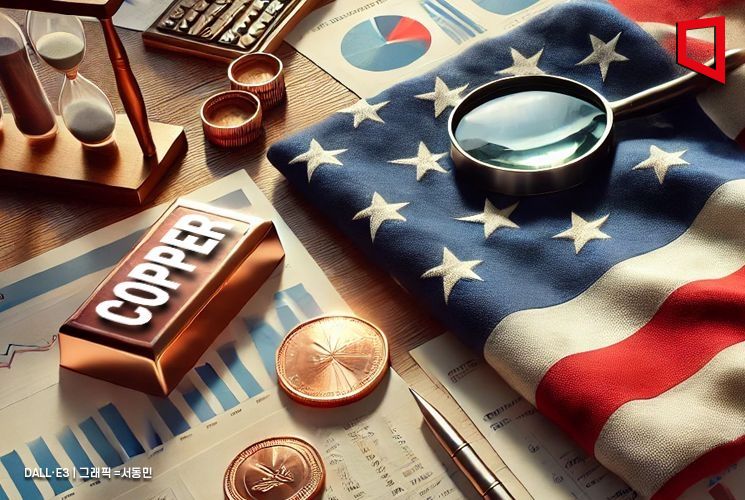
President Trump signed an executive order in the White House Oval Office on the same day, directing an investigation into U.S. copper imports under Section 232 of the Trade Expansion Act. Upon signing the order, Trump said, "There will be a big impact."
Section 232 of the Trade Expansion Act allows the U.S. to urgently restrict imports or impose high tariffs if foreign imports are deemed to threaten U.S. national security. During his first term in office in 2018 and 2019, Trump applied this law citing national security to investigate steel, aluminum, automobiles, and other products. Subsequently, tariffs were actually imposed on some items. BBC described Trump's directive to investigate copper imports as the first step toward imposing copper tariffs, calling it "a new front in the trade war."
However, unlike previous tariff impositions, President Trump did not specify the timing or tariff rates in detail. A senior White House official said the investigation into copper would proceed on "Trump time," meaning "as soon as possible."
Trump's designation of copper as the next target for tariffs is interpreted as an effort to raise import prices and support domestic production. Copper is a critical mineral not only for military equipment such as ships, aircraft, and tanks but also for advanced industries like artificial intelligence (AI).
Commerce Secretary Wilbur Ross stated in a release, "It's time for copper to come back home," adding, "If necessary, tariffs can help rebuild our copper industry and strengthen national defense."
A senior White House official also explained, "Copper is the second most widely used material in U.S. weapons systems," noting that U.S. copper production is only 14% of China's.
Like steel and aluminum tariffs, copper tariffs are expected to increase costs for industries dependent on copper, potentially provoking opposition from manufacturers. Although the U.S. is a major copper producer, it imports copper from countries such as Chile, Canada, and Mexico because domestic copper production has been declining annually. According to the U.S. Geological Survey (USGS), the U.S. mined about 1.1 million tons of copper in 2024, a decrease of approximately 20% over ten years.
There are also concerns that copper tariffs could trigger new trade disputes. If the U.S. enforces copper tariffs, affected countries might retaliate with counter-tariffs, as China has done. The largest copper supplier to the U.S. is Chile, exporting copper worth $4.636 billion annually, followed by Canada, Peru, Mexico, and the Democratic Republic of the Congo. The New York Times (NYT) expressed concern that "(copper) tariffs could spark new conflicts with countries exporting copper to the U.S."
There is also an interpretation that this move targets China. Peter Navarro, White House senior advisor for trade and manufacturing, pointed out, "China has long used overproduction and dumping as economic weapons to dominate the global market and drive competing industries out of business." However, since China's exports to the U.S. have already declined due to previously imposed tariffs, the impact of copper tariffs on China is expected to be limited.
If copper tariffs are introduced, South Korea will inevitably be affected as well. According to the Korea International Trade Association's K-STAT, South Korea exported copper products worth $570 million to the U.S. last year and imported copper products worth $420 million from the U.S.
© The Asia Business Daily(www.asiae.co.kr). All rights reserved.
![Clutching a Stolen Dior Bag, Saying "I Hate Being Poor but Real"... The Grotesque Con of a "Human Knockoff" [Slate]](https://cwcontent.asiae.co.kr/asiaresize/183/2026021902243444107_1771435474.jpg)















