BOK Stresses Need for Expanded Investment in U.S.
Considers Shifting Energy Import Sources
An analysis has emerged that South Korea should proactively and flexibly prepare strategies in advance to respond to future U.S. trade pressures. Specific measures include ▲emphasizing expanded investment in the U.S. ▲strengthening Korea-U.S. technological cooperation in areas such as AI ▲shifting energy import sources to the U.S. In the medium term, there is also a suggestion to consider expanding imports of U.S. agricultural products such as fruits.
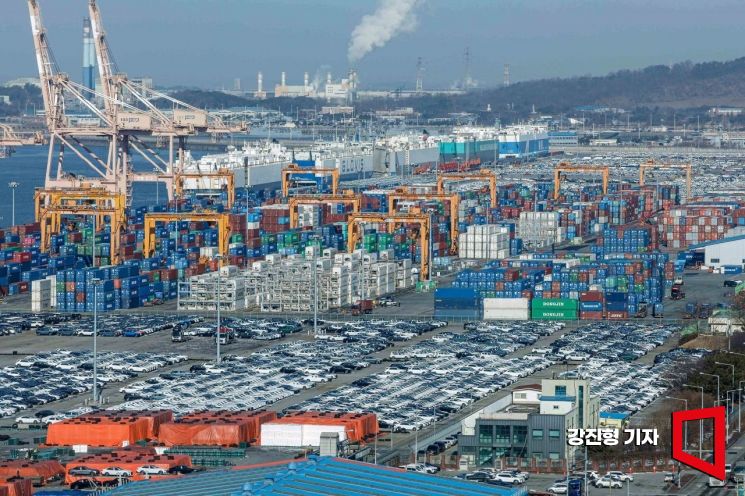 President Donald Trump signed a proclamation imposing a 25% tariff without exceptions on steel and aluminum products imported into the United States, and announced that tariffs on automobiles and semiconductors are also under consideration. On the 13th, export vehicles were waiting to be loaded at Pyeongtaek Port in Gyeonggi Province. 2025.2.13. Photo by Kang Jin-hyung
The Bank of Korea (BOK) emphasized this in its report titled 'Global and Domestic Economic Impact of the New U.S. Administration's Tariff Policy,' released on the 25th. The BOK stated, "While seeking alternative export destinations in the global market to buffer shocks, we must respond proactively and flexibly in tariff negotiations with the new U.S. administration."
South Korea's export share to the U.S. has recently risen to nearly 20%. In this situation, if alternative export destinations are not found when the U.S. imposes tariffs, our exports will be directly impacted through a decline in exports to the U.S. Particularly, automobiles and semiconductors, which have recently been targeted for tariffs, account for a large portion of exports to the U.S., so the impact of tariff imposition is inevitably greater.
The BOK first stated, "A significant portion of South Korea's trade surplus with the U.S. arises from capital goods exports, which inevitably increased as our companies expanded investment in the U.S." It also analyzed that technological cooperation between Korea and the U.S. should be strengthened in industries such as shipbuilding, nuclear power, and AI. A more proactive approach is needed, such as presenting business opportunities that jointly develop markets and increase mutual benefits. It also saw the need to increase the number of items imported from the U.S. by shifting energy import sources such as LNG to the U.S. The BOK said, "In the medium term, we should also consider expanding imports of U.S. agricultural products such as fruits."
© The Asia Business Daily(www.asiae.co.kr). All rights reserved.
![Clutching a Stolen Dior Bag, Saying "I Hate Being Poor but Real"... The Grotesque Con of a "Human Knockoff" [Slate]](https://cwcontent.asiae.co.kr/asiaresize/183/2026021902243444107_1771435474.jpg)















