Gold Panning Gains Attention as Hobby and Investment
Collecting Gold Grains from River and Stream Beds
Even Skilled Panners Recover Only 3 to 5 Grams per Day
Caution Needed for River Environment Damage and Private Land Issues
'Sagum chaechwi' (gold panning), once considered an unusual hobby, is now gaining attention as a serious investment method due to the soaring gold price of around 130,000 to 140,000 KRW per gram. Gold panning involves filtering natural gold particles formed as small grains at the bottom of rivers or streams. Excessive gold panning can cause inconvenience to nearby residents and may pose a risk of illegal river environment damage, so caution is required.
Recently, the number of 'gold panning clubs' has increased in online cafes and gatherings. These clubs usually operate by groups of 3 to 5 people roaming local rivers to find gold. Most emphasize it as a "weekend hobby" or "something done occasionally when free," but some groups show strong determination, saying their goal is to "make 10 don (37.5g)." One large club with over 200 members even requires participants to have specialized equipment such as suction devices for panning.

Gold particles are pure gold grains settled at the bottom of rivers and streams. It is known that gold accumulates near the watersides where gold mines once existed. Gold panning is the process of finding and scooping sand or gravel mixed with gold and then filtering out only the gold grains.
The recent increase in interest in gold panning is due to the soaring gold prices. According to the Korea Gold Exchange, as of the 28th of last month, the selling price of pure gold was 136,000 KRW per gram, a surge of about 59% over the past year. Even recovering just 1 don (3.7g) of gold can yield a considerable profit.
Gold panning has a long history both domestically and internationally. In ancient and medieval times, when explosives or heavy mining equipment were unavailable, gold panning was a primary method of securing gold instead of mining. During the 19th-century California Gold Rush in the United States, gold panners flocked to the gold mine areas. In the Korean Peninsula, gold mines were developed by the Japanese colonial government in the 1920s, and gold panning was active especially around mines in North Pyongan Province, Gyeonggi Province, and Gangwon Province.
Most gold mines have ceased operations, but natural gold still remains near the watersides of abandoned mines. Yangpyeong in Gyeonggi, Yeongdong in Chungbuk, and Jeongseon and Yeongwol in Gangwon are representative gold panning spots. Particularly in Gangwon, local governments have directly established and operate gold panning experience centers, and famous celebrities have visited to pan for gold, making it well-known among the general public.
A man in his 50s, Mr. A, who pursues gold exploration as a hobby, said, "Since the early 1900s, Gangwon has been a major workplace for gold panners, and there is still a lot of gold grains left. Gold exploration clubs often visit Gangwon valleys for both panning and travel."
However, gold panning requires considerable skill. Since it involves collecting gold grains settled on sandy riverbeds, the amount of gold obtained is very small even after working all day. Mr. A said, "I heard that a skilled panner can collect about 3 to 5 grams after working a full day. The amount of gold accumulated in one area is already fixed, so the yield decreases the more you pan."
Equipment costs for gold panning should also be considered. To pan for gold, basic tools such as shovels for scooping soil, drivers or crowbars, pickaxes, hammers, and buckets for extracting gold attached to rocks are necessary. Additionally, 'panning dishes' for separating gold from rock fragments and 'suction devices' for extracting gold from dust are needed, sold at various prices ranging from 20,000 to 100,000 KRW. Specialized equipment imported from overseas, such as metal detectors and vibration classifiers, can cost between 600,000 and 700,000 KRW.
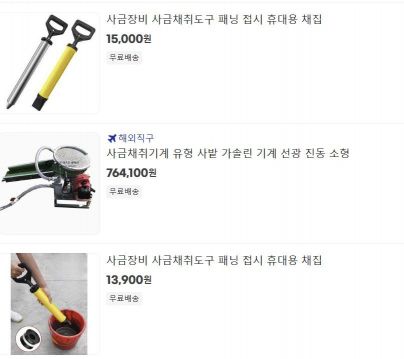 Equipment for gold panning sold in online malls. Specialized equipment imported from overseas is quite expensive. Screenshot from the online homepage
Excessive gold panning can cause inconvenience to residents near rivers or damage the environment, so caution is necessary. Current river laws do not prohibit gold panning in national or local rivers, but acts that damage the river environment are considered illegal. Examples include ▲blocking or changing the flow of the river ▲damaging or risking damage to river facilities ▲discarding wood pieces, soil, floating objects, or obstacles. If the panning area is private property, panning without the landowner's permission may lead to civil issues.
© The Asia Business Daily(www.asiae.co.kr). All rights reserved.


















