KDI Focus:
"Directions for Reforming the Basic Pension Selection Method"
A policy research institute has suggested changing the selection criteria for basic pension recipients, which currently covers 70% of all elderly people. As the income and asset levels of the elderly improve and elderly poverty declines, it is argued that pension recipients should be selected based on relatively poor elderly individuals within the entire society. KDI emphasized that gradually reducing the eligibility criteria for basic pension recipients from 100% to 50% of the median income standard would more effectively improve elderly poverty.
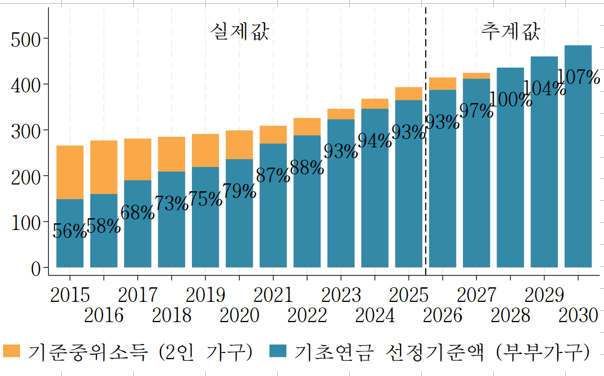
On the 25th, the Korea Development Institute (KDI) released a report titled "Direction for Reforming the Basic Pension Selection Method" (KDI Focus). Researchers Kim Do-heon and Lee Seung-hee diagnosed that the current basic pension selection criteria, which selects recipients among the bottom 70% of elderly people based on recognized income considering income and assets, do not reflect the improved economic situation of the elderly.
They pointed out that under the current system, the number of elderly recipients who are not vulnerable is increasing. As the economic situation of the elderly improves, the selection threshold also rises, resulting in non-poor elderly people continuing to receive basic pension benefits.
In fact, the basic pension eligibility threshold was about half of the median income in 2015, but as the economic situation of the elderly improved, it rapidly increased to 93% of the median income by 2025. The median income is the midpoint of household income nationwide as announced by the Ministry of Health and Welfare.
KDI also forecasted that elderly poverty will continue to improve gradually. This is because poverty levels are actually improving among more recent birth cohorts within the elderly population. While poverty rates are high among those born in the 1930s and 1940s, the poverty rate is lower for those born in the 1950s. The overall high elderly poverty rate is due to the high poverty rate among those born before 1950. Since those entering old age in the 1960s and 1970s have better income and asset levels, elderly poverty rates are expected to decline further in the future.
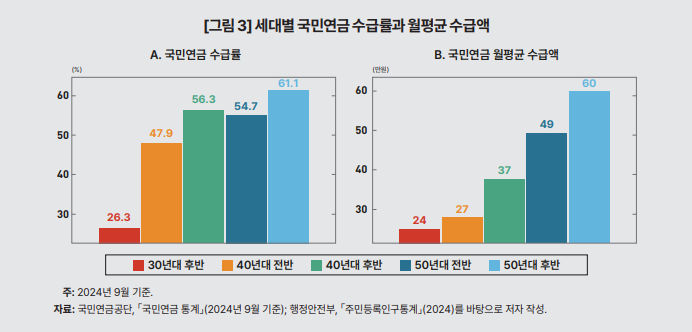
This generational difference is due to varying benefits from the National Pension. Since the National Pension was implemented nationwide only in 1998, the coverage rate and benefit amounts naturally increase for more recent birth cohorts. Especially, with a National Pension coverage rate close to 60% for those born after the 1950s, the 1960s and 1970s cohorts entering old age will have the National Pension as a practical retirement security measure.
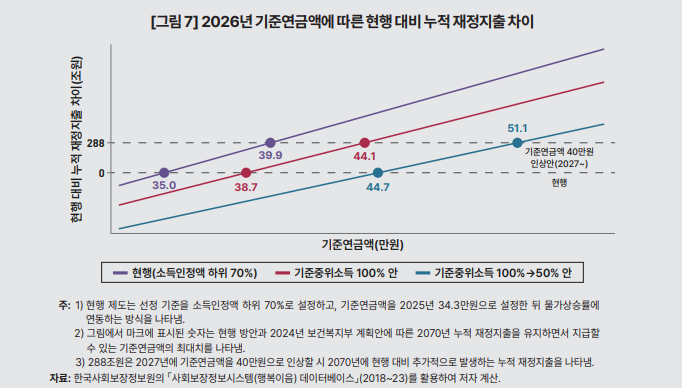
Therefore, KDI suggested that the basic pension recipient selection method should be set as a certain percentage of the median income. Furthermore, by gradually adjusting the eligibility criteria from 100% to 50% of the median income, fiscal savings can be achieved, and by increasing the benefit amount with the saved funds, poverty can be efficiently alleviated.
Along with this, it was seen necessary to gradually narrow the pension recipient pool to relatively poor elderly individuals based on the entire society's standard. Introducing a method to provide differentiated benefit amounts according to recognized income would allow for a more efficient resolution of elderly poverty.
In the long term, it was argued that integrating the basic pension and the basic livelihood security system for the elderly to operate a categorical minimum income guarantee system for the elderly should be considered. The categorical minimum income guarantee system for the elderly is a public assistance program that guarantees minimum essential living expenses for low-income elderly people.
If the basic pension selection method is changed to below 50% of the median income, the number of recipients will decrease and the benefit amount will increase, thereby strengthening the public assistance nature of the program. However, this change could cause functional overlap with the basic livelihood security system, increasing complexity.
© The Asia Business Daily(www.asiae.co.kr). All rights reserved.
![Clutching a Stolen Dior Bag, Saying "I Hate Being Poor but Real"... The Grotesque Con of a "Human Knockoff" [Slate]](https://cwcontent.asiae.co.kr/asiaresize/183/2026021902243444107_1771435474.jpg)

















