90 District and Neighborhood Officials Participate
"Expecting to Provide Substantial Services to Citizens"
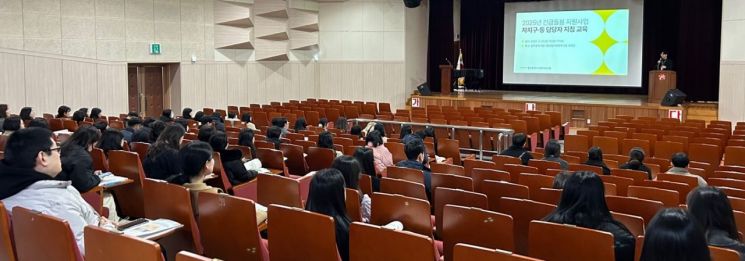 Gwangju Social Service Institute recently conducted practical training for 90 public officials involved in the urgent childcare support project at autonomous district and neighborhood administrative welfare centers, organized by the Gwangju Work-Family Balance Support Headquarters. Photo by Gwangju Social Service Institute
Gwangju Social Service Institute (Director: Kim Daesam) announced on the 25th that it recently conducted a "Ministry of Health and Welfare Emergency Care Support Program Practical Training for Local Government Officials" for 90 public officials in charge of the emergency care support program at district and neighborhood administrative welfare centers at the Gwangju City Work-Family Balance Support Center.
The training was led by Gwangju Social Service Institute staff who are directly involved in the care program. They developed the training materials and served as instructors, providing guidance on administrative procedures tailored to local characteristics, including: the purpose and operation of the emergency care program, understanding of revised program details, and key Q&A during program implementation.
Participating public officials commented in unison, "We realized that for the emergency care support program to truly live up to its name and be carried out effectively, administrative responses must be even faster and more coordinated."
As the regional emergency care support institution, Gwangju Social Service Institute is responsible for tasks such as establishing business plans, building public-private cooperation systems, improving the quality of service providers, operating the Emergency Care Committee, and monitoring the program. Last year, the institute provided prompt and thorough emergency care support, including assistance to the bereaved families of the Jeju Air accident.
Meanwhile, the Ministry of Health and Welfare's emergency care support program is designed to fill care gaps caused by illness, injury, or the sudden absence (such as death or hospitalization) of a primary caregiver. The program provides up to 72 hours of in-home care within a maximum of 30 days for eligible recipients. Citizens in need of emergency care can apply at the administrative welfare center corresponding to their resident registration address.
© The Asia Business Daily(www.asiae.co.kr). All rights reserved.
![Clutching a Stolen Dior Bag, Saying "I Hate Being Poor but Real"... The Grotesque Con of a "Human Knockoff" [Slate]](https://cwcontent.asiae.co.kr/asiaresize/183/2026021902243444107_1771435474.jpg)















