South Korea’s Growth Forecast Lowered to 1.5% This Year
Market Prices in Rate Cut Expectations, Focus Shifts to 'Hawkish Cut' and Gradual Pace
Many Variables for Additional Cuts... Watch Exchange Rate, U.S. Economic Policy, and Supplementary Budget
The shadow of low growth has deepened over the South Korean economy. On the 25th, the Bank of Korea sharply revised down its economic growth forecast for this year to 1.5%. This is lower not only than the 1.9% forecast from last November but also below the 1.6?1.7% range anticipated during last month's mid-term review. Reflecting concerns over expanded low growth, the Bank of Korea cut the base interest rate by 0.25 percentage points. The market interpreted this rate cut as a 'hawkish (preference for monetary tightening) cut.' Further cuts are expected to be made cautiously, considering the various complex factors comprehensively.
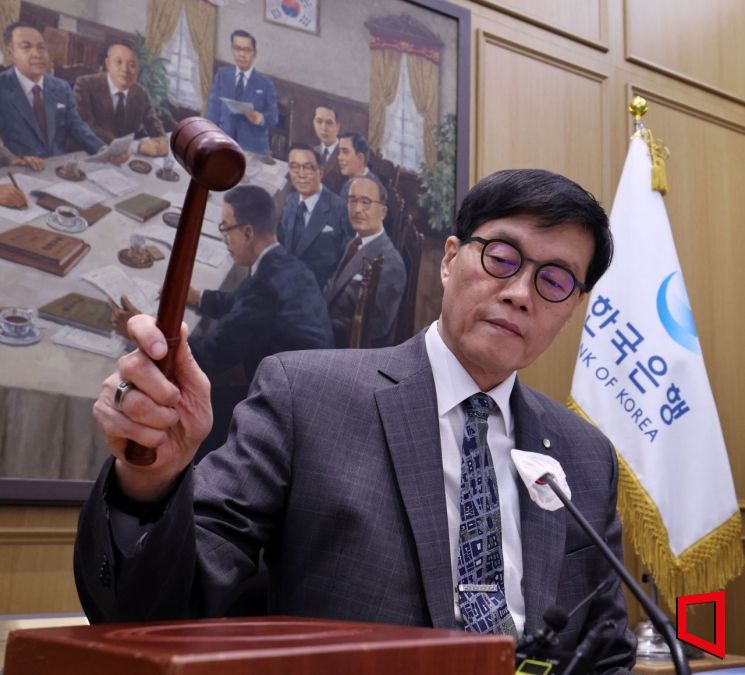 Lee Chang-yong, Governor of the Bank of Korea, is striking the gavel at the Monetary Policy Committee plenary meeting held at the Bank of Korea headquarters in Jung-gu, Seoul, on the morning of the 25th. 2025.02.25 Photo by Joint Press Corps
This Year’s South Korean Economic Growth Forecast at 1.5%... Red Lights for Domestic Demand and Exports
In the revised economic outlook announced that day, the Bank of Korea projected South Korea’s economy to grow by 1.5% this year. The '1.5%' forecast is lower than those of the Organisation for Economic Co-operation and Development (OECD·2.1%) and the International Monetary Fund (IMF·2.0%), and even more conservative than the recently lowered forecast by the Korea Development Institute (KDI·1.6%).
Previously, in November last year, the Bank of Korea lowered its growth forecast for this year from 2.1% (August forecast) to 1.9%, reflecting factors such as the strengthening of U.S. protectionist trade policies. This was further revised downward to 1.6?1.7% during last month’s mid-term review. This adjustment incorporated additional factors including political uncertainty triggered by the emergency martial law situation, resulting economic sentiment deterioration, changes in U.S. economic policy following President Trump’s election, and the base effect from South Korea’s economy growing only 0.1% quarter-on-quarter in Q4 of last year.
The Bank of Korea’s further downward revision of the growth forecast indicates the significant domestic and external uncertainties surrounding South Korea’s economy this year. Both domestic demand and exports, which drive the Korean economy, are performing worse than expected, which is the biggest concern. In domestic demand, the sluggish construction investment that eroded South Korea’s economic growth last year continues, and private consumption recovery has been delayed since the emergency martial law. Even exports, which have been supporting the Korean economy, are expected to see a slowdown in growth this year except for semiconductors.
Political uncertainty at home and the ongoing tariff war triggered by the second Trump administration in the U.S. are also reasons for the conservative growth forecast. In last month’s mid-term review, the Bank of Korea stated, "Depending on three conditions?the timing of resolution of domestic political uncertainty, the timing and scale of additional government stimulus measures, and the development of economic policies by the new U.S. administration?the February forecast could be lowered further." This can be interpreted as meaning that if domestic political instability continues beyond Q2 this year and Trump-related tariff pressures directly impact the Korean economy, growth could decline further.
The economic growth forecast for next year remains at 1.8%, maintaining the November forecast from last year. If this forecast materializes, the Korean economy will have recorded growth below or barely at the potential growth rate (2%) for four consecutive years, following 2023 (1.4%) and last year (2.0%). This implies that it will be difficult to see the same growth momentum as in the past. Analysts suggest that without finding clear new growth engines amid worsening aging and low birth rates, a decline in potential growth rate is inevitable.
'Rate Cut-like Freeze' in January... 'Freeze-like Cut' in February
At the monetary policy meeting held at the Bank of Korea headquarters in Jung-gu, Seoul, the Monetary Policy Board announced that it lowered the base interest rate to 2.75% per annum. This is a 0.25 percentage point cut from the previous 3.00%, matching market expectations. The base rate falling into the 2% range is the first time in about two years and four months since October 2022.
The Monetary Policy Board began pivoting after lowering the base rate by 0.25 percentage points from 3.50% to 3.25% in October last year, marking the first policy shift in three years and two months, and then consecutively cut by 0.25 percentage points in November. Last month, the rate was held steady due to factors such as trade policy variables following President Trump’s election and political uncertainty after the December 3 emergency martial law, which caused a sharp rise in the exchange rate, but this month it was cut again by 0.25 percentage points.
The main reason for this month’s cut is downward pressure on the economy and concerns arising from the further downward revision of South Korea’s economic growth forecast. Both domestic demand and exports, the core pillars of the Korean economy, have turned red, strengthening calls to support economic stimulus through interest rate cuts. The 'external variables' and 'exchange rate burden' that led to last month’s rate freeze have relatively stabilized, creating an environment to focus on growth concerns. With limited expansion of additional political risks and the easing of strong dollar pressure caused by 'Trump uncertainty,' the won-dollar exchange rate has entered a lull. At the end of last year, amid severe political turmoil and strong dollar pressure, the won-dollar exchange rate rose to 1,480 won, increasing volatility. Recently, it has remained below the 1,450 won level due to eased concerns about tariffs from the new U.S. administration.
Household debt is also currently not considered to be at a risky level. There are concerns that housing transactions, which had been quiet due to the lifting of land transaction permit zones, are showing signs of picking up again. However, this movement is limited to certain areas, while other regions are experiencing difficulties with unsold homes, deepening polarization. It is expected that responses will focus more on strengthening government measures such as the Debt Service Ratio (DSR) rather than monetary policy.
Many Variables for Additional Cuts... Attention on Exchange Rate, U.S. Economic Policy, and Supplementary Budget
The market interpreted the Monetary Policy Board’s recent rate decision as a 'hawkish cut,' expecting the pace of further cuts to be moderated. Both the relatively calm exchange rate and U.S. trade policy variables remain unpredictable and could change rapidly. Jaekyun Ahn, a researcher at Shinhan Investment Corp., said, "Since exchange rate volatility caused by domestic political risks and Trump policies remains significant, the exchange rate trend must continue to be closely monitored." The Trump administration’s announced tariffs on automobiles and semiconductors, which could be announced earlier than the scheduled April 2 date, are also key variables for the Korean economy and a core consideration in determining the interest rate path.
After this month’s cut, the timing of additional cuts is expected to be decided while monitoring factors such as the supplementary budget (chugyeong) decision and inflation trends. The uncertainty over the scale and timing of government stimulus measures was one of the reasons for last month’s rate freeze. The Bank of Korea maintained its consumer price inflation forecast for this year at 1.9%. It is expected to move within the Bank of Korea’s inflation target (2.0%), but consumer prices exceeded market expectations last month following December, and there remains the possibility that the high exchange rate will further impact inflation. Minju Kang, senior economist at ING Bank, forecasted, "The Bank of Korea will carefully monitor whether inflation slows down while observing the effects of the three rate cuts implemented since the end of last year."
There is a growing expectation that after this cut, only one additional cut will be made this year, leaving the final rate around 2.5%. With this rate cut, the interest rate gap with the U.S. has widened to 1.75 percentage points. Experts generally expect the U.S. Federal Reserve (Fed) to hold rates steady for the time being while assessing inflation and employment conditions, and similarly expect the Bank of Korea to moderate the pace of rate cuts. Seongjin Kang, professor of economics at Korea University, said, "The U.S. shows no signs of cutting rates immediately, so the gap may widen further, and oil prices are not fully stabilized. Household debt issues also need to be considered, making it a complex problem. It is a situation where there are many factors to consider before cutting rates indiscriminately to stimulate the economy."
© The Asia Business Daily(www.asiae.co.kr). All rights reserved.

















