Interview with Kim Seyong, CEO of GH
With Equity Accumulation Housing
20% Equity Without Initial Burden
Gradually Purchase the Rest
Will Help Increase Resettlement Rate
"How can they think of removing all the livelihood issues when so many young people in their 30s are waiting...?"
At the final plenary session of the Gyeonggi Provincial Council’s extraordinary meeting on the 20th, the ‘Consent for the Promotion of New Investment Projects in the Gwanggyo A17 Block Public Housing Project’ was ultimately not submitted. The ‘Gwanggyo Equity Accumulation Housing Project,’ which would have fulfilled the dreams of homeownership for young people and newlyweds, was also postponed by several months. This was the result of the council boycotting all 11 agenda items submitted by Gyeonggi Governor Kim Dong-yeon. From the morning of that day, Kim Se-yong, CEO of Gyeonggi Housing and Urban Development Corporation (GH), who earnestly requested, "This matter must be raised," could not hide his frustration.
Meeting him on the 26th at the GH headquarters office in Suwon, Gyeonggi Province, he sighed, saying, "Even if this agenda is processed at the extraordinary meeting scheduled for April, it will be delayed by two months. Since it was postponed once in December last year, from the perspective of those waiting, it means an indefinite delay of about a year."
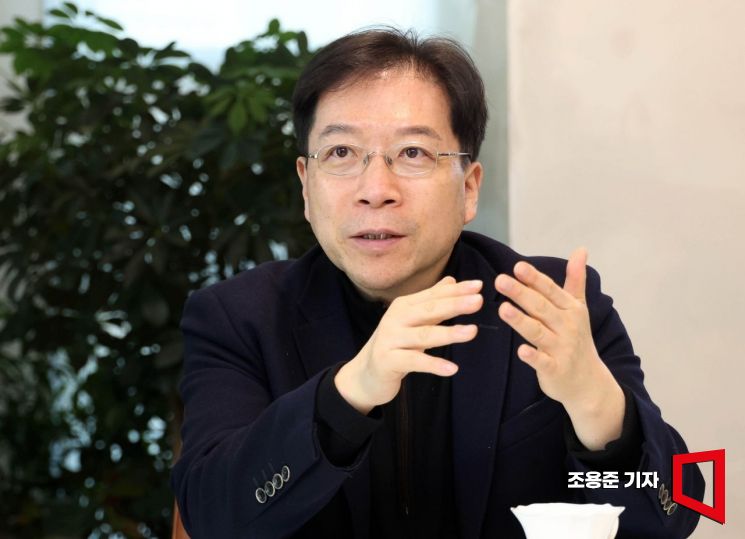 On the 26th, Kim Se-yong, President of Gyeonggi Housing and Urban Corporation (GH), is being interviewed by Asia Economy at the GH office in Suwon.
This agenda involves changing 240 of the existing 600 public rental housing units in Gwanggyo A17 Block to equity accumulation type housing (exclusive area 59㎡) and supplying 360 units as general public sale (exclusive area 84㎡). The A17 Block is located in Woncheon-dong, Suwon City, and is known as the last prime land remaining in Gwanggyo New Town. It was also the site of the former Suwon Legal Town. GH plans to supply ‘equity accumulation housing’ here. This housing allows residents to initially acquire only 20-40% equity and gradually purchase the remaining equity over 20-30 years to own their home. The goal was to start construction this year and enable move-in by 2028. After the plan was announced, expectations were high among young people, newlyweds, and those without homes.
The project was conceived by CEO Kim because housing prices are too high. The goal was to enable young people, who find it difficult even to dream of homeownership, to enjoy stable housing with a small amount of money. He said, "The average residence period in Seoul is only two years, so even if people live in jeonse (long-term lease), they should be able to live stably," adding, "Everyone should be able to own a home with about 100 to 200 million won." He emphasized, "If housing for young people is unstable, it will inevitably accelerate the national issue of low birth rates." GH plans to supply about 11,000 equity accumulation housing units in the metropolitan area’s 3rd New Towns. The first supply will begin in the Hak-on District of Gwangmyeong, where construction started in November last year.
CEO Kim is also trying to apply equity accumulation housing to redevelopment projects. He said, "If GH participates as the developer, redevelopment can be promoted through a joint public-private implementation method." However, he noted, "Private associations are likely to oppose it because increasing the general sale units is more profitable. But if the public sector provides incentives, there might be room for acceptance."
The legal basis for introducing equity accumulation housing in redevelopment areas has already been established. In July 2023, the Urban Maintenance Act was amended to relax the floor area ratio for public redevelopment projects by up to 120% compared to the existing ratio. In December of the same year, the enforcement decree was revised to allow some public redevelopment housing to be converted to public sale. Subsequently, in July last year, the Gyeonggi Province ordinance was amended to enable the supply of equity accumulation housing in redevelopment. It stipulates that 25% of the additional floor area ratio secured in public redevelopment can be supplied as equity accumulation housing.
CEO Kim pointed out that the resettlement rate of residents in redevelopment areas is only 20%. Many existing villa residents find the high initial sale price burdensome when trying to purchase apartments after redevelopment. He said, "By using equity accumulation housing, residents can secure 20% equity of an apartment with the proceeds from selling their villa and gradually purchase the rest," adding, "This will help increase the resettlement rate." He also mentioned, "People who run laundromats or restaurants have built up loyal customers over decades, and if they have to move to another area due to redevelopment, their entire livelihood is shaken," and said, "Introducing equity accumulation housing can solve such problems." However, he noted, "We have not yet started concrete discussions with residents in redevelopment areas," and "We plan to conduct simulations to examine feasibility."
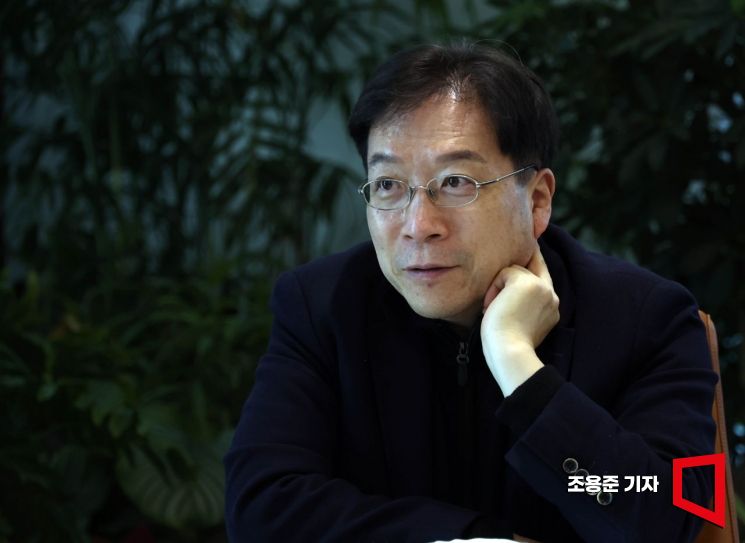 On the 26th, Kim Se-yong, President of Gyeonggi Housing and Urban Corporation (GH), is being interviewed by Asia Economy at the GH office in Suwon. Photo by Jo Yong-jun
CEO Kim is focusing not only on equity accumulation housing but also on modular housing supply for rapid housing provision. Modular housing is a building method where parts of the house are pre-fabricated in a factory and assembled on-site. The 25-story modular building construction project in Dongducheon has already passed the preliminary feasibility study and received approval from the provincial council. Kim said, "Only the construction schedule remains." He added, "I recently visited the modular housing complex in Yeongdeok, Giheung-gu, Yongin, completed in July 2023, and spoke directly with residents," reporting, "They said there was no discomfort to the extent that they could not tell the difference from conventional housing." He personally visited the site to verify quality and resident satisfaction. GH plans to introduce 11,000 modular housing units in new towns by 2030.
Discussions on senior housing are also expanding. CEO Kim said, "Growing old in a familiar neighborhood is the most emotionally stable," but "the reality is that people inevitably have to move to nursing homes or hospitals." To address this, GH plans to introduce the concept of ‘Aging in Community (AiC),’ which places nursing facilities and hospitals within housing complexes. They have also created related ordinances for senior housing development reflecting this concept in cooperation with provincial council members. Based on this, work is underway to incorporate it into new town development.
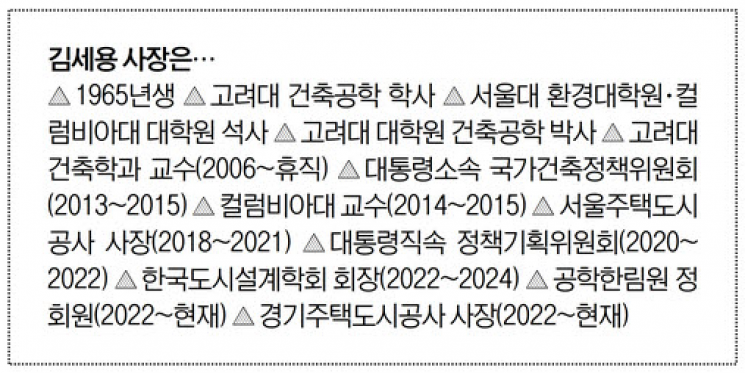
Interview by Hwang Jun-ho, Head of Construction and Real Estate Department
Compiled by Reporter Choi Seo-yoon
© The Asia Business Daily(www.asiae.co.kr). All rights reserved.
![Clutching a Stolen Dior Bag, Saying "I Hate Being Poor but Real"... The Grotesque Con of a "Human Knockoff" [Slate]](https://cwcontent.asiae.co.kr/asiaresize/183/2026021902243444107_1771435474.jpg)


















