Kim Byunghwan: Excessive Sale Prices and Supply Behind Unsold Properties
DSR Relaxation Alone Insufficient to Resolve Unsold Properties, Various Measures Under Discussion
Full Resumption of Short Selling at the End of Next Month, Market Impact Expected to Be Short-Term
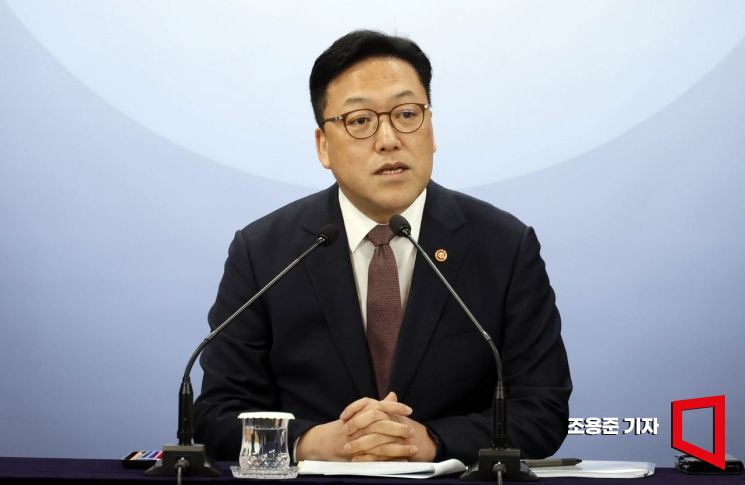 Financial Services Commission Chairman Kim Byung-hwan is speaking about recent financial issues at the monthly press briefing held at the Government Seoul Office in Jongno-gu, Seoul, on the 24th. 2025.2.24 Photo by Jo Yong-jun
Kim Byung-hwan, Chairman of the Financial Services Commission, stated that the relaxation of the Debt Service Ratio (DSR) system is unlikely to have a significant effect in revitalizing the sluggish local real estate market. He also reaffirmed the position that commercial banks should lower loan interest rates in line with the base rate cuts. Regarding the full resumption of short selling scheduled for next month, he assessed that the impact on the market would be limited.
DSR Relaxation Alone Insufficient to Resolve Unsold Properties, Various Measures Under Discussion
On the 24th, Chairman Kim held a press briefing at the Government Seoul Office in Sejong-ro and explained, "The current accumulation of unsold real estate in local areas is judged to be the result of a complex interplay between high sale prices, excessive supply, and insufficient demand."
He added, "The construction industry is a very important part of people's livelihoods, so government responses to alleviate this issue are necessary. Based on this recognition among government ministries, direct measures such as the Korea Land and Housing Corporation (LH) purchasing unsold properties have been considered."
He continued, "There have been requests from the financial sector to relax regulations like the DSR, but from the perspective of policy credibility and effectiveness, this does not seem to be an appropriate measure at this time. However, we are in the process of negotiating to allow more loan increases mainly through local banks rather than those in the metropolitan area," he emphasized.
Regarding the situation where banks are raising loan interest rates despite the Bank of Korea lowering the base rate since October last year, he responded that it is inappropriate. Chairman Kim said, "In August last year, household loans increased rapidly, and we issued messages to curb this. Banks responded by raising the spread, which led to an increase in loan interest rates. This actually contributed significantly to slowing the growth of household loans."
He added, "Loan interest rates are market prices, and it is not appropriate for financial authorities to intervene directly and strongly. However, from the perspective that market principles should operate in loan interest rates, it seems time for the base rate to be reflected in loan interest rates. In that context, the Financial Supervisory Service is inspecting whether banks' interest rate decision processes are conducted according to market principles," he stressed.
Regarding the recent rise in housing prices following the lifting of land transaction permit zones (Toheje) in some parts of Gangnam, Seoul, he acknowledged the situation and said they would monitor it further. Chairman Kim said, "Housing prices have risen slightly in areas where the Toheje was abolished, but looking at household loans, there was a decrease in January and a slight increase in February. Considering the scale of the increase, there is no cause for concern. We will maintain our current stance on household debt and continue to observe the situation," he responded.
In response to questions about the schedule for the acquisition review of Dongyang Life Insurance by Woori Financial Group, he said it is still difficult to predict when a conclusion will be reached. Chairman Kim said, "The Financial Supervisory Service is currently reviewing, and since the management evaluation grade is also being calculated, we have not yet received the results. Once we receive them, we will conduct the review. At this point, it is difficult to predict when a conclusion will be reached," he said.
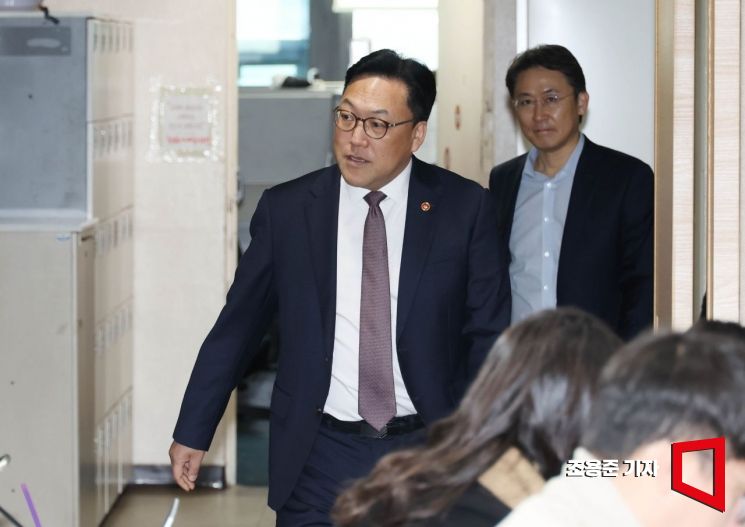 Kim Byung-hwan, Chairman of the Financial Services Commission, is attending the monthly press briefing held at the Government Seoul Office in Jongno-gu, Seoul on the 24th. 2025.2.24 Photo by Jo Yong-jun
Full Resumption of Short Selling at the End of Next Month, Market Impact Expected to Be Short-Term
Regarding the resumption of short selling scheduled for next month, Chairman Kim announced, "If there are no major issues, we plan to fully resume short selling on March 31."
He said, "We will continue to check whether the system operates stably and properly during the remaining period until March 31. Since we have been preparing for over a year, if the intended conditions are met, it is time for a full resumption." Previously, before the full ban in November 2023, short selling was only allowed for 350 stocks included in the KOSPI 200 and KOSDAQ 150 indices, but this will be expanded to all stocks.
Chairman Kim noted that the impact of the resumption of short selling on the overall domestic capital market will be "short-term," but acknowledged market concerns that short selling may concentrate on individual stocks. He explained, "To prevent excessive shocks to individual stocks, we plan to temporarily relax the criteria and requirements of the 'Short Selling Overheat Stock Designation System' for one or two months as a supplementary measure."
On the same day, Chairman Kim also mentioned the slow progress of the amendment to the Capital Markets Act aimed at protecting minority shareholders in the National Assembly. While both ruling and opposition parties agree on the broad goals of capital market value enhancement and shareholder protection, the ruling party advocates for targeted amendments through the Capital Markets Act, whereas the opposition insists on amendments to the Commercial Act that would also apply to unlisted companies. Chairman Kim said, "There are concerns from the business community and companies about the side effects of the Commercial Act amendment, so I hope the National Assembly will fully consider this. I hope there will be an opportunity for in-depth discussion on which law?Capital Markets Act or Commercial Act?can better protect general shareholders and minimize side effects from legal amendments."
Regarding the second phase of virtual asset legislation, he responded, "We will submit the second phase legislative bill to the National Assembly in the second half of the year and will speed up the process to avoid delays."
© The Asia Business Daily(www.asiae.co.kr). All rights reserved.


















