Survey of Korean Corporate Executives by EY Han Young
Consensus on the Need for Investment, but Concerns Remain
"Lack of Specialized Personnel and Uncertainty of Investment Outcomes"
More than 80% of domestic company executives show a strong willingness to invest in artificial intelligence (AI), but they are concerned about the lack of specialized personnel and the uncertainty of investment outcomes.
On the 24th, EY Han Young announced that it conducted a survey of 311 domestic company executives attending the '2025 EY Han Young New Year Economic Outlook Seminar' and obtained these results. The respondents' companies were composed of 39% with assets of 2 trillion KRW or more, 20% with assets between 500 billion KRW and less than 2 trillion KRW, and 41% with assets less than 500 billion KRW.
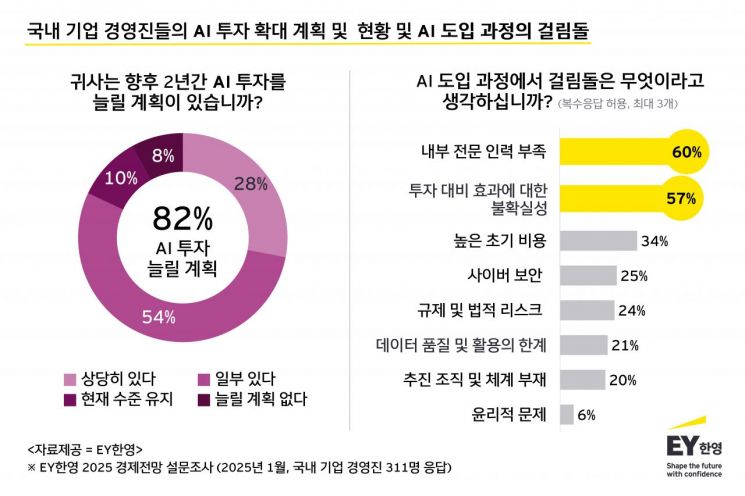
The majority of company executives showed a proactive attitude toward AI investment. 82% of all respondents said they plan to increase AI investment over the next two years, and 10% said they would maintain the current level of investment. The response rate for those with no plans to expand investment was only 8%.
Among respondents from companies with assets of 2 trillion KRW or more, 87% agreed on the necessity of AI investment. Only 5% said they had no investment plans. On the other hand, 13% of companies with assets less than 500 billion KRW responded that they had no plans to expand AI investment. Smaller companies tended to be relatively cautious about AI investment.
The biggest obstacles in the AI adoption process were identified as a lack of internal specialized personnel (60%) and uncertainty about the effectiveness of investment (57%). Other concerns included ▲high initial costs (34%) ▲cybersecurity (25%) ▲regulatory and legal risks (24%) ▲limitations in data quality and utilization (21%) ▲lack of implementation organization and system (20%) ▲ethical issues (6%) in that order.
Meanwhile, 52% of respondents said they have adopted and are utilizing AI either company-wide or in some areas, an increase of 14 percentage points compared to the previous year. 39% said they have not yet adopted AI but plan to do so in the future. Only 9% said they have no plans to adopt AI.
The larger the company, the more active the AI adoption. 73% of respondents from companies with assets of 2 trillion KRW or more have adopted AI, while only 30% of companies with assets less than 500 billion KRW have done so.
Expected benefits from AI adoption included ▲automation and operational efficiency improvement (68%) ▲improved accuracy of data analysis and prediction (64%) ▲product or service innovation (48%). AI is described as an innovative tool that enhances operational efficiency and decision-making accuracy.
Kim Jung-wook, CEO of EY Consulting, emphasized, "For AI investment to lead to expected outcomes and monetization, it is essential to set clear adoption objectives that all stakeholders within the company can agree on and to establish an AI strategy that can respond to the rapidly changing technology market."
© The Asia Business Daily(www.asiae.co.kr). All rights reserved.
![Clutching a Stolen Dior Bag, Saying "I Hate Being Poor but Real"... The Grotesque Con of a "Human Knockoff" [Slate]](https://cwcontent.asiae.co.kr/asiaresize/183/2026021902243444107_1771435474.jpg)
















