Merz, CDU Leader, Likely to Become Next Chancellor
Promises "Independence from the United States"
Expected to Pursue Strong Immigration Policies
With a shift in power to the center-right in Germany for the first time in three years, Friedrich Merz, leader of the Christian Democratic Union (CDU) and the likely next chancellor, is expected to focus on overcoming economic difficulties, blocking illegal immigration, and strengthening security as he leads the government. Foreign media noted that Germany’s next leader has changed during a turbulent time in Europe, and he is likely to become a key interlocutor for U.S. President Donald Trump in Europe. Depending on his foreign policy stance and security plans, the relationship between the U.S. and Western allies could shift.
According to the Financial Times (FT) on the 23rd (local time), exit polls from the German federal election held that day showed the center-right CDU-Christian Social Union (CSU) alliance would become the largest party, surpassing Chancellor Olaf Scholz’s Social Democratic Party (SPD) and the far-right Alternative for Germany (AfD). In the survey released at 6 p.m. by public broadcaster ARD, the CDU-CSU alliance was projected to receive 29.0% of the vote, far ahead of AfD’s 19.5% and SPD’s 16.0%. The Green Party followed with 13.5%, and The Left Party with 8.5%. The pro-business Free Democratic Party (FDP) was at 4.9%, and the populist-oriented B?ndnis Sahra Wagenknecht (BSW) at 4.7%, both expected to fall short of parliamentary representation.
The final count confirmed the projections. The center-right alliance secured 28% of the vote, solidifying its first-place position. With the CDU-CSU-led change of government virtually assured, Merz is expected to become chancellor if a coalition is successfully formed. This marks the return of a center-right government in Germany just over three years after former CDU Chancellor Angela Merkel stepped down in December 2021.
Should Merz become head of the federal government, changes are anticipated in security, foreign policy direction, and Germany’s relationship with the United States. Immediately after his election victory, Merz stated he would "achieve independence from the United States" and reclaim Germany’s voice in Europe. He also said Germany must fundamentally reform its security measures and end decades of dependence on Washington. The Financial Times reported that Germany’s next leader has changed amid Europe’s upheaval.
He is likely to become President Donald Trump’s key interlocutor in Europe. The Wall Street Journal (WSJ) evaluated that Merz’s election as chancellor would be the first step toward rebuilding more stable leadership in Europe.
Reviving Germany’s faltering economy is also a major task for the next government. Once called the engine of the European economy, Germany’s economic growth rate has contracted for two consecutive years for the first time in 21 years since 2002?2023, with -0.3% in 2023 and -0.2% last year under Chancellor Scholz. This was due to rising energy prices caused by the Ukraine war, which pushed up inflation, and the rapid growth of Chinese electric vehicles, which hurt German car sales.
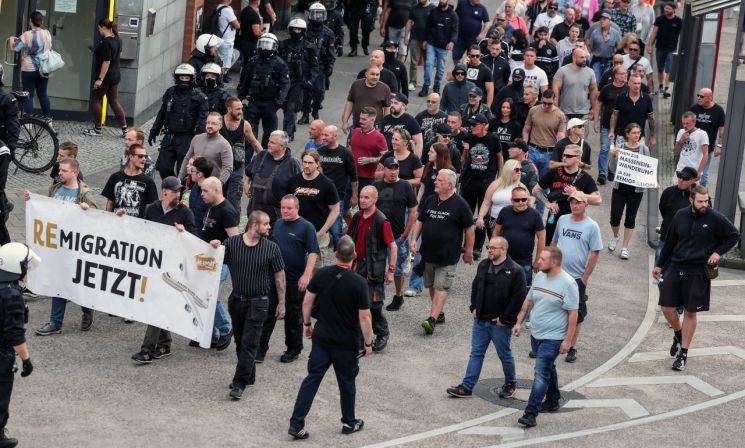
The WSJ reported that Chancellor Merz will face the enormous challenge of reviving the German economy, which barely grew even before the COVID-19 pandemic and is likely to shrink for three consecutive years. Immigration is also expected to be on the policy priority list. Merz recently promised to drastically reduce immigration to weaken the rapidly growing AfD.
Meanwhile, the New York Times (NYT) reported that the next German government is likely to form coalitions with several parties to secure a parliamentary majority, but the far-right AfD will almost certainly be excluded. This is because Germany’s mainstream parties have rejected including the AfD.
© The Asia Business Daily(www.asiae.co.kr). All rights reserved.
![Clutching a Stolen Dior Bag, Saying "I Hate Being Poor but Real"... The Grotesque Con of a "Human Knockoff" [Slate]](https://cwcontent.asiae.co.kr/asiaresize/183/2026021902243444107_1771435474.jpg)















