Optimization of Air Routes and Modular Transport Method
"Enhancing Expertise to Contribute to Globalization of K-Defense"
CJ Logistics successfully completed a defense logistics project transporting two fighter jet training equipment simulators to Poland.
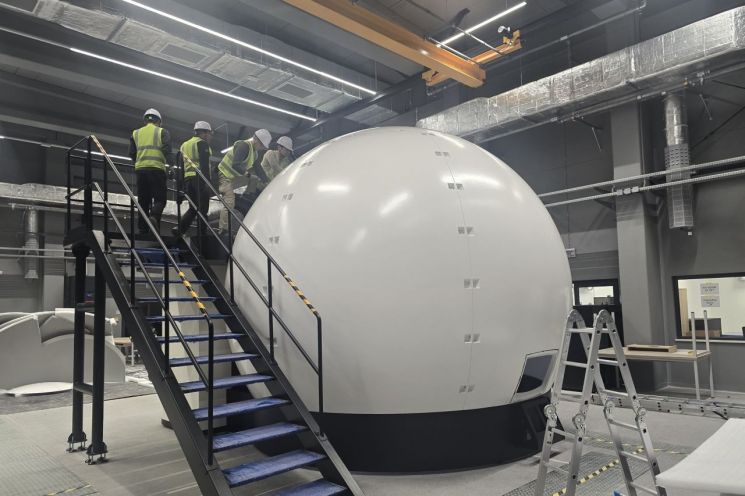 CJ Logistics is inspecting the cargo condition of the simulator transported to the Minsk Mazowiecki Air Base in Poland. Photo by CJ Logistics
According to CJ Logistics on the 24th, from December last year to January this year, over a period of five weeks, they transported one Fighter Mission Simulator (FMS) and one Operational Flight Trainer (OFT) from Korea Aerospace Industries (KAI) Goseong factory to the Minsk Mazowiecki Air Base in Poland.
Like main defense equipment such as fighter jets and tanks, training equipment simulators include precise electronic devices and complex mechanical structures, requiring extreme caution during transportation. They are particularly sensitive to external shocks and vibrations, making the risk of damage during transport high and demanding advanced logistics expertise.
To enhance transport stability, CJ Logistics applied a 'modular method' by transporting the cargo in a disassembled state to the final destination and assembling it locally. The simulators, disassembled into 35 parts, were individually packaged and transported via domestic land and air transport as well as local land transport in Poland. To minimize external shocks on the large-scale cargo weighing a total of 28 tons, 15 vibration-free vehicles were deployed for inland transport both domestically and internationally. After arrival in Poland, thorough import customs procedures were completed, followed by condition inspections and unloading operations. Subsequently, the disassembled parts were assembled to restore the final complete unit.
The air route was optimally designed considering national airspace transit regulations and security requirements. Since the simulators are classified as military goods, there were restrictions on airspace transit in some countries, so instead of a direct flight from Korea to Poland, a detour route via Vancouver, Canada was adopted. Although the transport time increased compared to a direct route, this approach demonstrated defense logistics capabilities by balancing efficiency and stability.
CJ Logistics emphasized that it has gained trust in the global defense market by utilizing route optimization technology and modular transportation methods. Last year, they successfully transported KAI’s T-50TH fighter jet, disassembled into four parts including fuselage, wings, vertical tail fin, and engine, to the Takli Air Base in Thailand. In 2022, they transported nine T-50B aircraft of the Republic of Korea Air Force’s Black Eagles aerobatic team to the international airshow held in the UK using the modular method. In addition, they have accumulated transportation experience with various defense materials such as tanks and helicopters, establishing themselves as a key partner.
Jang Young-ho, head of CJ Logistics IFS Division, said, “Based on specialized technology in defense logistics and experience accumulated through transporting various cargo, we successfully carried out the simulator transport to Poland. We will further enhance our expertise to increase competitiveness and reliability through stable logistics operations and contribute to the globalization of K-defense.”
© The Asia Business Daily(www.asiae.co.kr). All rights reserved.

















