A hybrid nano new material with enhanced uranium adsorption performance has been developed for processes such as radioactive waste management.
The Korea Atomic Energy Research Institute announced on the 24th that it has developed a nano-structured new material for uranium adsorption by bonding an organophosphorus compound (di(2-ethyl hexyl)phosphoric acid, hereafter HDEHP) to silica (SiO2), which is used as an adsorbent.
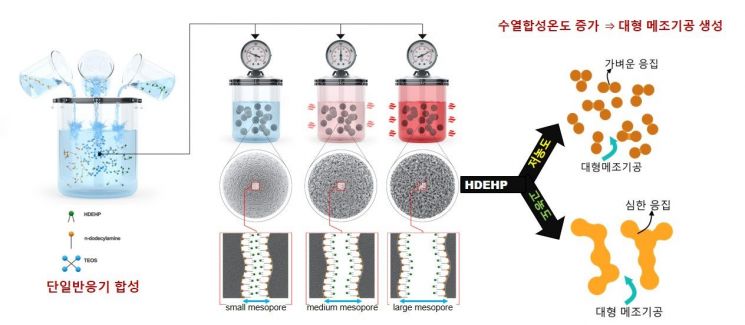 Conceptual diagram of the hybrid nano new material synthesis method developed by the research team of Dr. Kim Jong-yoon, Department of Radiochemical Technology Development, Korea Atomic Energy Research Institute. Provided by Korea Atomic Energy Research Institute
Uranium naturally dissolves in various substances and is also abundantly contained in radioactive waste, making its effective extraction and recovery important. Uranium extraction is generally carried out using adsorbents. Until now, domestic supply has depended on imports.
However, with the development of a new material with enhanced uranium adsorption performance domestically, it is expected that dependence on foreign sources can be reduced in the future.
The nano new material (uranium adsorbent) developed domestically can adsorb 136 mg of uranium per 1 g. This is at the same level as the highest-performing products currently commercialized.
In particular, this material can be synthesized through a simple process, making it economical, and it has the advantage of being environmentally friendly by drastically reducing waste due to the absence of post-treatment processes. Additionally, the Korea Atomic Energy Research Institute emphasized that the mesopore size can be freely adjusted, allowing it to be used not only as an adsorbent but also as a carrier for delivering active substances by loading them into the pores.
This research was conducted by Dr. Kim Jong-yoon’s research team at the Radiochemistry Technology Development Division of the Korea Atomic Energy Research Institute, supported by the Ministry of Science and ICT’s Nuclear Research and Development Project and the Ministry of Trade, Industry and Energy’s Nuclear Power Plant Decommissioning Competitiveness Enhancement Technology Development Project. The research results were published in the international journal Separation and Purification Technology.
Lim Sang-ho, head of the Radiochemistry Technology Development Division, stated, “The technology developed by the research team is a fundamental technology that can be used not only for uranium resource recovery and management of wastewater contaminated with radioactive materials but also in various fields such as catalysts and drug delivery materials. The research team will continue studies for large-scale production and commercialization.”
© The Asia Business Daily(www.asiae.co.kr). All rights reserved.
![Clutching a Stolen Dior Bag, Saying "I Hate Being Poor but Real"... The Grotesque Con of a "Human Knockoff" [Slate]](https://cwcontent.asiae.co.kr/asiaresize/183/2026021902243444107_1771435474.jpg)















