Various Public Transportation Policies to Bring Major Changes to Northern Gyeonggi's Transportation System
Taxi Supply Survey, Expansion of Metropolitan Bus Routes, and Transition to Quasi-Public Bus Operation
Dobongsan-Okjeong Metropolitan Railway, Okjeong-Pocheon Metropolitan Railway, and GTX-C Line Construction
Yangju City in Gyeonggi Province is implementing various transportation policies to expand public transportation infrastructure, aiming to become a fast and convenient 'future transportation hub city' in response to rapid population growth.
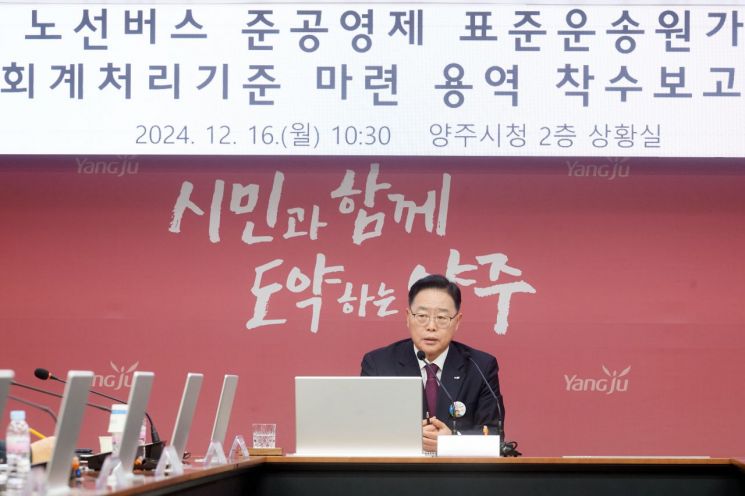 Yang Soo-hyun, Mayor of Yangju City, is giving a greeting at the commencement report meeting for the project to establish standard transportation cost calculation and accounting processing criteria for the semi-public bus system held on December 16 last year. Provided by Yangju City
According to Yangju City on the 24th, the city is promoting public transportation policies that will bring significant changes to the northern Gyeonggi transportation system, including a survey on the adequacy of taxi supply, expansion of metropolitan bus routes, conversion of route buses to quasi-public operation, and acceleration of metropolitan railway projects.
First, the city will conduct a taxi total volume system survey to analyze the adequacy of taxi supply and resolve supply-demand imbalances.
Based on the survey results, the city plans to discuss various supplementary measures such as increasing taxi licenses, improving the dispatch system, and expanding operations during late-night hours. Additionally, last month, the city proposed revisions to unreasonable parts of the taxi total volume system guidelines to the Ministry of Land, Infrastructure and Transport, resulting in the reinstatement of the calculation method exclusively for urban-rural complex cities, which had been previously removed.
The expansion of metropolitan bus routes will also be actively pursued.
The city currently operates seven metropolitan bus routes, including the recently launched Route 8300, and plans to add a new route to Jamsil starting in April, operating a total of eight routes. To minimize inconvenience for commuters during peak hours, the city has also requested an increase in the number of 'Gyeonggi-do Premium Buses.'
In the future, the city plans to expand metropolitan bus routes by establishing new routes to Seoul's Gangnam area such as Gangnam Station and Express Bus Terminal, as well as southern Gyeonggi areas like Pangyo Station and Suseo Station following the opening of the Guri-Anseong Expressway.
Alongside this, the city plans to separate part of the existing Route G1300 to serve the Samsungjai area, which currently lacks metropolitan bus service, and extend the starting point of Route 1304 to Gwangjeok-myeon.
Furthermore, to ensure the stability and public nature of bus operations, the city is promoting the conversion of route buses to a quasi-public operation system.
The 'quasi-public operation system' is a system where local governments support bus companies' operations and secure public interest. The city enacted the 'Yangju City Route Bus Quasi-Public Operation Ordinance' in December last year and is currently calculating the standard transportation cost.
In the first half of this year, 23 city buses and 5 village buses will be converted to quasi-public operation, with additional village bus conversions to be considered in the second half.
In particular, the city recently completed the 'Intelligent Transportation System (ITS) Construction Project,' promoted as a Ministry of Land, Infrastructure and Transport public contest project, and applied it to major roads, significantly improving the traffic environment.
The city applied 'smart intersections' capable of real-time traffic signal control to 24 major intersections with heavy traffic, including three sections: Goeup-dong to Gwangjeok-myeon, Yangju Station to Deokjeong Intersection, and Eunhyeon-myeon to Sangsu Intersection, as well as some sections of Okjeong New Town.
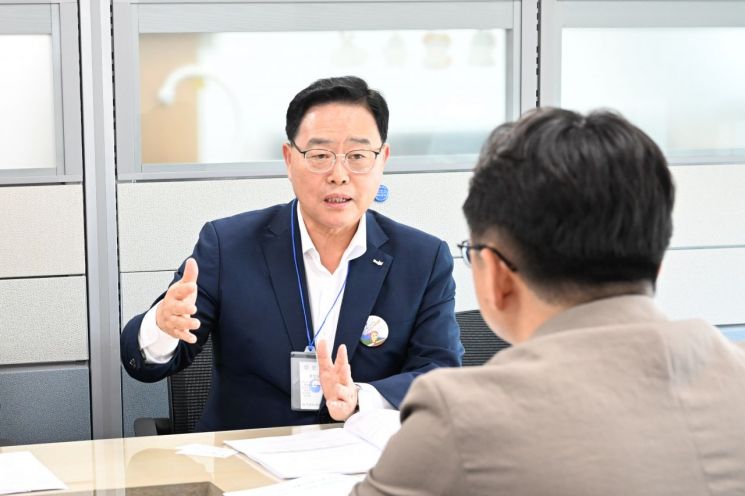
Additionally, the city established a 'metropolitan-level emergency vehicle priority signal' system to allow fire trucks and ambulances to reach their destinations quickly without being hindered by traffic signals.
Along with this, the city plans to expand traffic information CCTV, road electronic signboards, and vehicle detectors to efficiently operate the traffic signal system.
The railway network is also being steadily developed.
The Dobongsan?Okjeong metropolitan railway (extension of Subway Line 7) is a key project for expanding the northern Gyeonggi railway network, covering a total distance of 15.11 km with three stations (one renovated, two newly established).
Section 3 in Yangju began construction in December 2020, and tunnel excavation is currently underway with a progress rate of 41.61%, aiming for completion next year.
The Okjeong?Pocheon metropolitan railway project, an extension of the Dobongsan?Okjeong line, received project plan approval last December and is being promoted with a target completion year of 2030.
The Seoul Metropolitan Express Railway (GTX-C) line will connect Yangju Deokjeong to Suwon. It will have 14 stations over a total distance of 86.46 km, with a project cost of approximately 4.6 trillion KRW. Although the groundbreaking ceremony was held in January last year, actual construction has been delayed due to funding issues typical of private investment projects.
The city is conducting a preliminary feasibility study for the 'additional stop at Yangju Station' on the GTX-C line, and after forecasting transportation demand and conducting economic analysis, it plans to negotiate with relevant agencies.
This public transportation reform declared by Yangju City focuses on guaranteeing citizens' mobility rights and enhancing the city's competitiveness. In particular, by improving accessibility to Seoul and modernizing transportation infrastructure, it is expected to establish itself as a new transportation hub in northern Gyeonggi.
Additionally, the city is promoting a plan to operate shuttle trains on the Dongducheon?Yangju section (14.8 km) where increasing the frequency of the Gyeongwon Line, an extension of Subway Line 1, is difficult.
According to the current plan, three 6-car train sets will be deployed, operating up to 34 trips per day (17 trips one way). However, due to financial burdens such as facility upgrade costs (4.7 billion KRW) and annual operating costs (1.6 billion KRW), the city is negotiating with relevant ministries to secure national funding.
Mayor Kang Su-hyun stated, "The signal to open the era of 'Metropolitan Transportation Renaissance' is resoundingly ringing in Yangju," adding, "We will continue to improve transportation policies to create an environment where citizens can move conveniently and safely."
© The Asia Business Daily(www.asiae.co.kr). All rights reserved.


















