Gyeonggi Province is taking urgent measures to respond to the rapidly changing global trade environment following the launch of the second Trump administration by dispatching a 'Trade Environment Team to the U.S.' in March. It will also strengthen comprehensive crisis response consulting to minimize damage to export companies and support their return to the domestic market, expanding support through the ‘Integrated Export Difficulty Support Center’ and other channels. Furthermore, it will actively promote the expansion of export economic territories by pioneering emerging markets beyond the U.S.-centered approach.
According to Gyeonggi Province on the 23rd, the province has decided to dispatch the ‘Trade Environment Investigation Team to the U.S.’ in March, anticipating a high possibility of direct impact on major domestic export sectors such as automobiles, semiconductors, and bio industries due to the U.S.’s tariff increases.
The ‘Trade Environment Investigation Team to the U.S.,’ composed of Gyeonggi Province, the Gyeonggi FTA Trade Promotion Center, and the automobile parts industry, will visit U.S. state governments and chambers of commerce to investigate the trade environment. After building networks by meeting with domestic companies operating locally and their strategic partners, the team will provide customized consulting through local visits to automobile parts companies in the province around June.
Gyeonggi Province will also support 100 export companies affected by exchange rate fluctuations by providing insurance premium support. Exchange rate fluctuation insurance is a financial product that compensates for losses caused by exchange rate changes. The province has secured up to 2 billion KRW to fully cover the option-type exchange rate fluctuation insurance premiums for export companies (up to a limit of 20 million KRW).
General exchange rate fluctuation insurance compensates for losses or recovers profits by comparing the guaranteed exchange rate at the time of subscription with the exchange rate at maturity, which may impose a burden on companies. However, option-type exchange rate fluctuation insurance does not require companies to pay profits from exchange rate increases, thus imposing no burden on companies.
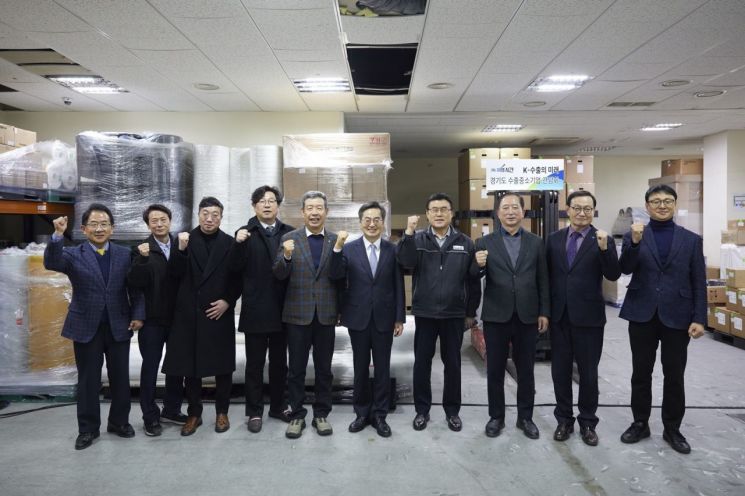 Kim Dong-yeon, Governor of Gyeonggi Province (fifth from the right), is cheering with participants at the "Gyeonggi Province Export Small and Medium Enterprise On-site Meeting" held in Gunpo on the 20th. Photo by Gyeonggi Province
Gyeonggi Province will reduce dependence on the U.S. market and diversify export markets by expanding the Gyeonggi Business Center (GBC), a comprehensive export support platform for small and medium-sized enterprises, from 19 to 25 locations, adding six new centers. In the first half of this year, GBCs will be established in Vancouver, Canada, a key country in the North American economy; Dubai, United Arab Emirates, the ‘hub of the Middle East region’; and Frankfurt, Germany, the ‘top desired European market’ for local companies. In the second half of the year, additional GBCs will be established in Dallas, U.S., Santiago, Chile, and Warsaw, Poland.
Additionally, four export consultation meetings will be held in the Middle East and other regions where new Free Trade Agreements (FTAs) are expected to take effect, supporting a total of 40 companies this year. Gyeonggi Province also plans to actively support overseas market expansion by holding the ‘Korea Excellent Products Exhibition (G-FAIR),’ its representative brand exhibition, three times a year.
To maintain the competitiveness of individual export companies, Gyeonggi Province will strengthen customized support measures and provide consulting in preparation for the implementation of the European Carbon Border Adjustment Mechanism (CBAM) and the introduction of a carbon tax in the U.S. Through this, it will support carbon emission calculations for 20 steel and automobile parts manufacturing companies and provide on-site pre-diagnosis services for 30 small and medium-sized enterprises.
Moreover, carbon emission calculation training reflecting the latest issues such as carbon tax regulation trends and changes in U.S. policies will be conducted for 350 companies. Customized consulting and practical training on actively utilizing the tariff refund system will also be provided.
In addition, Gyeonggi Province will pursue ▲ providing customized solutions for export damage cases and linking support projects through the ‘Integrated Export Difficulty Support Center,’ ▲ establishing a 24-hour rapid consultation response system both online and offline at the ‘Emergency Livelihood Economy Support Center’ within the Gyeonggi Economic Science Promotion Agency, and ▲ holding eight briefing sessions on changes in U.S. trade policies for 200 companies through the Gyeonggi FTA Trade Promotion Center, as well as supporting 75 companies with education on entering the U.S. online platform (Amazon) and marketing expenses.
Kim Dong-yeon, Governor of Gyeonggi Province, stated at a meeting with local export SMEs on the 20th, “To properly respond to the urgent changes in the trade environment, rapid elimination of uncertainty and a major shift in economic policy are prerequisites,” adding, “Gyeonggi Province will swiftly and boldly promote financial support and policy development to resolve the difficulties faced by export companies.”
© The Asia Business Daily(www.asiae.co.kr). All rights reserved.
![Clutching a Stolen Dior Bag, Saying "I Hate Being Poor but Real"... The Grotesque Con of a "Human Knockoff" [Slate]](https://cwcontent.asiae.co.kr/asiaresize/183/2026021902243444107_1771435474.jpg)















