11th Session Marks End of Impeachment Trial Arguments
Han Deok-su and Hong Jang-won Testify at 10th Session
Cabinet Meeting Procedures and 'Arrest List Memo' Discussed
Cho Ji-ho Refuses to Answer... "Will Testify in Criminal Trial"
The Constitutional Court decided to conclude the oral arguments for President Yoon Seok-yeol's impeachment trial on the 25th. This comes about 73 days after the impeachment motion was passed. Former Presidents Roh Moo-hyun and Park Geun-hye each took 50 and 81 days respectively until their final arguments, with rulings issued within two weeks thereafter. Therefore, the legal community anticipates that the ruling on President Yoon's removal will likely be made around the third week of March. At the 11th oral argument session on the 25th, comprehensive arguments from the National Assembly and President Yoon's representatives, as well as President Yoon's final statement, are scheduled. The comprehensive arguments are limited to two hours each, but there is no time limit for President Yoon's final statement.
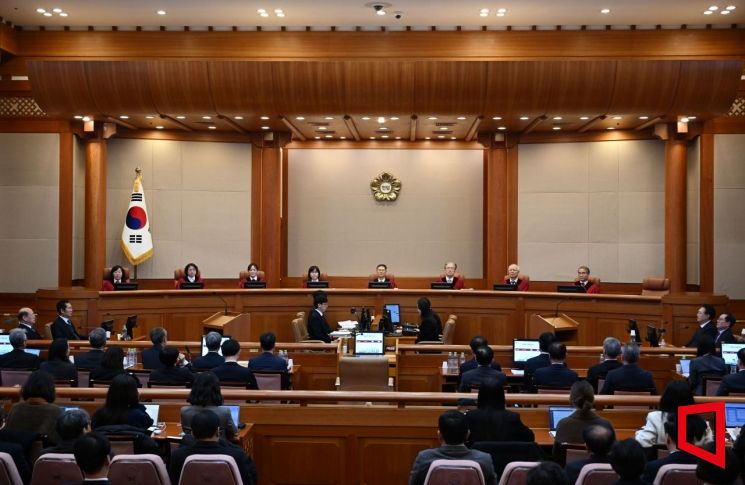 Acting Chief Justice Moon Hyung-bae and constitutional justices are seated at the 10th hearing of President Yoon's impeachment trial held on the afternoon of the 20th at the Constitutional Court in Jongno-gu, Seoul. Photo by Joint Press Corps
Han Deok-su: "It was different from a regular Cabinet meeting, and the procedures were considerably lacking"... Yoon leaves the courtroom
At the 10th oral argument on the 20th, Han Deok-su, Prime Minister, who appeared as the first witness, testified unfavorably to President Yoon, stating that the Cabinet meeting held just before the December 3 emergency martial law was not conducted according to procedure, and that not a single Cabinet member voted in favor. Previously, Han had also testified during police investigations and National Assembly government questioning that the meeting at that time was difficult to consider a formal Cabinet meeting. However, he drew a line by saying it was not appropriate for an individual to judge whether the meeting was indeed a Cabinet meeting.
Han stated, "It was different from a regular Cabinet meeting and had formal and substantive defects," adding, "When asked by investigative agencies, 'It was a briefing, not a Cabinet meeting, right?' I agreed." When asked by the National Assembly whether there were any Cabinet members who supported the declaration of martial law, he replied, "I remember everyone was worried and tried to dissuade it." President Yoon, who attended the hearing, left the courtroom after five minutes without meeting Han.
Hong Jang-won reappears with 'arrest list memo'... Yoon calls it "Hong's impeachment conspiracy"
Next, former First Deputy Director of the National Intelligence Service Hong Jang-won appeared as a witness and reiterated that he wrote down the list exactly as former Counterintelligence Commander Yeo In-hyung read it to him, along with the 'arrest list memo' he brought. President Yoon immediately claimed, "They connected my phone call with Hong to the president's arrest order and fabricated a conspiracy of rebellion and impeachment."
Hong appeared before the Constitutional Court for the second time following a witness request from President Yoon's side after the 5th oral argument session on the 4th. On this day, he explained the reason for writing the memo, saying, "I was curious why the Counterintelligence Service wanted to arrest these people during the emergency martial law period. I made it to avoid forgetting the names." However, he added that there was some confusion regarding the time and place the list was created, and that corrections were necessary.
At the end of Hong's witness examination, President Yoon, given the opportunity to state his opinion, raised his voice, saying, "When I told Hong, 'Help Yeo In-hyung,' it was a phone call of encouragement. The core issue is that they connected that to an arrest order without an object and turned it into the president's arrest order." While acknowledging that attempts to track politicians' locations during martial law were "unnecessary and wrong," he also explained that it was for 'monitoring' rather than 'arrest.'
At the same session, Police Commissioner Cho Ji-ho, who appeared as the last witness in the impeachment trial, refused to answer most questions from both the National Assembly and President Yoon's side, stating, "I am undergoing a criminal trial and cannot respond." However, in response to a National Assembly question about whether he heard about power and water cuts during a call with former Minister of the Interior and Safety Lee Sang-min, he testified, "Not at all."
© The Asia Business Daily(www.asiae.co.kr). All rights reserved.

















