Walmart’s Earnings Outlook Falls Short of Expectations, Pressuring Investor Sentiment
Jobless Claims Rise, but Employment Remains Strong
U.S. Treasury Secretary’s Remarks Push 10-Year Bond Yields Lower
The three major indices of the U.S. New York stock market were down in early trading on the 20th (local time). Overall investor sentiment weakened following a downward revision of earnings forecasts by U.S. retailer Walmart. Investors are awaiting public remarks from Federal Reserve (Fed) officials scheduled for the day.
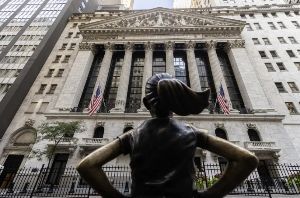
As of 9:48 a.m. in the New York stock market, the blue-chip-focused Dow Jones Industrial Average (Dow) was trading at 44,364.51, down 0.59% from the previous day. The large-cap-focused S&P 500 index was down 0.43% at 6,117.45, and the tech-heavy Nasdaq index was down 0.42% at 19,971.63.
Walmart issued a disappointing earnings outlook. Although the company reported results exceeding market expectations for the fourth quarter of fiscal year 2025, it forecasted a revenue growth rate of 3-4% for fiscal year 2026, falling short of expectations. As investors’ caution over earnings increased, buying sentiment also weakened.
Investors are focusing on U.S. President Donald Trump’s tariff policies and the Fed’s interest rate path. The previous day, President Trump said that the announcement of 25% tariffs on automobiles, semiconductors, and pharmaceuticals, originally scheduled for April 2, could be moved up to March. He also mentioned new tariffs on lumber and forestry-related imports, stating the tariff rate would be "probably 25%." The market has not been significantly shaken yet and appears to be taking a wait-and-see approach toward President Trump’s tariff policies.
The Fed reaffirmed a cautious monetary easing stance in the minutes of the January Federal Open Market Committee (FOMC) released the previous day. The minutes stated that the current policy rate is "considerably less restrictive" and that "participants indicated they want inflation to make progress before further adjusting the target range for the federal funds rate if the economy remains close to maximum employment." This implies that rate cuts will be withheld until inflation declines further. Currently, the market is pricing in about a 50% chance that the Fed will either keep rates steady throughout the year or cut rates only once.
Investors are awaiting public remarks from Fed officials scheduled for the day following the release of the January FOMC minutes. Speeches will be given by Austan Goolsbee, President of the Federal Reserve Bank of Chicago; Philip Jefferson, Fed Vice Chair; Michael Barr, Fed Vice Chair for Supervision; and Adriana Kugler, Fed Board member.
Andrew Craig, Co-Head of the Investment Insights Center at BNP Paribas Asset Management, said, "Our bond team believes the U.S. could potentially cause a supply shock that slows U.S. growth and the pace of disinflation. We assess that the Fed is unlikely to ease policy rates in a stagflation scenario."
U.S. employment data released that morning showed continued strength. According to the U.S. Department of Labor, initial jobless claims for the week of February 9-15 rose by 5,000 to 219,000, compared to the revised previous week’s figure of 214,000. Although this was 4,000 higher than market expectations of 215,000, it remains at a level similar to pre-COVID-19 times, indicating sustained robust employment.
U.S. Treasury yields were weaker, mainly in long-term bonds. The 10-year U.S. Treasury yield, a global bond yield benchmark, fell 3 basis points (1 bp = 0.01 percentage points) to 4.5% compared to the previous trading day, while the 2-year Treasury yield, sensitive to monetary policy, remained around 4.26%. This decline in the 10-year yield followed remarks by U.S. Treasury Secretary Janet Yellen in a Bloomberg interview that day. Secretary Yellen said that increasing the proportion of long-term bonds in Treasury issuance is still a distant prospect, and that government restructuring, deregulation, tax cuts, and expanded U.S. energy supply could lay the foundation for lower inflation and thus lower long-term Treasury yields.
By individual stocks, Walmart was down 6.22% after its disappointing earnings outlook. Video game platform Vimeo and used car trading platform Carvana fell 18.88% and 12.49%, respectively, after reporting earnings below expectations. Nikola, an electric truck manufacturer that filed for bankruptcy protection due to financial difficulties, dropped another 12.1% following a 39.13% plunge the previous day.
© The Asia Business Daily(www.asiae.co.kr). All rights reserved.

















