Baemin to Implement Mutually Beneficial Fee System Starting March 26,
Coupang Eats to Follow in April
Identical Commission Rates,
But Different Tier Calculation Methods
The delivery app market leaders, Baedal Minjok and Coupang Eats, are entering the final countdown to implementing the mutually beneficial fee system they agreed upon last year. The main framework remains the same: reducing the current 9.8% commission to a tiered rate ranging from 2.0% to 7.8% based on sales. However, there are differences in how the tiers are calculated and the commission rates applied to newly joined vendors. Since this is the first implementation, the industry finds it difficult to gauge which method best aligns with the purpose of the mutual cooperation council. Each company plans to listen to vendors’ feedback during the implementation process and reflect it in future operations.

According to Woowa Brothers on the 21st, Baemin vendors can currently check their tier under the mutual benefit fee system through the ‘Baemin Self-Service’. Baemin has decided to apply 7.8% for the top 35% of sales, 6.8% for those exceeding the top 35% up to 80%, and 2.0% for those exceeding 80% up to 100%, starting from the 26th. They have been informing vendors since the 19th so they can verify which tier they belong to.
Baemin’s tier calculation method is based on the average daily delivery sales of vendors who have used Baemin1 Plus at least one day within the past three months. The tiers were determined based on sales from November last year to January this year and will be applied until May. The next tier classification will be based on sales from February to April, decided in May, and applied from June to August.
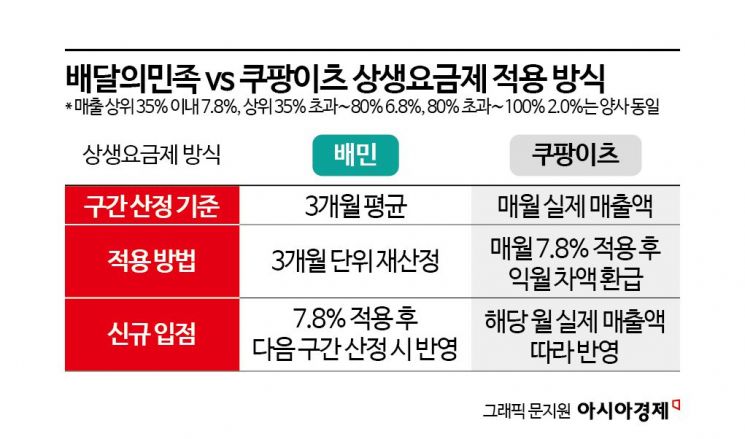
On the other hand, Coupang Eats, which will implement the same tiered fee system from April, plans to operate it as a monthly sales rebate model. Initially, a basic brokerage fee of 7.8% will be applied monthly, and the tier will be calculated based on actual monthly sales from the 1st to the end of each month, with the difference refunded the following month. This means Coupang Eats vendors will know which tier they belong to when the rebate is issued in May, one month after implementation.
The two companies also differ in how they assign tiers to newly joined vendors. Baemin applies the basic 7.8% tier initially and reflects the vendor’s tier in the next tier calculation period. However, Coupang Eats, due to its rebate system, calculates the tier based on actual sales even if the vendor joins mid-month.
Opinions within the industry, including vendors, are divided. Some say, “Coupang Eats’ post-payment rebate method is inconvenient because vendors only learn their sales including the rebate amount a month later, making it difficult to assess profits and losses.” Others criticize, “Baemin’s three-month tier calculation does not reflect a tier adjustment if sales temporarily drop in a given month.” Regarding new vendors, some argue, “Starting at the highest commission on Baemin is disadvantageous,” while others claim, “Since Coupang Eats calculates tiers based on total sales even if vendors join mid-month, existing vendors may be disadvantaged as new vendors could occupy lower tiers.”
An industry insider said, “Since commissions are the most sensitive issue between delivery platforms and vendors, each company will carefully listen to opinions during the implementation process and improve the operation method to align with the purpose of mutual cooperation.”
© The Asia Business Daily(www.asiae.co.kr). All rights reserved.
![Clutching a Stolen Dior Bag, Saying "I Hate Being Poor but Real"... The Grotesque Con of a "Human Knockoff" [Slate]](https://cwcontent.asiae.co.kr/asiaresize/183/2026021902243444107_1771435474.jpg)
















