Development of 'National Representative LLM' Through Corporate Consortium
Government to Provide Comprehensive Support for Data, GPUs, and Labor Costs
Early Operation of the National AI Computing Center
18,000 Advanced GPUs to Be Secured by First Half of Next Year
Tax Benefits for Private R&D and Investment
The government is selecting an 'AI National Representative Elite Team' among companies to develop world-class generative artificial intelligence (AI) models. Selected companies will receive support in data, computing, and research funding. The government stated, "The global AI hegemony competition has entered a new phase with the 'DeepSeek' wave," and promised "unprecedented support." On the same day, Naver unveiled the 'HyperCLOVA X Flagship Model,' emphasizing low cost and high performance.
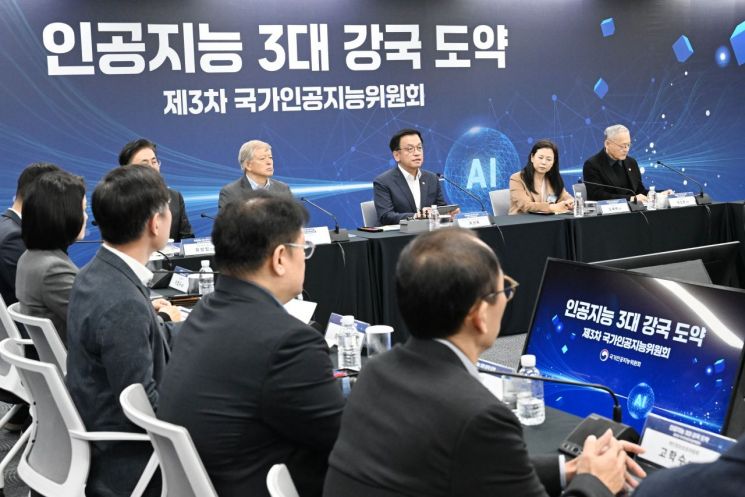
On the 20th, the government announced the 'National AI Capability Enhancement Plan' at the 3rd National AI Committee meeting chaired by Acting Prime Minister and Minister of Economy and Finance Choi Sang-mok. About 40 people from related ministries and private companies such as Naver, More, and Rhyner attended the meeting, including Acting Prime Minister Choi.
In his opening remarks, Acting Prime Minister Choi said, "We must secure independent AI model competitiveness," and added, "We will promote the AI national representative project called the ‘World Best LLM (hereinafter WBL).’" Large Language Models (LLMs) are language models trained on vast amounts of text data. OpenAI's ChatGPT service operates based on LLMs such as GPT-4.
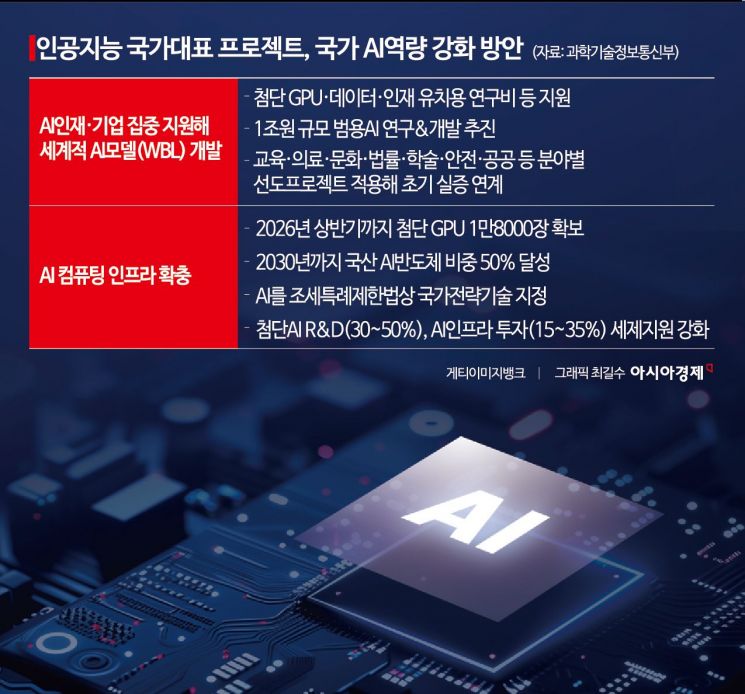
This project was established because there is a need to consolidate the dispersed LLM development capabilities of domestic companies. A Ministry of Science and ICT official explained, "Currently, companies are developing LLMs individually, but the 'each-for-themselves' approach takes considerable time to advance the models," adding, "The government will form a corporate consortium to pool resources and capital from individual companies and enhance development efficiency by providing government support for GPUs, data, and talent."
In this process, companies can either develop completely new models or upgrade existing models like LG's ExaOne. The developed models will undergo initial validation linked to government-designated leading projects such as expert work-assist AI services development or AI digital textbook dissemination. In particular, the government plans to support labor costs to reduce wage disparities with overseas markets.
For future AI competitiveness, the government will secure 10 trillion KRW worth of core foundational technologies for Artificial General Intelligence (AGI, currently undergoing preliminary feasibility study) and acquire 18,000 high-performance GPUs by the first half of next year. The plan is to secure 10,000 GPUs within the year through public-private cooperation centered on the National AI Computing Center and to operate the AI Data Center early. It is expected to cost about 800 billion KRW to acquire 10,000 units of NVIDIA's 'H100,' known as an advanced GPU. A supercomputer No. 6 with 8,000 GPUs will also be built to focus on supporting the research community. In the mid to long term, the National AI Computing Center will be fully operational, and the government aims to achieve a 50% share of domestically produced AI semiconductors by 2030.
The government will also increase tax incentives to activate private investment in AI data centers. AI will be designated as a national strategic technology under the Restriction of Special Taxation Act to support advanced AI R&D and AI infrastructure investment. According to the recently passed amendment to the Special Taxation Act by the National Assembly's Planning and Finance Committee, R&D will receive a tax credit rate of 30-50%, and investments will receive 15-35%.
Improvements will also be made to power and location-related systems. The government is considering preferential treatment for power system impact assessments for AI data centers outside the metropolitan area and discussing plans to allow centers to be located in hinterland complexes of ports or airport zones.
Public and private data will also be expanded for AI training. The government decided to extend the use of unstructured original data such as video, previously allowed only in autonomous driving, to other fields. To enable stable data use in AI research, special provisions for personal information use will be established, and the system will be improved to allow the use of personal information for developing public interest AI, such as crime prevention. Plans were also announced to build and open synthetic data for sensitive fields like medical and defense, as well as specialized data for media, industry and manufacturing, and finance.
The AI computing infrastructure secured in this way will be intensively supported for the 'AI National Representative Elite Team,' whose technological capabilities have been verified. Acting Prime Minister Choi said, "The government will provide focused support to develop world-class AI models as soon as possible and strengthen the training of core AI talent and the attraction of outstanding overseas talent," adding, "We will expand infrastructure such as computing resources and data and support AI startup cultivation and market creation to become number one in AI utilization and industrialization worldwide."
On the same day, Naver completed and internally released an update of the 'HyperCLOVA X Flagship Model,' emphasizing low cost and high performance. The new model outperformed the previous model in all areas including Korean, English, coding, and mathematics. Despite the significantly enhanced performance, it is characterized by cost savings. The number of parameters used in the new model was about 40% of the previous one, and operating costs improved by more than 50% compared to the previous model.
© The Asia Business Daily(www.asiae.co.kr). All rights reserved.



















