SPHEREx, the Next-Generation Space Telescope, to Launch on the 28th
Korea-U.S. Joint Project Marks Milestone in International Collaboration
Selected for NASA's Space Telescope Project After 20:1 Competition
Korean Research Team's Technology Recognized as World-Class
"Collaboration with Leading Global Scientists Provided Invaluable Experience"
Ambition to Build Korea's Own Space Telescope Grows
With the Launch of the Space Agency, International Cooperation Expands
Urgent Need to Increase Human and Material Resources for Global Projects
On the 28th at 12 noon, the next-generation space telescope 'SPHEREx,' developed with the Korea Astronomy and Space Science Institute (KASI) as a key participant, will be launched from the Vandenberg Space Force Base in California, USA.
SPHEREx is part of NASA's Small Explorer program (SMEX), a project led by NASA's Jet Propulsion Laboratory (JPL) and the California Institute of Technology (Caltech).
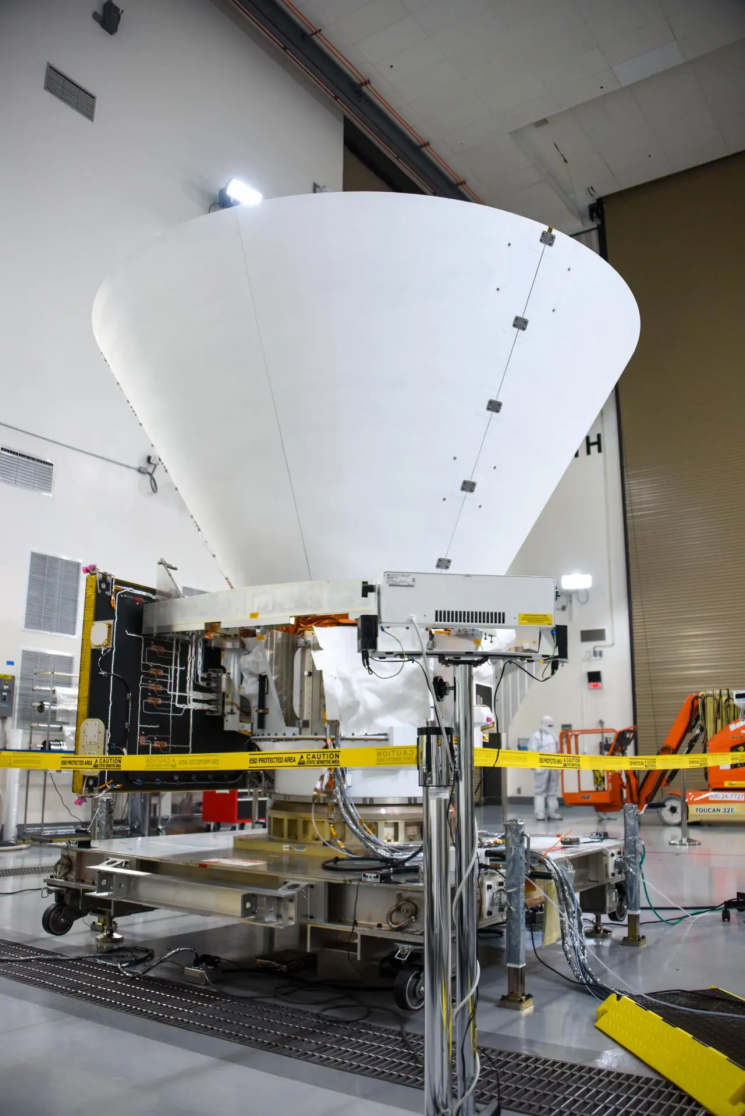 The SPHEREx space telescope is placed on a workbench ahead of pre-launch operations at the Astrotech processing facility at Vandenberg Space Force Base in California, USA. Photo by Christopher, USSF 30th Space Wing
SPHEREx is an 'all-sky infrared imaging and spectroscopic survey space telescope,' a technology developed by KASI researchers. This technology enables SPHEREx to observe infrared wavelengths that are difficult to detect from the ground. It will observe the entire sky across 102 wavelength bands, obtaining physical information on about one billion celestial objects and creating the world's first three-dimensional infrared space map.
Jung Woong-seop, the principal investigator of SPHEREx and senior researcher at KASI, said, "SPHEREx is an international collaboration in which we participated in the entire project from the planning stage," adding, "It is significant as the world's first observation of the atmospheric colors of the entire sky."
◆ Selected for NASA space telescope project after beating 20:1 competition = The noteworthy aspect here is not just the already known 'world's first' but the 'international collaboration.' The process of the KASI research team, led by Dr. Jung Woong-seop, participating in the project led by NASA JPL and Caltech was not easy.
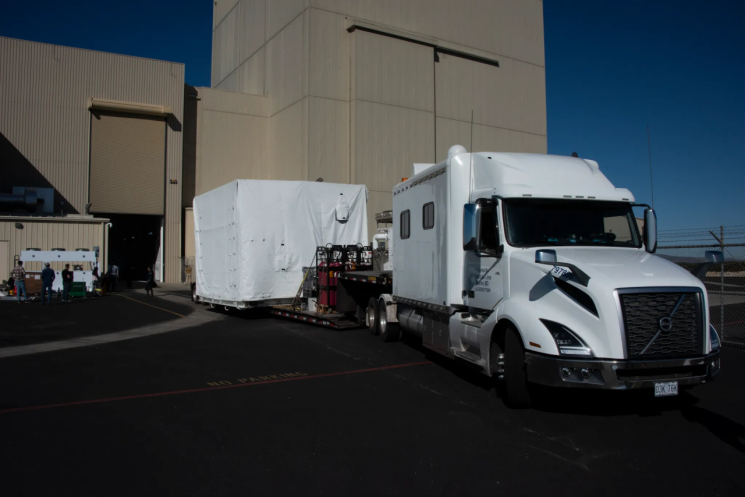 The SpearX space telescope arrived at Vandenberg Space Force Base in California, USA, on the 14th of last month. SpearX will be launched aboard the SpaceX Falcon 9 rocket. Photo by USSF 30th Space Wing/Tony Vauclin
In 2015, the SPHEREx project was initially selected as a 'small mission' research team with a budget of $242 million (approximately 346 billion KRW, excluding launch costs) by NASA, but it failed the final selection the following year.
However, the research team did not give up and re-applied in 2016 for the 'medium mission.' In 2017, they were selected among three research teams in the first round, and after the final review in 2018, KASI's 'all-sky infrared imaging and spectroscopic survey technology' was finally selected in 2019. The competition rate at that time was 20 to 1. They defeated 19 research teams composed of the world's top scholars and were evaluated as having the world's best exploration technology.
NASA solicited proposals from research teams worldwide for the mission, shortlisted the final three teams, and evaluated their research over a year before selecting the team with the best results to determine the mission's direction.
While the process of being selected as the final research team for this NASA project deserves high praise, the more valuable aspect is the intangible value that our research team learned and acquired during the project process with NASA JPL and Caltech. The Korean development team led by Principal Investigator Jung consists of 30 researchers involved in instrument development, data processing software, and scientific research.
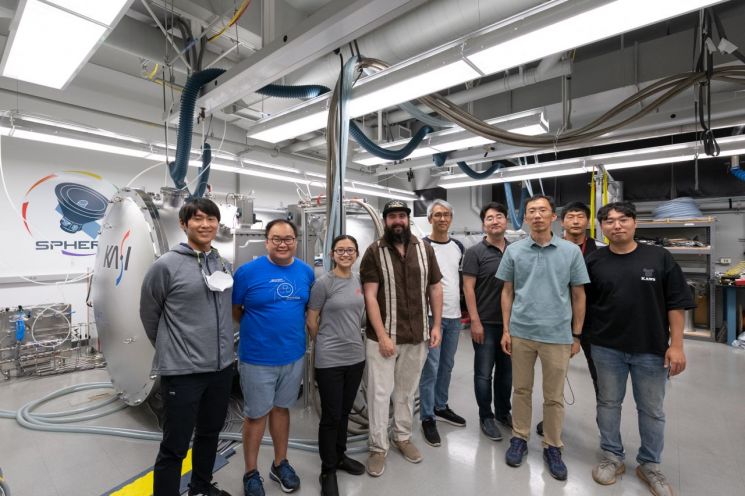 The research team from the Korea Astronomy and Space Science Institute and the research team from the California Institute of Technology in the United States, who participated in the SPHEREx project, posed together. The third person from the right is Woongseob Jeong, Principal Researcher at KASI, and the fifth person from the right is Yujin Yang, Principal Researcher. Photo by NASA/JPL-Caltech.
◆ "Researching with world-renowned scholars, learned a lot... We will build our own space telescope" = The budget allocated by the Korean government for this project is 15 billion KRW. Although this is less than one-twentieth of NASA's project budget, the scientific community evaluates that the value gained per researcher exceeds 15 billion KRW.
One of the project leaders, Yang Yoo-jin, senior researcher at KASI, emphasized, "This project can be considered excellent just based on the research outcomes. However, through nearly nine years of research with famous American and NASA scientists, world-renowned astronomers, and engineers, we have learned a great deal."
Yang said, "By working together on this project?from planning small missions, writing proposals, to preparing for subsequent research?we were able to learn many things," adding, "Based on this invaluable experience that cannot be measured in cost, I have the ambition to eventually build our own space telescope."
The background for recruiting John Lee, a former NASA official, as the head of the Space Mission Headquarters with better treatment than the agency chief likely reflects the intention to promote international cooperation as a major task of the Space Agency. In January, the Space Agency announced leading and diversifying international cooperation as one of the seven core tasks for 2025 to support global expansion.
◆ With the opening of the Space Agency, 'international cooperation' is in full swing: "Urgent need to expand human and material resources" = The institution with which the Space Agency has the closest international cooperation is NASA. In September last year, they signed the 'Joint Statement on Space and Aeronautics Cooperation between KASA and NASA' and the 'L4 Research Agreement,' and in October, they signed the 'Artemis Research Agreement,' maintaining close cooperation.
The 'L4 Research Agreement' is for joint research to explore the fourth Lagrange point (L4), considered a clue to acquiring space resources. The Artemis Research Agreement supports the Artemis Accord signed in 2021, marking Korea's foundation for playing a key role in global lunar and Mars exploration. The Artemis Accord, led by NASA in 2020, is an international agreement that sets principles and guidelines for peaceful and transparent space exploration and resource utilization.
The project that the Space Agency has been focusing on since this year is the SKAO (Square Kilometre Array Observatory) project. It is a mega international project to install about 130,000 international radio interferometer telescopes (SKA) in South Africa and Australia.
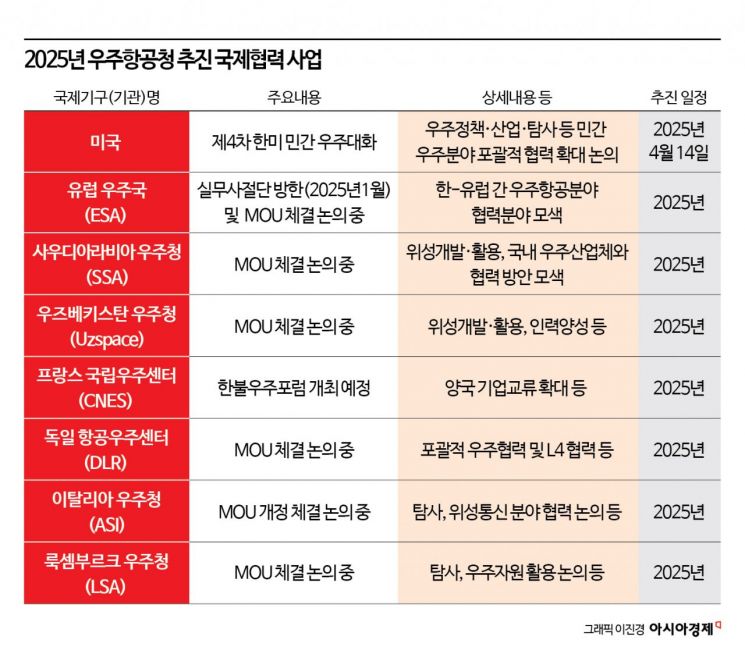
Additionally, the Space Agency continues discussions to expand cooperation frameworks with various national space agencies, including the European Space Agency (ESA), the French National Centre for Space Studies (CNES), the German Aerospace Center (DLR), the Indian Space Research Organisation (ISRO), the Italian Space Agency (ASI), the Saudi Space Agency (SSA), the Luxembourg Space Agency (LSA), and the Uzbekistan Space Agency (Uzspace).
The reason the Space Agency and the government are actively promoting international cooperation in various ways is that through role-sharing and collaboration among countries, they expect advancements in science and technology and cost reduction effects. In fact, NASA promotes space science exploration activities such as the Artemis project based on international cooperation, and ESA advances space development by sharing costs and roles among its member countries.
A Space Agency official said, "Only after the opening of the Space Agency has Korea been able to focus on the global trend of international aerospace cooperation," emphasizing, "It is a critical time to expand human and material resources to actively promote international aerospace cooperation based on the accumulated technological capabilities."
© The Asia Business Daily(www.asiae.co.kr). All rights reserved.
![Clutching a Stolen Dior Bag, Saying "I Hate Being Poor but Real"... The Grotesque Con of a "Human Knockoff" [Slate]](https://cwcontent.asiae.co.kr/asiaresize/183/2026021902243444107_1771435474.jpg)


















