Impeachment Hearing for Prime Minister Han Concludes in 90 Minutes
Constitutional Court Rejects Han Dong-hoon as Witness
Debate Over 'Impeachment Quorum' Also Wrapped Up
President Yoon Attends First Criminal Trial Preparatory Hearing
The formal hearing on the impeachment motion against Prime Minister Han Deok-su, which passed the National Assembly plenary session 54 days ago, was held on the 19th and concluded within 90 minutes.
During the hearing, the National Assembly side presented five grounds for impeachment against Prime Minister Han, stating that he should be dismissed "to uphold the constitutional order." They argued that Han merely observed the serious situation of the ongoing acts of rebellion and that his refusal to appoint three judicial candidates due to the lack of bipartisan agreement was problematic. Additionally, they claimed that Han's attempt to jointly govern with former People Power Party leader Han Dong-hoon, his evasion of appointing a permanent special prosecutor for the rebellion, and his rejection of the Kim Geon-hee special prosecutor were "unconstitutional and illegal acts."
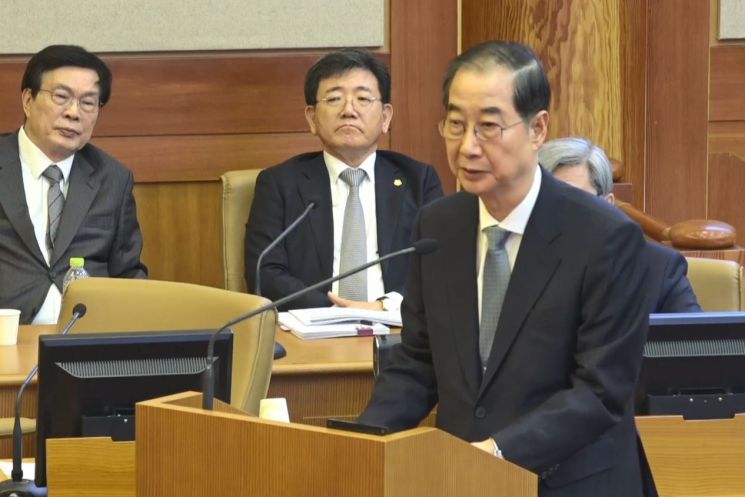 Prime Minister Han Duck-soo is speaking after attending the first hearing of the impeachment trial held at the Constitutional Court in Seoul on the 19th. Photo by Yonhap News
However, the Prime Minister's side countered, saying, "Prime Minister Han only became aware of the martial law declaration plan at 8:40 p.m. on the day of the martial law," and that "once the National Assembly passed a resolution demanding the lifting of martial law, he promptly pushed for its repeal." They also argued that "appointing judicial candidates without bipartisan agreement is unprecedented," and regarding the special prosecutor appointments and rejection of the special prosecutor law, they insisted these actions were "in accordance with procedures and granted authority."
On the same day, the Constitutional Court dismissed the National Assembly's witness request for former People Power Party leader Han Dong-hoon and also rejected the request to extend the hearing schedule, citing that the suspect interrogation records requested from the prosecution had not been received. Accordingly, the ruling on Prime Minister Han's impeachment case is expected as early as the end of February or at the latest in early March. This will conclude earlier than the anticipated ruling on President Yoon Seok-youl's impeachment trial, expected around mid-March. The Constitutional Court recently ruled on the dismissal of Broadcasting and Communications Commission Chair Lee Jin-sook's impeachment just eight days after the hearing concluded.
Whether Prime Minister Han will be dismissed depends on whether the 'grounds for impeachment' presented by the National Assembly constitute a serious enough unconstitutional or illegal act to warrant dismissal. If not, Han will immediately return to his role as acting president and prime minister upon the ruling. Hypothetically, if Han returns to office and President Yoon is dismissed, Han would be responsible for managing the early presidential election.
On the same day, the Constitutional Court also held hearings on the constitutional dispute filed by 108 People Power Party lawmakers against Speaker Woo Won-shik. Previously, on December 27 last year, Speaker Woo caused controversy by applying the quorum standard for cabinet members (a majority of 151 members) rather than the presidential standard (two-thirds of the total members, 200 or more) when passing the impeachment motion against Prime Minister Han. The People Power Party argued that since Han is acting president, the same standard as for presidential impeachment should apply.
During the hearing, Constitutional Court Justice Jeong Hyeong-sik asked Speaker Woo's side, "In such a critical situation where the quorum determines approval or rejection, why was it not handled as an agenda item first?" In response, Woo's side lawyer Noh Hee-beom said, "We received several responses interpreting the constitution that impeachment requires a majority of the total members excluding the president," adding, "Given the politically chaotic situation, it was not appropriate to make it a subject of debate."
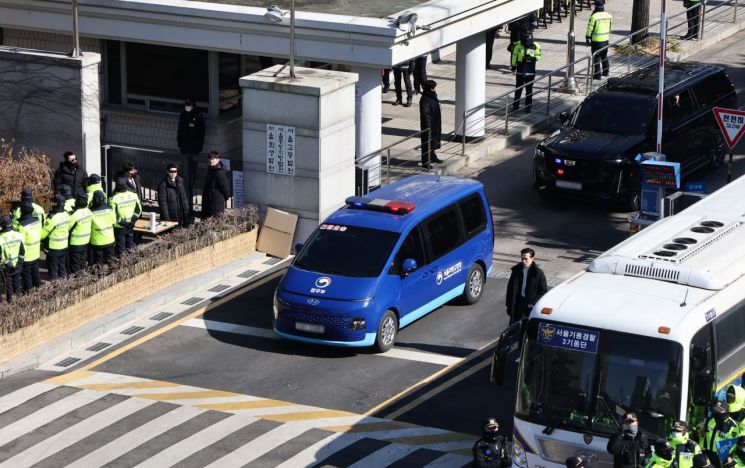 On the 20th, when President Yoon Seok-yeol's first criminal trial was held, the Ministry of Justice escort vehicle carrying President Yoon was leaving the Seoul Central District Court in Seocho-gu. Photo by Yonhap News
Meanwhile, President Yoon is scheduled to attend both the first criminal trial in the morning and the 10th hearing of the impeachment trial in the afternoon on the 20th. President Yoon, indicted on charges of rebellion, appeared at the preparatory hearing held at the Seoul Central District Court. The defendant is not obligated to attend the preparatory hearing, which sets the procedures and evidence for the upcoming trial. The 10th hearing of the impeachment trial, starting at 3 p.m., will have Prime Minister Han Deok-su testify first, followed by former National Intelligence Service First Deputy Director Hong Jang-won and Police Commissioner Cho Ji-ho. Since this hearing is likely to conclude the witness examination, a fierce battle between both sides is expected. In particular, regarding the so-called 'Hong Jang-won memo' listing politicians and others to be arrested during the emergency martial law, President Yoon's side claims it was a 'plot' by former Deputy Director Hong and the opposition, while Hong and the opposition accuse President Yoon and others of "telling blatant lies," intensifying the confrontation.
© The Asia Business Daily(www.asiae.co.kr). All rights reserved.
![Clutching a Stolen Dior Bag, Saying "I Hate Being Poor but Real"... The Grotesque Con of a "Human Knockoff" [Slate]](https://cwcontent.asiae.co.kr/asiaresize/183/2026021902243444107_1771435474.jpg)

















