Bank of Korea 'Provisional Producer Price Index for January 2025'
After rising 0.1% in November and 0.4% in December last year, up 0.6% last month
Time lag by item, but "expected to impact consumer price inflation"
Producer prices have risen for three consecutive months. Last month, prices of manufactured goods and services increased, leading to a higher rate of increase compared to the previous two months. The continuing rise in producer prices raises concerns as it could sequentially trigger an increase in consumer prices.
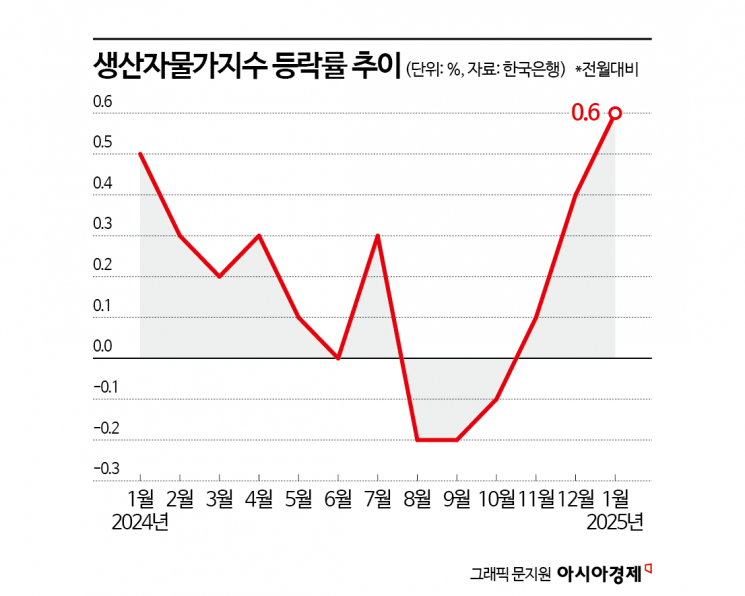
According to the 'January 2025 Producer Price Index (provisional)' released by the Bank of Korea on the 20th, the producer price index rose by 0.6% month-on-month last month. This is the largest increase since August 2023 (0.8%). The rise was driven by increases in manufactured goods (0.6%) and services (0.4%), which have high weights.
The producer price index has been on an upward trend for three consecutive months since turning positive at 0.1% in November last year after four months of decline. Following a 0.4% increase in December, it rose by 0.6% last month, showing an accelerating rate of increase. Compared to the same month last year, it rose by 1.7%, maintaining the previous month's growth rate.
Agricultural, forestry, and fishery products rose 4.0% month-on-month, led by increases in agricultural products (7.9%) and fishery products (1.4%). Reduced shipment volumes caused significant month-on-month jumps in strawberries (57.7%), tangerines (26.5%), and anchovies (13.9%), driving the rise. However, the weight of agricultural, forestry, and fishery products is relatively low at 29.5 out of 1000, so their impact on the overall index was minimal.
Manufactured goods rose 0.6% month-on-month due to increases in raw material prices such as international oil prices, with coal and petroleum products (4.0%) and primary metal products (1.2%) increasing. Electricity, gas, water, and waste services saw a rise in sewage treatment (2.8%), but industrial city gas (-2.5%) declined, resulting in no change from the previous month. Services rose 0.4% month-on-month, driven by increases in information and communication and broadcasting services (0.7%) and business support services (1.1%).
Regarding the outlook for producer prices in February, the situation needs to be monitored. Lee Moon-hee, head of the Price Statistics Team 1 at the Bank of Korea's Economic Statistics Department 1, said, "In February, international oil prices and exchange rates, which affect costs, fell somewhat compared to the previous month's average, but there is uncertainty about how much they will fluctuate until the end of February." He added, "It will depend on domestic and international economic trends and whether public utility rates are adjusted."
Meanwhile, the Domestic Supply Price Index, which measures price changes including imported goods, rose 0.6% in one month due to the impact of the won-dollar exchange rate increase. Compared to the same month last year, it rose 2.6%. Raw materials (0.7%), intermediate goods (0.5%), and final goods (0.6%) all increased.
The Total Output Price Index, which measures price changes of goods and services on a total output basis including domestic shipments and exports to capture overall price changes of domestically produced goods, rose 0.7% month-on-month last month. Compared to the same month last year, it jumped 3.4%. Manufactured goods (0.8%) and services (0.4%) increased.
The soaring producer prices in January are also expected to fuel consumer price increases. Lee said, "It is expected to affect future consumer price inflation, but the timing and extent will vary depending on the item." He added, "It may be reflected with a time lag through rising corporate production costs, and for consumer goods, it may vary depending on how discounts or margins are applied at the distribution stage."
© The Asia Business Daily(www.asiae.co.kr). All rights reserved.
![Clutching a Stolen Dior Bag, Saying "I Hate Being Poor but Real"... The Grotesque Con of a "Human Knockoff" [Slate]](https://cwcontent.asiae.co.kr/asiaresize/183/2026021902243444107_1771435474.jpg)
















