Answers Vary by Performance, Release Timing, and Payment Status
On Climate Change Causes, GPT-1 Simply Says "Greenhouse Gas Emissions"
GPT-4o Adds "Will Lead to Changes in Ecosystems and More"
'GPT-4o, DeepSeek V3, Grok3, Gemini 2.0 Pro...'
When reading articles about generative artificial intelligence (AI), you can often see a string of letters and numbers following service names like GPT, DeepSeek, Grok, and Gemini, almost like a code. These are the names of generative AI models. Just as Galaxy phones are divided into models like S25, S24, and S23, AI models that power these services come with different tags depending on their training volume, performance, and release timing. Since answers can vary depending on whether the model is a general type or inference type, or whether it is paid or free, users need to properly understand the characteristics of each model.
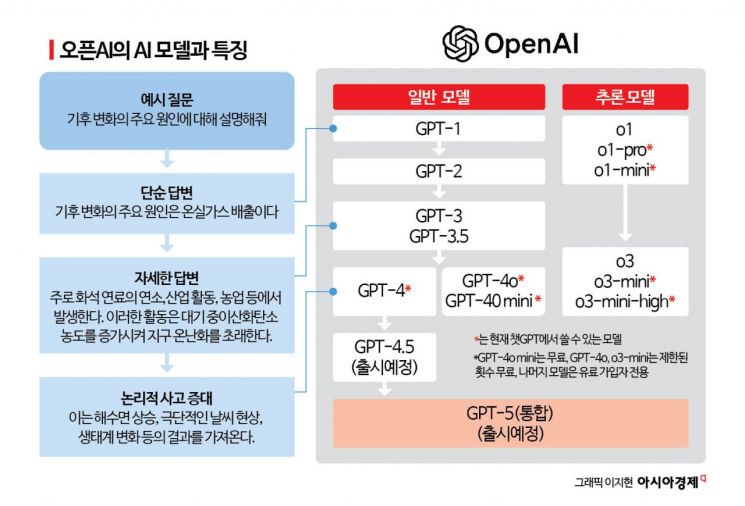
OpenAI, which shocked the world with "ChatGPT" two years ago, continues to release new versions of GPT. The initial model, GPT-1, was first created in 2018 and was a very basic language model. Since then, by increasing training data and improving algorithms, performance has been enhanced to provide longer, more accurate, and more natural responses. When ChatGPT, launched in November 2022, attracted global attention, the model was GPT-3.5.
For example, when asked "Explain the main causes of climate change," GPT-1 would respond simply with "The main cause of climate change is greenhouse gas emissions," whereas GPT-3.5 could provide a more detailed answer such as "These mainly come from the combustion of fossil fuels, industrial activities, and agriculture. These activities increase the concentration of carbon dioxide in the atmosphere, leading to global warming." GPT-4o, released last year, goes a step further by adding "This results in sea level rise, extreme weather events, and changes in ecosystems." Starting with GPT-4, users could input not only text but also images to ask questions.
Currently, free ChatGPT users have limited access to GPT-4 and GPT-4o models. The GPT-4o version can handle complex tasks requiring heavy computation or even generate images, but free users have a limited number of uses for GPT-4o. OpenAI plans to release the GPT-4.5 model as early as next month, and the next version, GPT-5, is expected within a few months.
In the second half of last year, OpenAI released inference models o1 and o3-mini and mini-high. These models are high-performance and specialized in solving complex scientific, mathematical, and coding problems, mainly used for business or research purposes. Only o3-mini is free; the others require payment.
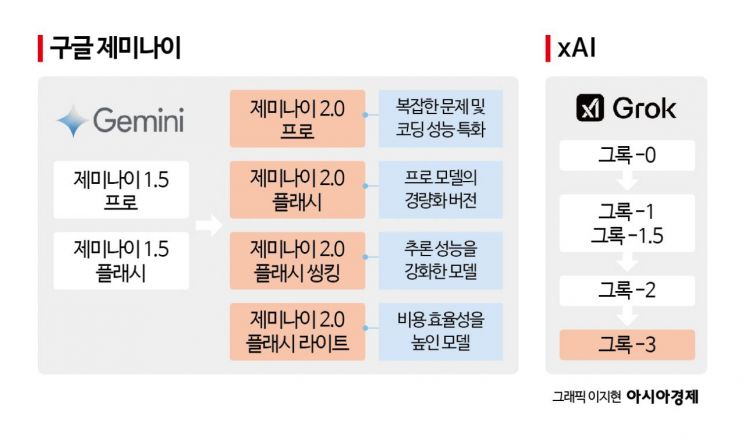
AI models with enhanced inference capabilities are also emerging in other services. DeepSeek from China, which caused the so-called "DeepSeek shock," released its latest model R1 last month. R1 is based on the previous V3 model but with improved inference capabilities, outperforming OpenAI’s inference model o1 and gaining attention. The AI startup xAI, led by Elon Musk, also has a specialized inference-enhanced version of its model "Grok3."
Google’s AI model "Gemini 2.0," unveiled earlier this month, is divided into "Pro" and "Flash." Flash is characterized by providing quick and concise answers to everyday conversations or simple questions. Pro includes analysis, inference, and creativity. For example, if asked "How is the weather in Seoul today?" Flash might respond with "Seoul is clear today with a temperature of 10 degrees," while Pro would provide details such as the minimum and maximum temperatures, humidity, wind speed, and fine dust concentration. Except for the Pro version, the other versions are available for free.
© The Asia Business Daily(www.asiae.co.kr). All rights reserved.



















