HBM to Account for 30.6% of Total DRAM Revenue by 2028
It is forecasted that the global semiconductor market size will surpass $1 trillion (approximately 1,443 trillion KRW) within the next 5 to 6 years.
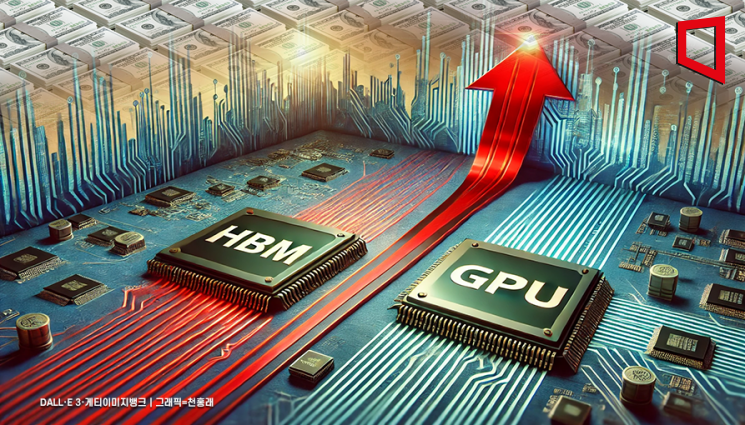
The expansion of artificial intelligence (AI) data center investments by major cloud service providers (CSPs) and the resulting increase in demand for graphics processing units (GPUs) and high-bandwidth memory (HBM) are expected to drive the market.
Gaurav Gupta, an analyst at global market research firm Gartner, stated at a press briefing held on the 19th at COEX in Gangnam-gu, Seoul, during 'Semicon Korea 2025,' "By 2030 or 2031, global semiconductor industry sales are expected to exceed $1 trillion," adding, "GPU and AI processors will lead the growth trend."
According to Gartner, the compound annual growth rate (CAGR) of the semiconductor market led by GPUs and memory (based on sales) from 2023 to 2028 is projected to be 9.4%.
The market size this year is expected to reach $705 billion, a 12.7% increase from last year's $626 billion. Analyst Gupta explained, "This year, prices will rise due to (AI memory) supply shortages, and growth in the automotive semiconductor market, including advanced driver-assistance systems (ADAS) and automotive high-performance computing (HPC), will also drive performance."
Expansion of regional investments by North American big tech companies is also a positive factor. As big tech companies compete to increase data centers, demand for AI semiconductors such as GPUs and HBM will inevitably rise.
Clark Tseng, Senior Director at the Semiconductor Equipment and Materials International (SEMI), said, "The capital expenditure of top CSPs will increase from about $80 billion in 2018 to $200 billion last year and $250 billion this year," adding, "The share of servers and data centers in the overall semiconductor market will expand to 34% by 2030."
In particular, the growth of HBM, a core component of AI semiconductors, is expected to be even more pronounced. Analyst Gupta said, "HBM will continue to attract significant attention this year," and "By 2028, HBM will account for 30.6% of the total DRAM market, and as technologies mature among major suppliers such as Samsung Electronics and SK Hynix, the focus will be on improving yield."
He added, "(With technological maturity) the number of HBM layers is expected to increase from 8 layers to 16 layers, and eventually up to 20 layers." While memory prices such as DRAM and NAND have been declining until the first quarter of this year, they are expected to gradually rise from the second half of the year.
Analyst Gupta noted, "In the case of NAND, prices will fall in the first quarter due to reduced demand for PCs and smartphones, but prices will recover in the second half as supply decreases," adding, "DRAM is in a similar situation." Due to oversupply, NAND prices have continued to decline, and global memory suppliers have recently started reducing NAND production.
Director Tseng also said, "Memory prices are expected to face headwinds in the first quarter of this year," but "recovery will occur over the third and fourth quarters." Regarding the foundry (semiconductor contract manufacturing) market, overall growth is expected, but Taiwan's TSMC, the industry leader, is anticipated to maintain its dominance.
Director Tseng forecasted, "Foundry companies are increasing sales by strengthening advanced packaging, and capital expenditures will continue to rise until 2026," adding, "While TSMC, Intel, and Samsung Electronics are advanced foundry companies, difficulties will persist for all except TSMC."
© The Asia Business Daily(www.asiae.co.kr). All rights reserved.
![Clutching a Stolen Dior Bag, Saying "I Hate Being Poor but Real"... The Grotesque Con of a "Human Knockoff" [Slate]](https://cwcontent.asiae.co.kr/asiaresize/183/2026021902243444107_1771435474.jpg)















