Attorney Cho Daehyun Protests and Walks Out
During the 12·3 emergency martial law, prosecution investigation records revealing that President Yoon Seok-yeol instructed Police Chief Jo Ji-ho to 'arrest the members of the National Assembly' were disclosed at the impeachment trial held at the Constitutional Court.
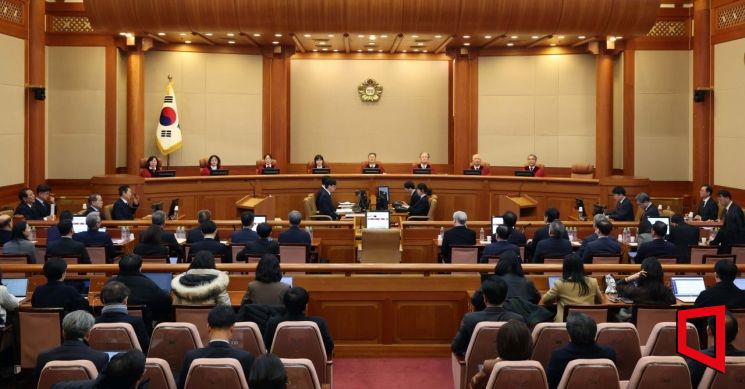 Presiding Justice Moon Hyung-bae, Acting Chief Justice of the Constitutional Court, along with other justices, are attending the 9th hearing of President Yoon Seok-yeol's impeachment trial held at the Constitutional Court in Jongno-gu, Seoul on February 18, 2025. Photo by Joint Press Corps
On the afternoon of the 18th, the National Assembly side revealed part of Police Chief Jo's suspect interrogation record (suspect interrogation record) as 'evidence to prove the grounds for impeachment' during the 9th hearing of President Yoon's impeachment trial at the Constitutional Court.
Police Chief Jo testified to the investigative agency, "When I answered the phone, the President said to me, 'Chief Jo! Arrest all the members of the National Assembly entering the National Assembly. Arrest them. It's illegal,'" adding, "The following five calls contained the same content. I felt the President was very urgent."
Chief Jo stated that he received a total of six calls from President Yoon with this content from around 11:30 p.m. on December 3 last year until 1:03 a.m. the next day.
He testified that former Counterintelligence Commander Yeo In-hyung named 15 people, including Lee Jae-myung, leader of the Democratic Party of Korea, Woo Won-shik, Speaker of the National Assembly, and Judge Kim Dong-hyun, during the first call at the time of martial law, and in the second call said, "Han Dong-hoon (former leader of the People Power Party) is an addition."
The National Assembly side also disclosed former Commander Yeo's testimony. He said in a military prosecution investigation, "It is true that I first heard from the minister immediately after the emergency martial law that 14 people had to be specifically arrested," and "(The President) did say that if emergency measures were used, action should be taken against these people."
The National Assembly side added the testimony of former First Deputy Director of the National Intelligence Service Hong Jang-won, arguing, "The list of people to be arrested almost matches," and "The existence of the list of people to be arrested and the fact that there was an arrest order for the targets are sufficiently supported by evidence."
Investigation records of the Cabinet members regarding the Cabinet meeting before the declaration of martial law were also disclosed at the Constitutional Court that day. Minister of Justice Park Seong-jae stated in his testimony record, "It was a meeting without a beginning or an end, so there is a theory whether it can be considered a Cabinet meeting deliberation."
Prime Minister Han Deok-soo said, "It was more like a gathering than a meeting, except that people gathered," and "All Cabinet members were worried and opposed," while Acting Prime Minister and Minister of Economy and Finance Choi Sang-mok testified, "There was no start or end to the meeting itself," and "I still do not consider it a Cabinet meeting," as recorded in the testimony.
When the National Assembly side presented the investigation records and made a statement during the hearing that day, President Yoon's side strongly protested.
Attorney Cho Dae-hyun, a former Constitutional Court justice, interrupted the National Assembly side's statement by saying, "Objection," stood up, and said, "It violates the law (Criminal Procedure Act) to investigate as evidence a suspect interrogation record that was not presented as a witness in court and whose credibility cannot be impeached by cross-examination from the respondent (President Yoon) side," and requested, "Please exclude it from evidence investigation."
Attorney Cho said, "If the content of such interrogation records is also investigated as evidence, it will be difficult to avoid criticism that evidence inadmissible in criminal trial procedures was used as evidence in the impeachment trial procedure."
Acting Chief Justice Moon Hyung-bae of the Constitutional Court responded, "The court's decision to admit the evidence was already made at the 4th hearing," and "I think this objection is out of time, and the court has already expressed its opinion on this matter more than twice," rejecting the objection.
Attorney Cho protested again, saying, "There is no evidentiary value in the content, so it cannot be investigated as evidence," but Acting Chief Justice Moon told the National Assembly side, "Please continue," and proceeded with the hearing as scheduled. Attorney Cho left the courtroom with his bag and did not return until the hearing ended around 6:40 p.m.
After the hearing, President Yoon's lawyer Yoon Gap-geun explained to reporters, "Attorney Cho left because he said he could not participate in a constitutional trial where the rules of evidence are not applied and the law is blatantly violated."
During the hearing that day, President Yoon's side argued that considering Police Chief Jo did not issue arrest orders to his subordinates despite receiving orders from President Yoon, his testimony to the investigative agency cannot be trusted.
President Yoon's side has continuously opposed the use of suspect interrogation records from investigative agencies as evidence in the constitutional trial. Since the 2020 amendment to the Criminal Procedure Act, co-defendants' suspect interrogation records cannot be used as evidence in criminal trials unless admitted by the defendant. The impeachment trial is conducted by applying the Criminal Procedure Act. However, under the Constitutional Court Act, the scope of application is limited to 'the extent that does not contradict the nature of constitutional trials,' so the Constitutional Court holds the position that there is no problem in using investigative agency records as evidence.
© The Asia Business Daily(www.asiae.co.kr). All rights reserved.
![Clutching a Stolen Dior Bag, Saying "I Hate Being Poor but Real"... The Grotesque Con of a "Human Knockoff" [Slate]](https://cwcontent.asiae.co.kr/asiaresize/183/2026021902243444107_1771435474.jpg)











