About 20,958 Fewer Patients Received Transfusions at Tertiary Hospitals from February to July Last Year, Says Assembly Member Kim Yoon
Only 4,755 More Patients Received Transfusions at General Hospitals During the Same Period
Due to the collective resignation of residents, the number of medical staff at tertiary hospitals has decreased, resulting in approximately 22,200 fewer transfusions from February to July last year compared to the same period the previous year. It is estimated that the number of transfusions decreased as surgeries and treatments for patients with severe diseases were reduced or delayed due to the medical vacuum.
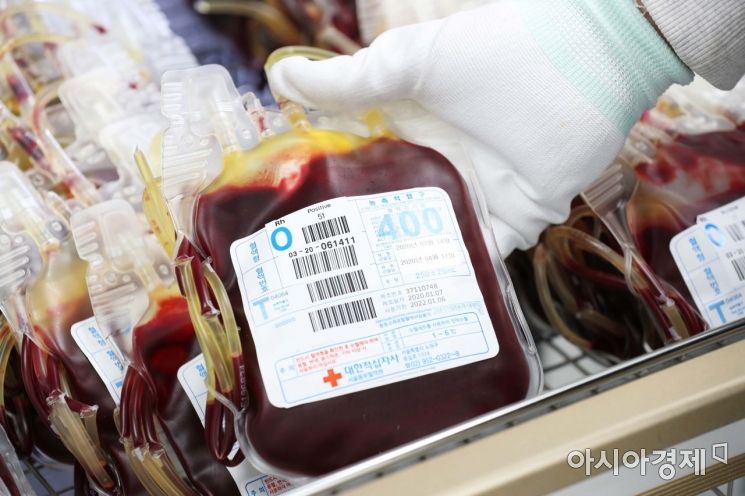 The blood supply shortage caused by COVID-19 is gradually improving thanks to the continuous interest and participation of citizens. As of midnight on the 17th, the blood stock was sufficient for 5.1 days. The usual adequate blood stock is five days. An employee at the Seoul East Blood Center of the Korean Red Cross is organizing the blood storage refrigerator. Blood donation is an act of sharing love together. Photo by Moon Honam munonam@
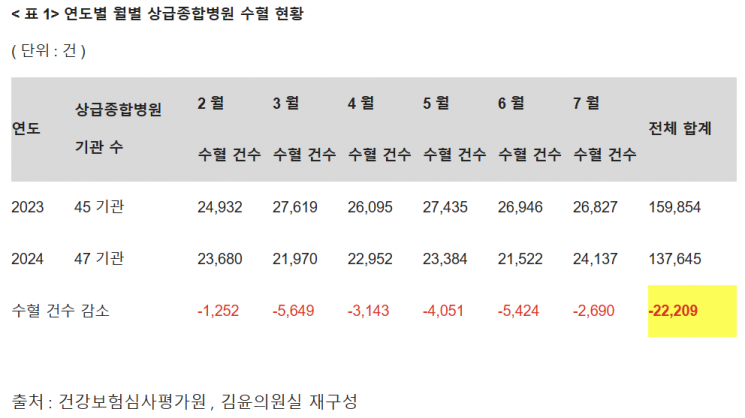
According to data submitted by the Health Insurance Review and Assessment Service (HIRA) to Kim Yoon, a member of the National Assembly's Health and Welfare Committee from the Democratic Party of Korea, the total number of whole blood and blood component usage cases at tertiary hospitals nationwide from February to July last year was 137,645.
This figure represents a 13.9% (22,209 cases) decrease compared to 159,854 cases during the same period the previous year. Whole blood refers to donated blood in its entirety, while blood components use only parts of the blood such as red blood cells and platelets.
Of the 22,209 fewer transfusions, 12,578 occurred in the metropolitan area. Among these, 66.5% (8,364 cases) were concentrated in the so-called 'Big 5' hospitals?Seoul National University, Seoul Asan, Samsung Seoul, Seoul St. Mary's, and Severance?which are highly frequented by patients.
The government believes that patients who could not receive treatment or care at tertiary hospitals due to the medical crisis likely moved to general hospitals. However, according to HIRA data, the total number of whole blood and blood component usage cases at general hospitals nationwide from February to July 2024 was 138,198, only a 2.9% (3,847 cases) increase compared to 134,351 cases in the same period the previous year. This accounts for only 17.3% of the decrease in transfusions at tertiary hospitals.
The decrease in blood product usage can be interpreted as a reduction in surgeries and treatments for patients with severe diseases. Looking at the top 20 frequently claimed diseases along with whole blood and blood component fees at HIRA, transfusions are necessary for treating diseases such as myelodysplastic syndrome, myeloid and lymphoid leukemia, multiple myeloma, lung cancer, and pancreatic cancer. These are mostly severe diseases requiring prompt treatment.
The bigger issue is that patients who decreased at tertiary hospitals may not have received appropriate surgeries and treatments. From February to July 2024, the number of patients receiving whole blood and blood components at tertiary hospitals nationwide decreased by 20,958, while the number of patients receiving transfusions at general hospitals increased by 4,755 during the same period. The office of the assembly member claims that it is highly likely that 16,203 patients did not receive surgeries and treatments.
Assembly member Kim Yoon stated, "The decrease in transfusions, which are essential for surgeries and treatments of patients with severe diseases, means there is a greater possibility of delays in their surgeries or treatments," and added, "Despite the prolonged medical crisis causing increasing harm such as delays in surgeries and treatments for patients with severe diseases, the government has not even accurately grasped the situation."
© The Asia Business Daily(www.asiae.co.kr). All rights reserved.
![Clutching a Stolen Dior Bag, Saying "I Hate Being Poor but Real"... The Grotesque Con of a "Human Knockoff" [Slate]](https://cwcontent.asiae.co.kr/asiaresize/183/2026021902243444107_1771435474.jpg)
















