'Pan-Ministerial Emergency Export Measures' Announced at Export Strategy Meeting
Reducing Uncertainties Through Provision of Tariff-Related Information
Record-High Financial Support to Secure Corporate Liquidity
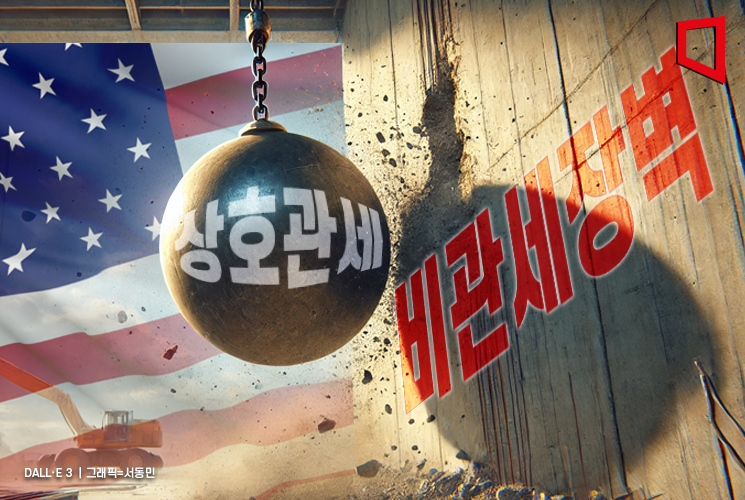
The government has announced emergency export measures to reduce uncertainties amid expanding external export risks due to tariffs following the launch of the second Trump administration.
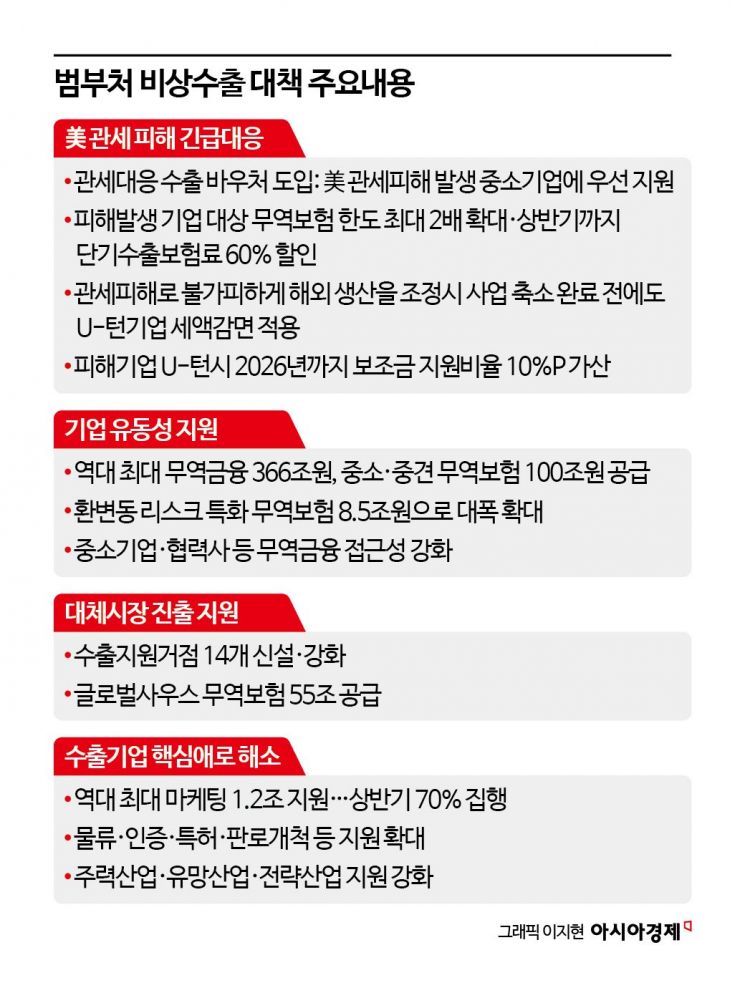
First, to provide accurate information on U.S. tariff measures, an export voucher program will be introduced to support small and medium-sized enterprises (SMEs) and mid-sized companies in analyzing damages caused by U.S. tariffs and preparing countermeasures. Additionally, companies affected by tariffs will have their trade insurance limits increased up to twice the current amount, and short-term export insurance premiums will be discounted by 60% to compensate for unpaid export payments.
On the 18th, the government held the 6th Export Strategy Meeting at the Government Seoul Office, chaired by Choi Sang-mok, Acting Prime Minister and Minister of Strategy and Finance, where it announced the 'Pan-Ministerial Emergency Export Measures' containing these details.
Last year, exports reached a record high of $683.7 billion. The trade balance also recorded a surplus of $51.6 billion, the largest since 2018 ($69.7 billion).
However, export conditions this year are challenging. The U.S. government's repeated tariff announcements have raised concerns about a global tariff war, which would inevitably negatively impact Korean companies' exports if it escalates. Furthermore, ongoing high interest rates and exchange rate uncertainties, along with volatility in maritime freight rates, raise concerns about liquidity crunches and deteriorating price competitiveness for Korean exporters. Due to these factors, the government expects exports this year to follow a 'low in the first half, high in the second half' trend, worrying about price declines in key export items such as semiconductors and reduced import demand in major markets.
An official from the Ministry of Strategy and Finance explained, "There is a high risk that a global tariff war will intensify due to the new U.S. administration's tariff measures. This plan proactively addresses the difficulties faced by companies concerned about tariff damages, includes unprecedented financial support to secure corporate liquidity, and provides support measures to secure alternative markets."
◆Focused Support for Tariff-Affected Companies= The government will strengthen consulting, trade insurance, and reshoring support for companies at risk of damage from U.S. tariffs and major countries' protectionist trade measures.
To support companies affected by tariffs, a 'Tariff Response Export Voucher' will be introduced to assist SMEs and mid-sized exporters at risk of tariff damage. Through 20 trade office help desks in the U.S., Mexico, Canada, and other countries, consulting packages will be provided for damage analysis, response strategies, and alternative market exploration in cooperation with local partners.
For companies affected by U.S. tariffs, preferential trade insurance will be offered. Trade insurance limits will be expanded up to twice for companies suffering damage due to tariffs and trade barriers in sectors such as home appliances, automobiles and parts, and secondary batteries. Additionally, SMEs and mid-sized companies affected will receive a 60% discount on short-term export insurance premiums until the first half of the year.
Special support will also be provided for reshoring companies affected by tariffs. Companies that inevitably adjust overseas production due to tariff damage will receive reductions in corporate tax, income tax, and tariffs when returning to Korea even before completing the reduction of overseas operations. Furthermore, tariff-affected companies will be exempted from overseas business restructuring (liquidation, transfer, reduction) requirements for reshoring subsidies until 2026, and companies recognized as damaged by tariff measures will receive a temporary 10 percentage point increase in support rates when returning domestically until 2026.
◆Support for Securing Liquidity through Trade Finance= To secure short-term liquidity, the government will supply a record-high 366 trillion won in trade finance and 100 trillion won in trade insurance for SMEs and mid-sized companies. Until the first half of this year, SMEs and mid-sized companies will receive a uniform 50% discount on Korea Trade Insurance Corporation premiums and guarantees, and 35,000 companies with annual export performance under $1 million will receive a special 90% discount on short-term export insurance premiums. Support for mid-sized companies will also be strengthened to ensure sufficient export funds for early-stage exporters with low past export performance and companies with rapid export growth over a short period.
Trade finance specialized for exchange rate risk will also be supplied at 8.05 trillion won. To ensure no disruption in the import of key raw materials, 4 trillion won in import loan guarantees will be provided (2.9 trillion won in 2024), expanding the target items to all except luxury goods, and temporarily doubling the guarantee limit until the first half of this year.
To expand trade finance accessibility for SMEs, mid-sized companies, small business owners, and partner companies, the supply of 'Export Package Preferential Guarantees' supporting production funds, early cash conversion of export receivables, and import funds through commercial banks will be increased to 2 trillion won.
◆Support for Exploring New Export Routes in Response to Protectionism= The government recognizes the need to explore new export routes in response to protectionism in major markets such as the U.S. and China and will actively support market development for alternative markets like the Global South. To proactively support market development in the Global South, 14 overseas bases of export support organizations (KOTRA, Korea International Trade Association, Korea Trade Insurance Corporation) will be newly established or strengthened, and the short-term insurance limit for high-quality importers in the Global South will be tripled.
The government will also support discovering new export opportunities linked to trade cooperation and projects. ASEAN (Association of Southeast Asian Nations) will be developed as the next-generation export market for advanced industries and consumer goods amid global trade disputes; India will receive support for export and order acquisition through non-tariff barrier responses and development cooperation; and the Middle East will be supported in strengthening new industry cooperation and securing large-scale projects.
Alongside this, the government will provide a record-high 1.2 trillion won for export marketing, with 70% of the support amount to be executed in the first half of the year. It will also proactively build infrastructure to respond to logistics expansion toward alternative markets. For promising alternative markets such as South Asia and Latin America, where there is a shortage of vessels, temporary ships will be deployed in case of logistics congestion, and dedicated logistics organizations will be established domestically and abroad to strengthen logistics-related functions.
© The Asia Business Daily(www.asiae.co.kr). All rights reserved.


















