Oh Jinwoo’s Team Precisely Detects Nitrate Nitrogen Using a Transition Metal-Based Colorimetric Sensor Array
Detects in Seawater and Groundwater Without Complex Pretreatment for Water Quality and Pollution Monitoring
Busan National University (President Choi Jae-won) announced on the 18th that Professor Oh Jin-woo’s research team from the Department of Nano Energy Engineering has developed a technology capable of detecting nitrate nitrogen, which causes water pollution, on-site without any pretreatment process.
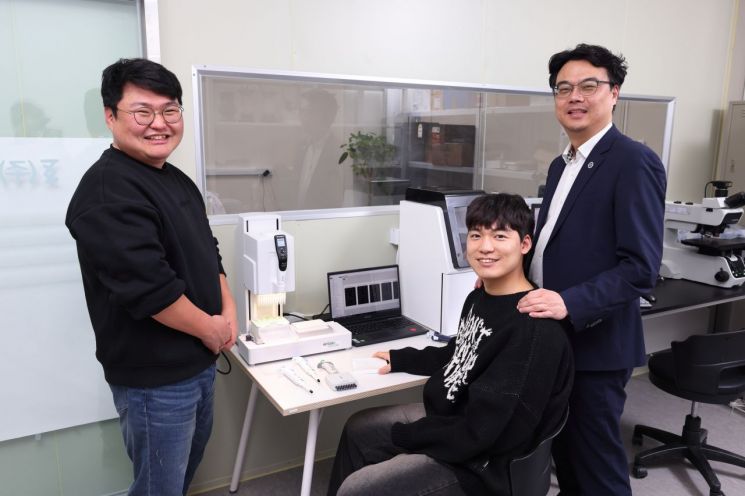 From the left, Dr. Jeong Taeyoung, PhD candidate Lee Jeonggeun, Professor Oh Jinwoo. Provided by Pusan National University
'Nitrate nitrogen (NO₃-N)' is one of the main causes of eutrophication, a phenomenon where excessive nutrients such as nitrogen and phosphorus are supplied to water bodies, causing excessive growth of plankton and aquatic plants. As its concentration increases, it causes an imbalance in the nitrogen cycle and disrupts ecosystems. This can lead to reduced growth rates in farmed fish, potentially causing large-scale die-offs. When ingested by infants, it can also pose risks such as methemoglobinemia (blue baby syndrome).
Various technologies have been developed to monitor nitrate nitrogen, but since nitrate nitrogen itself is thermodynamically stable, it is difficult to detect using conventional chemical methods, making pretreatment processes essential. Additionally, interference from various minerals can significantly reduce measurement accuracy, and existing measurement methods take a long time, lacking the capability for real-time quantitative analysis. This has highlighted the need for new sensor technologies.
In this study, a sensor capable of measuring nitrate nitrogen concentration in real time was developed using a transition metal-based colorimetric sensor. Unlike existing methods that rely on chemical analysis, this sensor measures nitrate nitrogen concentration through color changes, offering high practicality.
A colorimetric sensor is a sensor that operates on the principle of color change caused by a chemical reaction with a specific substance.
To achieve this, transition metals from the 4th period (Mn, V, Fe, Co, Cr, Cu, Ni) were mixed with solvents and additives in specific ratios, and the sensor’s color changes were measured over time. Sensors exhibiting color changes that increased linearly with nitrate nitrogen concentration were selected and combined. To verify sensor performance, hierarchical cluster analysis and compositional analysis were conducted based on color change data to evaluate the sensor’s capabilities. The use of time-dependent color change data, rather than simple color change alone, distinguishes this sensor from other colorimetric sensors.
The 4th period transition metals belong to the group of transition metal elements in the 4th period of the periodic table (elements 21 to 30), including Sc (Scandium), Ti (Titanium), V (Vanadium), Cr (Chromium), Mn (Manganese), Fe (Iron), Co (Cobalt), Ni (Nickel), Cu (Copper), and Zn (Zinc). These metals can exist in multiple oxidation states, exhibiting color-changing properties, and play important roles in catalytic actions and redox reactions. Their excellent ability to form coordination compounds makes them useful in chemical sensors, catalysts, and metalloproteins.
The research team also constructed a large-scale dataset of color change patterns and developed an expandable selective sensor system capable of detecting not only nitrate nitrogen but also major pollutants in seawater and groundwater. By applying machine learning-based pattern analysis, there is potential to evolve this into next-generation field diagnostic technology capable of simultaneously analyzing various pollutants.
Professor Oh Jin-woo of Busan National University stated, “This study developed a system that precisely detects nitrate nitrogen using a transition metal-based colorimetric sensor array. It can rapidly detect nitrate nitrogen in seawater and groundwater without the complex pretreatment processes of conventional chemical analysis methods, and is expected to be utilized in future water quality monitoring and environmental pollution detection technologies.”
The paper on the development of this technology, which effectively detects nitrate nitrogen without pretreatment using a transition metal-based colorimetric sensor array, was published in the February 2 issue of the international journal 'ACS Sensors.'
This research was conducted with Professor Oh Jin-woo of Busan National University’s Department of Nano Energy Engineering and Dr. Jung Tae-young of the Nano-Bio Convergence Research Institute as corresponding authors, and doctoral student Lee Jung-geun from the Department of Nano Convergence Technology as the first author. It was supported by the Korea Institute of Marine Science & Technology Promotion (KIMST) funded by the Ministry of Oceans and Fisheries, and by the National Research Foundation IRC (Innovation Research Center) project research funds funded by the Ministry of Science and ICT in 2024. The research was carried out in collaboration with Busan National University, GenLife, FishCare, and BlueGen.
© The Asia Business Daily(www.asiae.co.kr). All rights reserved.
![Clutching a Stolen Dior Bag, Saying "I Hate Being Poor but Real"... The Grotesque Con of a "Human Knockoff" [Slate]](https://cwcontent.asiae.co.kr/asiaresize/183/2026021902243444107_1771435474.jpg)















