"Increasing Defense Spending Only Benefits Far-Right Parties"
Some Argue "EU Has Capacity to Handle More Debt"
Push for a Defense Spending 'Waiver Clause'... Considering a 'Rearmament Bank'
The Donald Trump administration in the United States has drawn a line on European security, putting Europe on high alert. Although European countries must significantly increase defense spending to counter Russia on their own, the two major powers, Germany and France, are entering an economic recession and seem unable to raise defense budgets immediately. Political decisions to unite the voices of European countries with differing interests are expected to be put to the test.
According to Politico Europe and other political media on the 17th (local time), leaders of major European countries held an informal meeting in Paris, France.
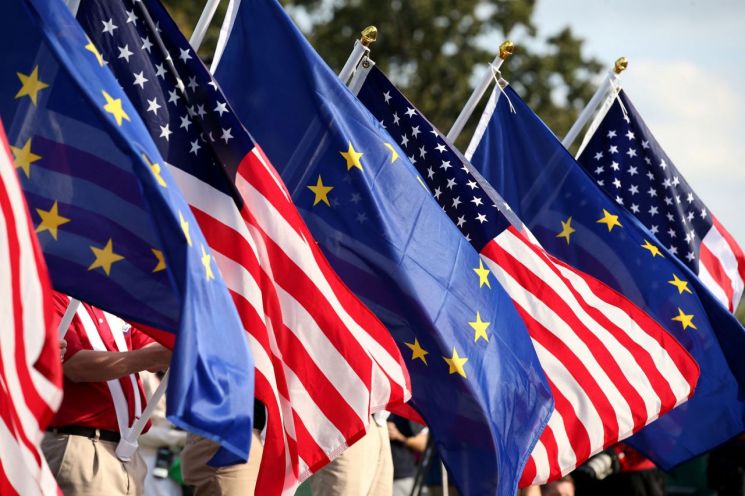
European leaders expressed support for Ukraine ahead of peace negotiations and voiced concerns about Ukraine and Europe being excluded from the peace talks. They also reached a consensus on expanding Europe's role in guaranteeing Ukraine's security, increasing defense spending, and the so-called European self-reliance theory.
Earlier, on the 13th, U.S. Secretary of Defense Pete Hegseth stated at a NATO press conference that Europe must take responsibility for its own security, saying, "President Donald Trump will not let Uncle Sam become Uncle Sucker." The Trump administration is pressuring NATO to increase its defense spending target from the current 2% of GDP to 5%.
With the war between Russia and Ukraine in Eastern Europe entering its third year, if Europe must counter Russia and ensure security without the U.S., the burden of defense spending will inevitably increase significantly. It is not feasible to simply wait for a change in the U.S. administration four years from now.
Jean-Yves Le Drian, French Minister of Foreign Affairs, said at the Munich Security Conference, "We are going through difficult times to guarantee security and must make complex decisions and sacrifices that we had not anticipated until now."
Mette Frederiksen, Prime Minister of Denmark, emphasized, "The most important duty of a political leader is to protect the people," adding, "The NATO defense spending target of 2% is absolutely insufficient."
Concerns have also been raised that excessive increases in defense spending could burden the credit ratings of individual European countries.
Credit rating agency S&P Global estimated that increasing defense spending to 5% of GDP would cost $875 billion annually (approximately 1,264 trillion KRW) and assessed that "this amount far exceeds what individual countries can bear without offsetting other expenditures or harming their credit ratings."
While cuts to welfare budgets have been suggested to increase defense budgets, political backlash is expected to be significant. Boris Pistorius, German Minister of Defense, expressed concern at the Munich Security Conference on the 14th, saying, "If we cut welfare budgets to increase defense spending, our society will be divided, and the only beneficiaries will be far-right parties."
There is also analysis that European finances can handle increased defense spending given the current level of fiscal deficits.
According to European Union (EU) data, the United States carries national debt amounting to about 120% of GDP and an annual fiscal deficit of around 6%, whereas the EU average debt is about 81.5% of GDP with an annual fiscal deficit of 2.9%. Former European Central Bank (ECB) President Mario Draghi stated that since 2009, the U.S. has injected five times more funds into its economy using deficits than Eurozone countries (20 countries using the euro).
Zolt Darvas, senior researcher at the Brussels-based European think tank Bruegel, said, "Many EU countries can handle higher public debt," adding, "The problem is political will."
Ursula von der Leyen, President of the European Commission, announced at the Munich Security Conference that she would push to activate a ‘waiver clause’ excluding defense spending from the EU fiscal rules’ deficit limits to increase defense budgets. Earlier, Poland, the current EU Council presidency, proposed establishing a ‘rearmament bank’ with NATO allies outside the EU such as the UK and Norway to raise capital.
Foreign media view the German general election on the 23rd as a test of this political will. Friedrich Merz, leader of the Christian Democratic Union (CDU) and a candidate for the next German chancellor, said at the Munich Security Conference, "If we do not act with vigilance now, the entire EU may be too late."
© The Asia Business Daily(www.asiae.co.kr). All rights reserved.
![Clutching a Stolen Dior Bag, Saying "I Hate Being Poor but Real"... The Grotesque Con of a "Human Knockoff" [Slate]](https://cwcontent.asiae.co.kr/asiaresize/183/2026021902243444107_1771435474.jpg)















