Handwashing, Thorough Cooking, and Safe Food Preparation
Jeonju Public Health Center in North Jeolla Province has urged the public to strictly adhere to personal hygiene guidelines as cases of norovirus infection are increasing nationwide during the winter season.
According to the Korea Disease Control and Prevention Agency on the 18th, the number of reported norovirus infection cases at 210 sentinel surveillance medical institutions (hospitals and above) across the country has been steadily increasing since the first week of November last year, reaching 469 cases as of the fourth week of January. This marks the highest incidence in the past 10 years.
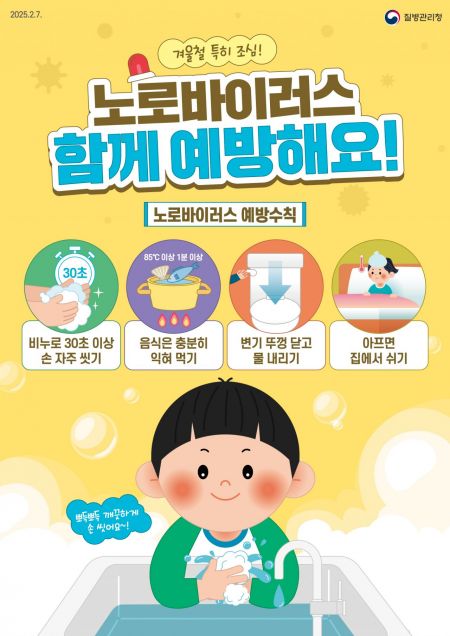
In particular, infants and young children account for 51.4% of all cases, making it especially important for them and related facilities to strictly follow personal hygiene rules. Norovirus infection mainly occurs from late autumn to early spring of the following year (November to March), particularly among infants and young children (ages 0-6) who are more vulnerable to poor personal hygiene and group living environments.
The main route of norovirus infection is the consumption of water (such as groundwater) or food (such as seafood) contaminated with norovirus. However, human-to-human transmission through contact with infected individuals or droplets from patient secretions is also possible. Once infected, symptoms such as vomiting and diarrhea typically appear within 12 to 48 hours, and some individuals may also experience abdominal pain, chills, or fever.
The health center is maintaining surveillance for group outbreaks and a constant emergency contact system. It is also actively promoting preventive measures for enteric infections to protect high-risk groups, such as children under five, the elderly over 65, and immunocompromised individuals.
To prevent norovirus and other enteric infections, it is important to: ▲Practice proper handwashing regularly ▲Thoroughly cook food before eating ▲Prepare food safely ▲Ensure that food handlers with symptoms such as diarrhea do not prepare or cook food.
Additionally, norovirus patients should: ▲Refrain from attending daycare, school, or work for 48 hours after symptoms disappear ▲Separate living spaces, including bathrooms ▲Close the toilet lid after defecation to prevent the spread of norovirus through droplets.
Kim Sinsun, head of Jeonju Public Health Center, said, "To prevent norovirus and other enteric infections during winter, wash your hands with soap for at least 30 seconds and eat only safely prepared food." He added, "Since these infections often occur among infants and young children who may struggle to maintain personal hygiene, we ask that parents and teachers provide active guidance."
© The Asia Business Daily(www.asiae.co.kr). All rights reserved.
![Clutching a Stolen Dior Bag, Saying "I Hate Being Poor but Real"... The Grotesque Con of a "Human Knockoff" [Slate]](https://cwcontent.asiae.co.kr/asiaresize/183/2026021902243444107_1771435474.jpg)















