Ruling and Opposition Parties Blame Each Other for Failure of Semiconductor Act
Government Consultation Meeting Seen as Turning Point... Attention on Leadership Decision
The Semiconductor Special Act, designed to support the semiconductor industry, failed to pass the National Assembly standing committee subcommittee. This was due to the inability of the ruling and opposition parties to narrow their differences regarding the exception clause to the 52-hour workweek. As a result, the issue has been deferred to the government consultation meeting scheduled for February 20.
On February 18, both parties blamed each other for the failure of the Semiconductor Special Act to pass the National Assembly subcommittee. Kwon Seongdong, floor leader of the People Power Party, criticized at a party strategy meeting, saying, "The Democratic Party’s decision to remove the exception clause to the 52-hour workweek is like putting shackles on a track athlete’s ankles and then cheering them on to run hard." Lee Jaemyung, leader of the Democratic Party, also criticized through social media, stating, "Due to the People Power Party’s irresponsible obstinacy, insisting that nothing can be agreed upon without the 52-hour exception clause, the nation’s future and 'industrial competitiveness' have been held back."
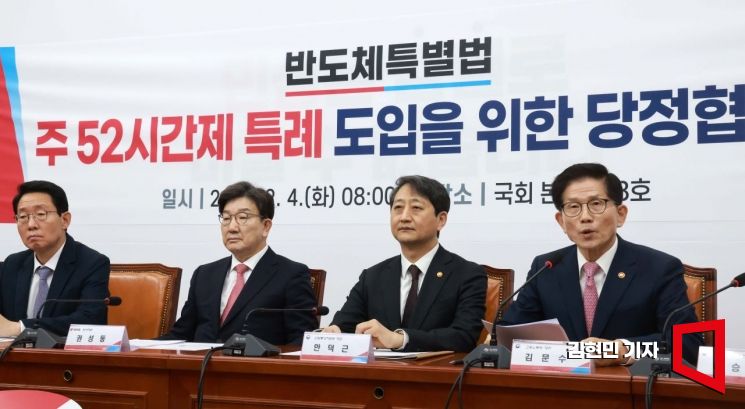 Minister of Employment and Labor Moonsoo Kim is speaking at the ruling party and government consultation meeting held at the National Assembly on the 4th to introduce exceptions to the 52-hour workweek under the Semiconductor Special Act. Photo by Hyunmin Kim
The National Assembly’s Trade, Industry, Energy, SMEs, and Startups Committee held a subcommittee meeting on February 17 to discuss the Semiconductor Special Act, but failed to reach a conclusion. The People Power Party demanded that the bill be passed in its entirety, including the exception clause for the 52-hour workweek, while the Democratic Party insisted on passing only the agreed-upon provisions, such as tax benefits and subsidies, excluding the exception clause. As a result, the parties could not bridge their differences.
The core of the disagreement lies in which law should serve as the basis for handling the exception to the 52-hour workweek. The People Power Party argues that the exception clause should be included in the Semiconductor Special Act, while the Democratic Party contends that the exception should be added to the existing Labor Standards Act. If the relevant clause is included in the Semiconductor Special Act, it could potentially be applied broadly to other laws, such as the Artificial Intelligence (AI) Act. Therefore, the Democratic Party’s position is to allow an exception to working hours only for semiconductor research and development (R&D) personnel.
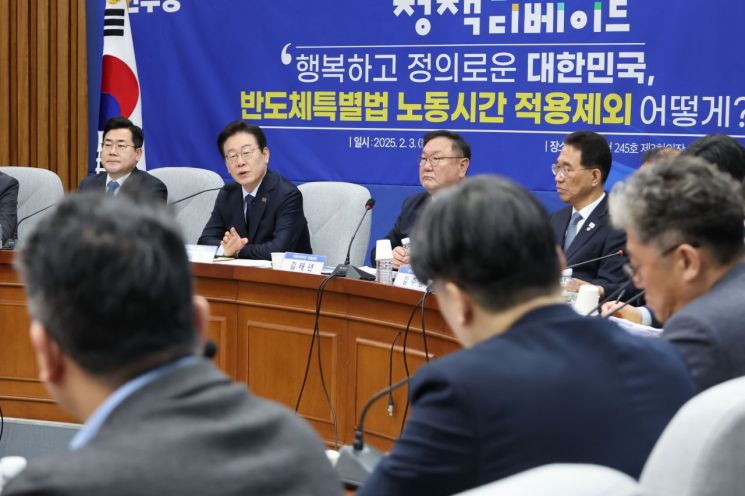
Ultimately, the government consultation meeting scheduled for February 20 is expected to be a turning point. Acting President and Deputy Prime Minister for Economic Affairs Choi Sangmok, National Assembly Speaker Woo Wonshik, People Power Party Emergency Committee Chairman Kwon Youngse, and Democratic Party leader Lee Jaemyung will attend to discuss policies related to public welfare and the economy.
It is pointed out that a decision by the leadership of both parties is necessary to resolve the Semiconductor Special Act at the government consultation meeting. As the government consultation meeting is effectively the only negotiation channel, there is a possibility of a dramatic agreement being reached through direct negotiations between the party leaders. However, with additional contentious issues such as the supplementary budget (extra budget), national pension reform, and the recent emergence of inheritance tax reform, it remains uncertain whether a compromise can be found on the Semiconductor Special Act.
Within the ruling bloc and the industry, dissatisfaction is growing, with criticism that "Lee is only pretending to shift to the right." Although he has advocated for 'corporate growth' and shown a rightward shift, he has neglected to support this with legislative action. Even within the Democratic Party, there are calls for greater consistency in Lee’s pragmatic policies. While Lee attempted to strengthen the push for amending the 52-hour exception as part of expanding support among moderates, even organizing a forum himself, he ultimately put the matter on hold due to opposition from labor groups and within his own party.
© The Asia Business Daily(www.asiae.co.kr). All rights reserved.
![Clutching a Stolen Dior Bag, Saying "I Hate Being Poor but Real"... The Grotesque Con of a "Human Knockoff" [Slate]](https://cwcontent.asiae.co.kr/asiaresize/183/2026021902243444107_1771435474.jpg)
















