Recruiting 79 Buildings... Up to 7 Million KRW in Support
Elderly and Childcare Facilities Included Alongside Houses, Barns, and Warehouses
Yongin City in Gyeonggi Province announced on the 18th that it will accept applications for the slate roof demolition support project for houses, livestock barns, warehouses, and other buildings until the 7th of next month.
Slate roofs contain asbestos, a Group 1 carcinogen, which poses health risks with long-term exposure and can also have adverse effects on the environment.
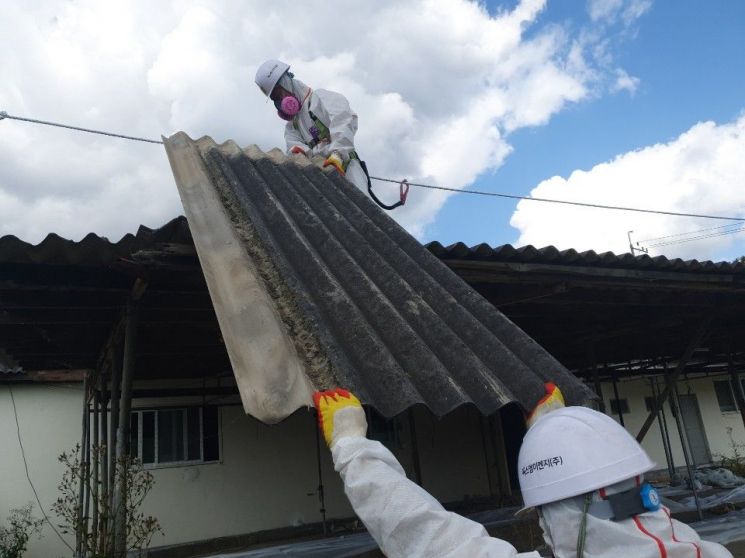 Employees of a company are dismantling a slate roof at an old house in Yongin City. The slate roof contains asbestos, a Group 1 carcinogen. Provided by Yongin City
This year, the city has secured a budget of 340 million KRW to support a total of 79 buildings, including 50 houses, 21 non-residential buildings such as barns and warehouses, and 8 buildings for roof improvement after demolition. Notably, while only warehouses and barns were eligible for support until last year, this year elderly and childcare facilities under the Building Act are also included. Neighborhood living facilities, where many citizens frequently visit and asbestos exposure to unspecified many can occur, are also eligible for support.
The support amount limit is up to 7 million KRW per building for general houses, and up to 5.4 million KRW for non-residential buildings with slate areas of 200㎡ or less. For priority support households such as basic livelihood security recipients, the full cost of slate roof demolition for houses will be covered.
When improving the roof after slate demolition, priority support households can receive up to 10 million KRW, and general households up to 3 million KRW additionally. Both owners and tenants of the buildings can apply.
However, to receive demolition cost support, pre-inspection, demolition, and post-processing must be conducted by companies contracted with the city; applicants cannot select companies arbitrarily for demolition and still receive support. The city prioritizes vulnerable groups such as basic livelihood security recipients and near-poverty households, and among the application areas, smaller areas will be selected first to support as many households as possible within the budget.
Applicants wishing to apply can visit or mail the application form, building register, and other required documents found in the announcement section on the city’s website to the city’s Climate and Air Quality Division. They may also visit the administrative welfare centers in the building’s local eup, myeon, or dong.
© The Asia Business Daily(www.asiae.co.kr). All rights reserved.
![Clutching a Stolen Dior Bag, Saying "I Hate Being Poor but Real"... The Grotesque Con of a "Human Knockoff" [Slate]](https://cwcontent.asiae.co.kr/asiaresize/183/2026021902243444107_1771435474.jpg)















