Last year, the total sales amount for domestic performance tickets reached 1.4537 trillion KRW, marking a 14.5% increase compared to 2023 (1.2697 trillion KRW).
This was confirmed through an analysis of performance ticket reservation data compiled in the 2024 Integrated Performing Arts Network by the Ministry of Culture, Sports and Tourism (MCST) in collaboration with the Arts Management Support Center. On the 18th, MCST and the Arts Management Support Center announced the publication of the "2024 Year-End Summary - Analysis Report on the Performing Arts Market Ticket Sales Status," which analyzed performance ticket reservation information.
Last year saw increases in the number of performances, showtimes, and ticket reservations. The number of performances recorded was 21,634, up 6% from the previous year; the number of showtimes was 125,224, up 7.4%; and the total number of ticket reservations was 22.24 million, up 6.1%. The average ticket price was approximately 65,000 KRW per ticket, about 5,000 KRW higher than in 2023.
Excluding popular arts, the fields of theater, musicals, classical music, gugak (traditional Korean music), dance, and mixed genres accounted for 77.5% of the total number of performances and 68.5% of ticket reservations, but only 45.9% of ticket sales revenue. This is due to the lower ticket prices and paid occupancy rates for pure arts performances.
Popular music was identified as the sector with the largest growth last year. Ticket sales revenue rose 31.3% from 2023, reaching a total of 756.9 billion KRW. The number of performances increased by 9.8%, and ticket reservations grew by 22.2%. This growth is attributed to active large-scale performances with over 10,000 seats, nationwide tours, and visits by world-renowned singers.
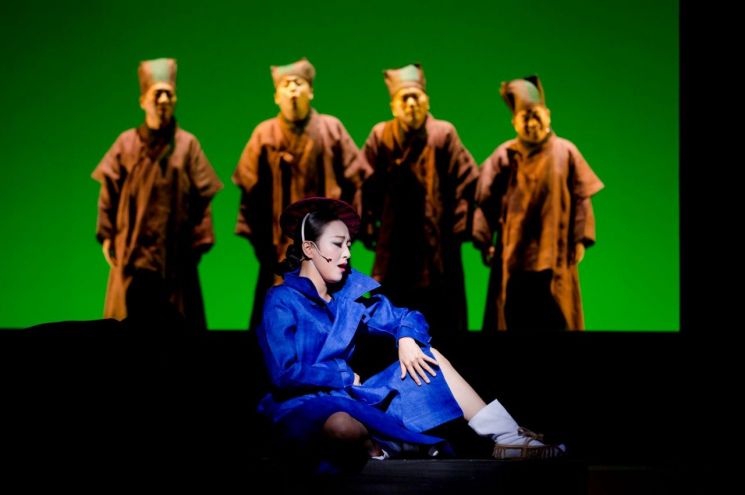 Performance scene from the changgeuk 'Byeonggangsoe Jeomjjikgo Ongnyeo'
 Photo by National Changgeuk Company of Korea
Musicals saw a slight decrease in the number of performances and ticket reservations compared to 2023, which recorded the highest ticket sales revenue ever. However, with a 4.9% increase in showtimes compared to the previous year, total ticket sales revenue also rose slightly by 1.3%, reaching 465.1 billion KRW.
Theater showed an upward trend in all indicators. The number of performances increased by 7.5%, showtimes by 7.3%, ticket reservations by 4.6%, and ticket sales revenue by 16.5%. This is attributed to actors who have been active in television broadcasting and films appearing on theater stages, attracting a broader audience.
The concentration of performance supply and demand in the metropolitan area (Seoul, Gyeonggi, Incheon) remained unchanged. The metropolitan area accounted for 75.3% of nationwide ticket reservations and 79.1% of ticket sales revenue. However, changes within the metropolitan area were observed. Seoul's share of nationwide ticket sales revenue decreased from 68% in 2023 to 65.1% last year, while Gyeonggi's share increased from 6.4% to 8.7%, and Incheon's from 3% to 5.2%. This is attributed to the expansion of performance infrastructure in Gyeonggi and Incheon, leading to an increase in large-scale performances.
Outside the metropolitan area, the regions with the most performances were Busan (1,311 performances) and Daegu (1,279 performances). While the number of performances increased by 3.3% in Busan and 7% in Daegu compared to the previous year, ticket sales revenue decreased by 8.2% and 7.1%, respectively, with Busan at 82.3 billion KRW and Daegu at 56.5 billion KRW.
By field, classical music had the highest number of performances in most regions, but gugak was the most performed genre in Jeonnam, and musicals were the most performed in Chungbuk. Chungbuk also saw the largest increase in demand for theater performances nationwide. Ticket reservations for theater in Chungbuk rose significantly from 7,018 in 2023 to 16,140 last year. Ticket sales revenue surged from 120 million KRW to 530 million KRW. This is interpreted as a result of the establishment of the Chungbuk Provincial Theater Company, which created a foundation for large-scale theater productions in the region and increased local interest accordingly.
This report can be accessed on the Arts Management Support Center website and the Integrated Performing Arts Network.
Minister Yoo In-chon stated, "While performances that were previously overly concentrated in Seoul are showing a tendency to spread to Gyeonggi and Incheon, the metropolitan area still accounts for most of the supply and demand for performances. We will continue to provide practical support to help regional performing arts communities increase their self-sustainability, as exemplified by the establishment of the Chungbuk Provincial Theater Company through last year's MCST regional representative arts group support project. Furthermore, we will actively expand the services of national arts institutions to the regions so that people anywhere in the country can enjoy diverse and excellent performances."
© The Asia Business Daily(www.asiae.co.kr). All rights reserved.
![Clutching a Stolen Dior Bag, Saying "I Hate Being Poor but Real"... The Grotesque Con of a "Human Knockoff" [Slate]](https://cwcontent.asiae.co.kr/asiaresize/183/2026021902243444107_1771435474.jpg)
















