Invalidation of Electronic Evidence Seized at Samsung Biologics Factory
Courts Repeatedly Block Prosecution's Search and Seizure and Separate Investigations
Will the Fear of Corporate and Personal Mobile Phone Seizures Disappear?
"Dragnet and Separate Investigation Practices Must End"
Following the acquittal of Samsung Chairman Lee Jae-yong, a warning against 'due process' violations is spreading within the prosecution. Various electronic information secured through search and seizure, submitted as evidence of crimes, is increasingly losing its evidentiary value and becoming useless during trials due to violations of due process.
The Story Behind the Prosecution Losing All 'Evidence' in the 'Samsung Case'
The 18-terabyte backup server that the prosecution's special investigation team claimed to have found on the factory floor of Samsung Biologics was not admitted as evidence in either the first or second trial. The reason can be summed up in one word: due process was not observed during the search and seizure. Legal circles point out that investigative agencies must observe four requirements during search and seizure.
First, when conducting a search and seizure, investigators must selectively collect only the materials necessary for the investigation within the scope permitted by the warrant. Additionally, the list of seized materials must be provided to the defense counsel or the party involved, the search and seizure must be conducted in the presence of the party or their representative, and any information unrelated to the investigation must be deleted, discarded, or returned.
The Seoul High Court Criminal Division 13 (Presiding Judge Baek Gang-jin), which handled the second trial of the Samsung case, devoted as many as 36 pages of its ruling to stating that these principles and requirements were hardly observed. Furthermore, the prosecution's evidence from the mobile phone of then-President Jang Choong-ki was deemed 'illegally collected evidence' because it was information seized during the separate 'Choi Soon-sil political scandal' investigation, stored by the Supreme Prosecutors' Office, and 'recycled' for this case.
This can be seen as a critique of the pitfalls of 'separate investigations' that investigative agencies easily fall into. The bad practice of retaining mobile phone information seized in other cases and using it in different investigations was a source of fear for companies that could be subject to investigation at any time. A lawyer from a major law firm noted, “It is also noteworthy that the court rejected the prosecution's argument that the defendant's provision of password codes constituted a guarantee of participation rights.”

Precedents Excluding 'Illegally Collected Evidence' Flood in, Including the Democratic Party Money Envelope Case
In the so-called 'Democratic Party National Convention Money Envelope Case,' the court ruled that the recording file from the mobile phone of former Democratic Party Deputy Secretary-General Lee Jung-geun, which the prosecution presented as evidence, lacked evidentiary value due to illegal collection. The court questioned whether due process was observed during the prosecution's acquisition of the recording file, doubting the 'genuineness of voluntary submission.'
Similar precedents are accumulating. On the 9th, a defendant indicted for violating the Narcotics Control Act was sentenced to three years in prison in the lower court, but the Supreme Court overturned the ruling. The police had collected a lost mobile phone without a search warrant and found clues related to drug transactions on it, which led to a confession. The Supreme Court ruled that evidence and confessions obtained through warrantless searches were invalid.
Earlier, on the 2nd, a university student leader tried for threatening former lawmaker Yoon So-ha was acquitted. The court found that the investigative agency did not present the original search warrant and that the remaining evidence, excluding illegally collected evidence, was insufficient to identify the suspect.
The CEO of Medytox, tried for unauthorized Botox distribution, also received a first-instance acquittal on the 2nd. The court ruled that the prosecution conducted the search and seizure after the warrant's validity period had expired and therefore did not recognize the evidentiary value. In June 2023, the Supreme Court ruled in a case where the Military Security Command did not discard past search and seizure materials and used them as grounds for a separate investigation, stating that 'unrelated information must be deleted.'
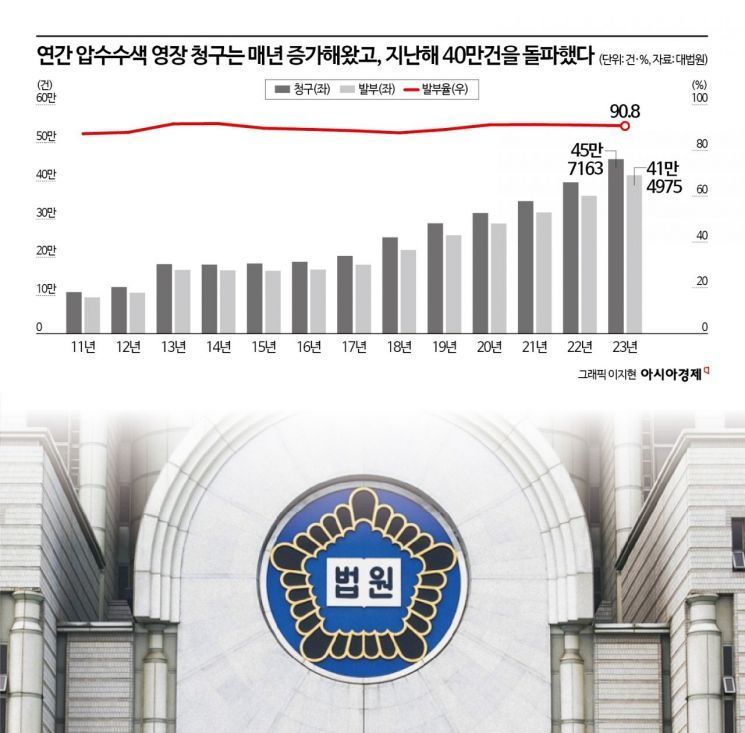
The More 'King of Evidence,' the More Careful Scrutiny of Illegally Collected Evidence Is Needed
The courts are increasingly putting the brakes on investigative agencies' improper evidence collection practices because electronic information?often called the 'king of evidence' (such as personal data stored on mobile phones or servers)?is vast and poses significant risks of human rights violations. Investigative agencies are thus easily tempted to use it for separate investigations.
According to the Judicial Yearbook, the number of search and seizure warrant requests has steadily increased from 108,992 in 2011 to 457,163 in 2023. The issuance rate rose from 87.3% in 2011 to 90.8% in 2023, which is very high compared to the 70% range for arrest warrants.
A former chief judge turned lawyer said, “Investigative agencies, which hold a superior position compared to suspects, often avoid requesting warrants for key clues and instead obtain voluntary submissions to circumvent restrictions on evidentiary value. This is an issue that investigative agencies need to reflect on deeply.”
Another lawyer from a major law firm stated, “The annex to search and seizure warrants clearly lists the obligations of investigative agencies, such as 'guaranteeing the right of the person subject to seizure to participate' and 'detailed provision of electronic information subject to seizure.' The practice of not conducting searches and seizures according to the warrant and the law is becoming problematic in court.” A lawyer in Seocho-dong added, “Judgments emphasizing procedural justice and preventing 'dragnet investigations' are becoming the norm.”
© The Asia Business Daily(www.asiae.co.kr). All rights reserved.
![Clutching a Stolen Dior Bag, Saying "I Hate Being Poor but Real"... The Grotesque Con of a "Human Knockoff" [Slate]](https://cwcontent.asiae.co.kr/asiaresize/183/2026021902243444107_1771435474.jpg)
















