Five Major Areas Including Livelihood Economy Targeted Until May 27
Weekly Visits to Professional Associations to Hear Concerns
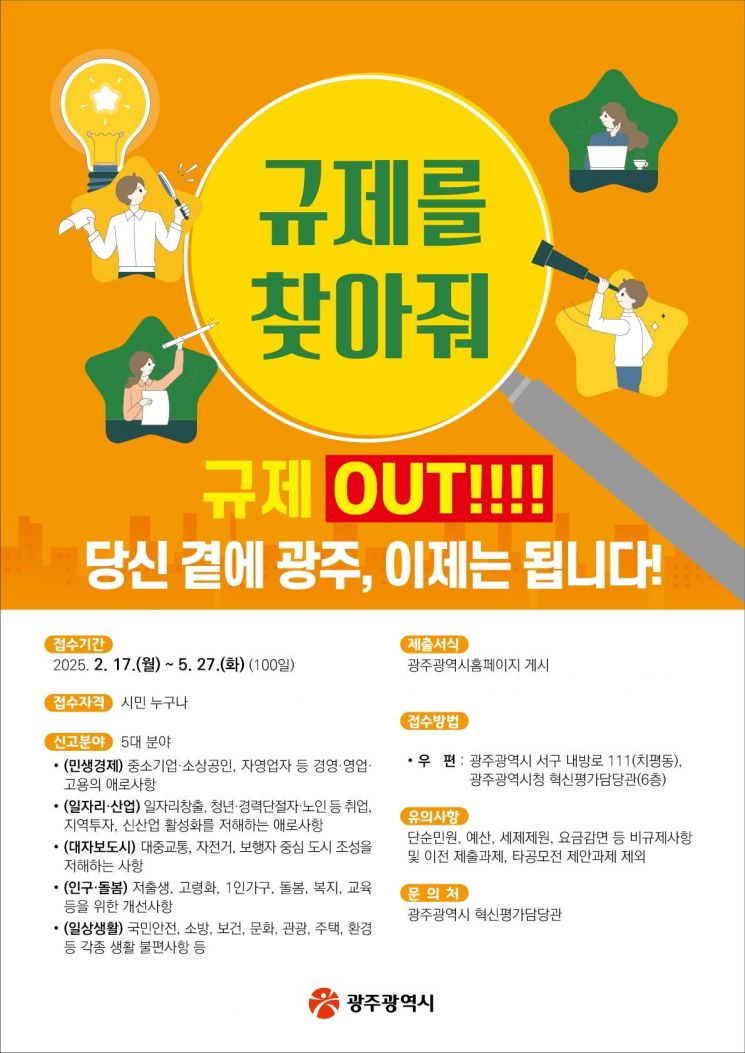
Gwangju City will embark on a 100-day intensive campaign to identify unreasonable regulations until May 27. This initiative aims to revitalize the local industry and economy, which have been dampened by the December 3 Martial Law and impeachment crisis, as well as the December 29 Jeju Air passenger plane disaster.
In particular, to promote this year's municipal goal of "2025 Gwangju Economy: Together Step by Step" (Good Consumption, Good Finance, Good Jobs) and to discover non-budgetary regulations that have a significant impact on citizens, the city will operate a focused period for identifying unreasonable regulations in five major areas. These five areas are: people's livelihood and economy, jobs and industry, Daejabo (public transportation, bicycles, pedestrian-oriented city), population and care, and daily life.
In the area of people's livelihood and economy, the city will look into the difficulties faced by small and medium-sized enterprises, small business owners, and the self-employed in management, business operations, and employment. In the jobs and industry sector, the focus will be on issues hindering job creation, employment for youth, career-interrupted individuals, the elderly, regional investment, and the activation of new industries. For the Daejabo city sector, the city will address issues obstructing the creation of a public transportation, bicycle, and pedestrian-oriented city. In the population and care sector, improvements will be sought for low birth rates, aging population, single-person households, care, welfare, and education. In the daily life sector, the city will collect complaints related to public safety, fire services, health, culture, tourism, housing, environment, and other inconveniences.
Suggestions for identifying unreasonable regulations can be submitted to the Gwangju City Innovation Evaluation Office via email, mail, or by visiting the Innovation Evaluation Office on the 6th floor.
The city will also visit professional associations such as the Korea Construction Association and the Small Business Association once a week to actively listen to their difficulties and identify regulations together.
Among the identified regulations, those requiring review by central government ministries will be submitted directly by Gwangju City to the "Regulatory Reform Sinmungo" platform for comprehensive management of the review process. Local regulations related to ordinances, rules, and plans will be reviewed directly by Gwangju City and the autonomous districts, and recommendations for improvement will be made through expert reviews by the Gwangju City Regulatory Reform Committee and relevant departments.
On the 17th, Lee Byungcheol, Director of Planning and Coordination, said, "Regulatory improvement can be effective for local industry growth and citizens' daily lives even without budget allocation. We hope all institutions and citizens will actively participate."
© The Asia Business Daily(www.asiae.co.kr). All rights reserved.
![Clutching a Stolen Dior Bag, Saying "I Hate Being Poor but Real"... The Grotesque Con of a "Human Knockoff" [Slate]](https://cwcontent.asiae.co.kr/asiaresize/183/2026021902243444107_1771435474.jpg)















