Constitutional Court Holds First Impeachment Hearing for Three Prosecutors in Kim Gun-hee Non-Prosecution Case
"Failure to Fulfill Prosecutors' Duties" vs "Most Abused Case of Impeachment Power"
Constitutional Court Schedules Final Hearing for the 24th
The Constitutional Court has decided to conduct direct questioning of the respondents, including Lee Chang-soo, the head of the Seoul Central District Prosecutors' Office, who was impeached for allegedly failing to properly investigate Kim Gun-hee's involvement in the Deutsche Motors stock manipulation case.
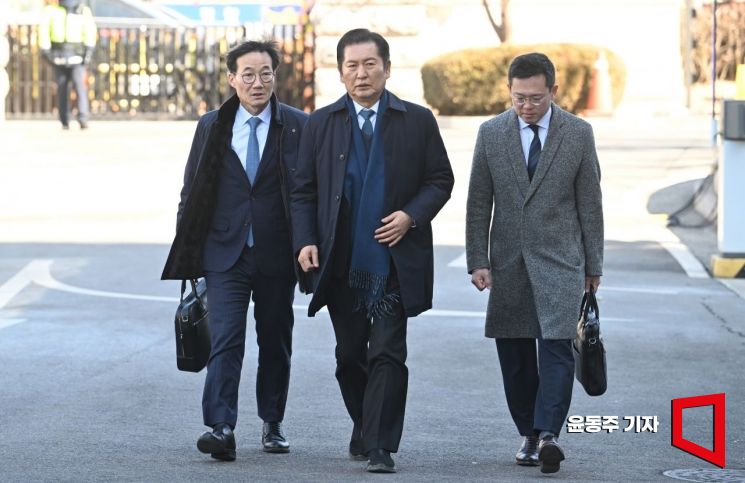 The petitioner from the National Assembly, Jeong Cheong-rae, Chairman of the Legislation and Judiciary Committee, attended the first formal impeachment trial hearing of Lee Chang-soo, Chief Prosecutor of the Seoul Central District Prosecutors' Office, Cho Sang-won, 4th Deputy Chief Prosecutor of the Central District Prosecutors' Office, and Choi Jae-hoon, Head of the Anti-Corruption Investigation Division 2 of the Central District Prosecutors' Office, held at the Grand Bench of the Constitutional Court in Jongno-gu, Seoul on February 17, 2025. Photo by Yoon Dong-joo
On the 17th, Moon Hyung-bae, acting Chief Justice of the Constitutional Court, announced during the first hearing of the impeachment trial for Lee, along with Deputy Chief Prosecutor Cho Sang-won and Anti-Corruption Division Chief Choi Jae-hoon, that "the justices have reached a consensus to proceed with direct questioning of the respondents." The National Assembly had requested the questioning of the respondents during the third preparatory hearing held on the 22nd of last month, and the Constitutional Court accepted this request on the same day.
Jung Cheong-rae, chairman of the National Assembly's Legislation and Judiciary Committee and a member of the Democratic Party, stated, "Prosecutors in our country hold very powerful authority," adding, "The real power often manifests not on the surface but during the investigative process through their will or actions." He further argued, "There must be continuous oversight by the National Assembly, and the threshold for impeachment should be lowered so that impeachment can be conducted at any time, thereby strengthening post-control and promoting preemptive checks."
He emphasized that the reason for this impeachment is the failure to fulfill the duties assigned to prosecutors. Jung said, "The National Assembly's decision to impeach was not because Kim Gun-hee was not prosecuted, but because there are suspicions that the prosecutors failed to fulfill their duties while handling the case," pointing out, "Despite Prosecutor General Lee Won-seok emphasizing that summons investigations are the principle, the respondents conducted a non-public business trip investigation at the Security Office annex building." He also requested the Constitutional Court to "allow the submission of detailed materials to verify whether the prosecutors conducted the investigation sincerely and strictly," noting that "the investigation records held by the prosecution have been requested through document submission, and we ask that this be accepted."
On the other hand, Lee Chang-soo's defense argued that the National Assembly's impeachment power was abused. They claimed, "Impeachment, an exceptional system, has become a routine procedure," and "The case involving the three prosecutors relates to general criminal procedures, making it the most abused case of impeachment power among all impeachment cases." They added, "The grounds for impeachment remain unspecified and the claims are unjust," insisting, "At the time of the impeachment resolution, the unconstitutionality and illegality must be specified. The impeachment trial petition should be dismissed." They also argued that conducting the investigation at the Security Office annex building was not a special favor, and since the Prosecutor General has the authority to convene the Investigation Review Committee, the district chief prosecutor cannot be impeached based on this.
Deputy Chief Prosecutor Cho and Chief Prosecutor Choi's defense also stated, "The petitioner's claims appear to be objections to the judgments of the quasi-judicial institution, the prosecution," and argued, "The National Assembly's claims are no different from holding picket protests in front of the court asking, 'Why was there a not guilty verdict?'" They added, "It is clear from the contents of the impeachment opinion that the necessity for impeachment cannot be recognized."
Meanwhile, the Constitutional Court has scheduled the second hearing for 4 p.m. on the 24th and plans to conclude the trial on that day. Final statements from both the respondents and the petitioners are also expected to be made then. The National Assembly plans to focus its questioning on testimonies given during the National Assembly's Legislation and Judiciary Committee's audit, and will concentrate on the investigation of the Deutsche Motors stock manipulation and related press conference content when questioning Deputy Chief Prosecutor Cho and Chief Prosecutor Choi.
© The Asia Business Daily(www.asiae.co.kr). All rights reserved.

















