The Aircraft Musk Was Obsessed With: "A-12"
The 12th Candidate of the Cold War Secret Reconnaissance "Archangel" Project
The Legacy of American Aerospace Technology from A-12 to SpaceX
Elon Musk, CEO of Tesla, appeared at the White House Oval Office in Washington DC on the 11th (local time) with his young son. His son, born in 2020, is the seventh child from Canadian singer Grimes. He has a unique name, X Æ A-Xii (X). This name, which sounds like a complex password, is known to have been created by Musk and Grimes together. The two did not just combine meaningless words to name him. The name contains the history of American aerospace technology spanning from the Cold War era to SpaceX.
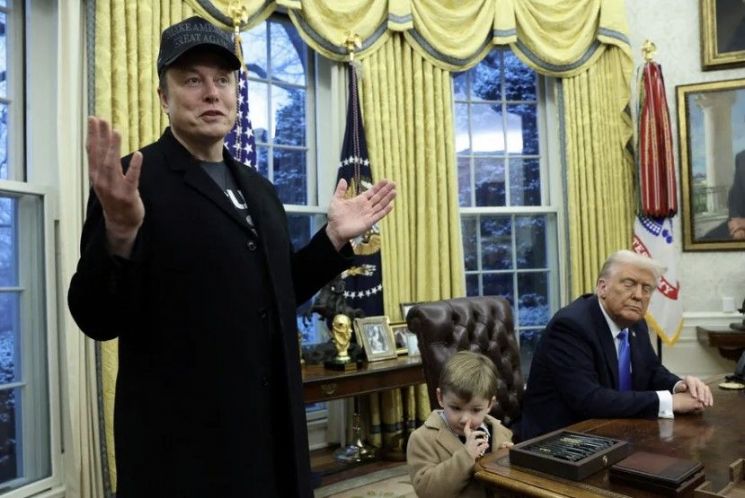 From the left, Elon Musk, CEO of Tesla, and his son X, and Donald Trump, President of the United States. Photo by Reuters and Yonhap News.
The Aircraft Musk Was Obsessed With, 'A-12'
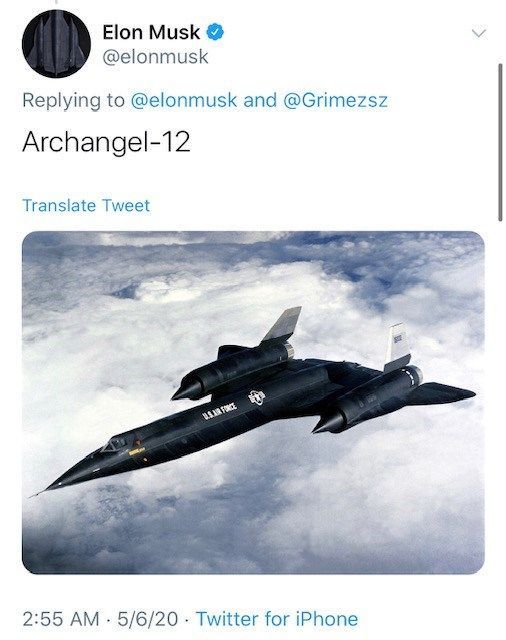
Musk and Grimes have previously explained in podcast interviews and on social media why their son's name is X Æ A-Xii. The "X" stands for the unknown variable X. "Æ" is a fictional word created by Grimes that embodies the meanings of love and artificial intelligence (AI). It was inspired by ancient Latin characters.
The "A-Xii" at the end was originally "A-12." At the time X was born, California law prohibited numbers in children's names, so the number 12 was changed to its Roman numeral form. A-12 was chosen by Musk and Grimes together and refers to the aircraft called "Archangel-12."
Musk is known to have a strong attachment to the A-12. When posting photos of his son on his personal social media account, he referred to him as "Archangel-12," and in a podcast interview, he praised the A-12 aircraft as "the coolest plane in America."
The 12th Candidate of the Cold War Secret Reconnaissance 'Archangel' Project
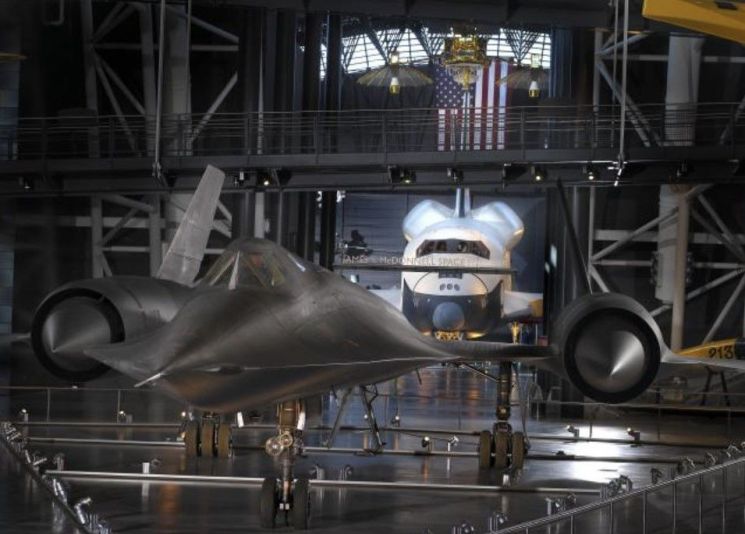 The SR-71 aircraft (front), the successor to the A-12, and the Space Shuttle. Official website of the Smithsonian Museum
The A-12, which Musk is fascinated with, was a reconnaissance aircraft secretly developed in 1962 by the American defense contractor Lockheed Martin. During the height of the Cold War between the United States and the Soviet Union, the CIA demanded the defense industry to create "the fastest aircraft capable of evading all Soviet interceptor missiles," leading Lockheed Martin to start the "Archangel Project."
In other words, the letter A stands for Archangel. The number following the A is the serial number assigned to the prototype designed by Lockheed Martin, with A-12 being the 12th experimental aircraft. Thanks to two massive engines attached to its wings, this aircraft could fly at Mach 3.3, more than three times the speed of sound.
Based on the design of the A-12, Lockheed Martin developed the supersonic reconnaissance aircraft called the SR-71. The SR-71 flew supersonically at an altitude of 26,000 meters, conducting reconnaissance of sensitive Soviet military facilities.
The Legacy of American Aerospace Technology from A-12 to SpaceX
The technology gained from developing and manufacturing the A-12 and SR-71 became a crucial foundation for American aerospace technology after the Cold War. The difficulty in developing supersonic aircraft lies in the immense heat exerted on the fuselage during flight, and the A-12 and SR-71 underwent numerous design and material innovations to suppress internal heat.
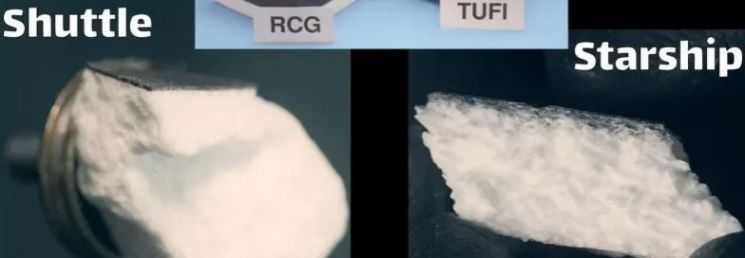 Thermal tiles from NASA's Space Shuttle era (left) and SpaceX's thermal tiles. Screenshot from Hacker Day website.
This know-how was fully transferred to the U.S. space shuttle development program in 1981. The space shuttle is a manned spacecraft that is launched into space by a rocket and returns to Earth by re-entering the atmosphere. During its landing sequence, it must withstand speeds and heat up to Mach 20, six times that of the A-12 and SR-71. According to a report published by NASA in 2009, NASA and Lockheed Martin engineers used the A-12 and its successors as testbeds to simulate the shuttle's landing environment during the early stages of the project.
Thanks to this, engineers were able to identify the most suitable aluminum alloy for the shuttle's fuselage and, most importantly, invented heat shields to protect the lower part of the fuselage from heat. The heat shields are black tiles made by embedding special silica filled with air layers. Each shuttle had 24,000 tiles attached to block the thousands of degrees of heat generated during atmospheric re-entry.
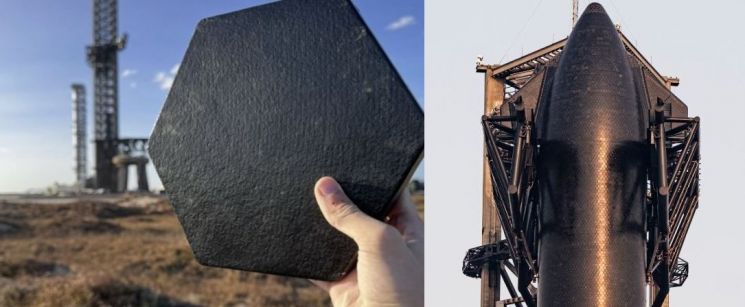
The space shuttle was retired in 2011 due to cost issues, but its legacy continued with Musk's space development startup, SpaceX. Notably, the heat shield technology is also applied to SpaceX's large reusable rocket, Starship. Like the A-12, SR-71, and the space shuttle, Starship faces the challenge of withstanding extreme heat upon returning to Earth. The hexagonal tiles covering Starship's fuselage protect the spacecraft. These tiles are also developed by NASA and are an improved version of those used on the space shuttle.
© The Asia Business Daily(www.asiae.co.kr). All rights reserved.



















